Power / Batteries & Chargers
User Manual for Giant Power 100AH LiFePO4 Deep Cycle Battery
Quick guide for the Giant Power 100AH LiFePO4 Deep Cycle Battery. Includes installation, charging methods, connection guidelines, safety warnings, and technical specifications.
Table of contents
Manual images
Click an image to enlargeQuick guide from the manual
This manual provides essential safety and operational instructions for the Giant Power 100AH LiFePO4 Deep Cycle Battery. Users must read and understand these instructions before installation or operation. The battery is designed for deep cycle applications and requires specific charging profiles to ensure longevity and safety.
Safety Warnings
- Do not install the battery under the bonnet of a vehicle or use it for cranking applications.
- Do not use chargers with 'Pulse' or 'Equalisation' stages; this will damage the battery and void the warranty.
- Do not submerge in water, short circuit terminals, puncture, or disassemble the battery.
- Do not connect to batteries with different chemistries.
- Ensure the battery is installed by a qualified professional if necessary.
Specifications
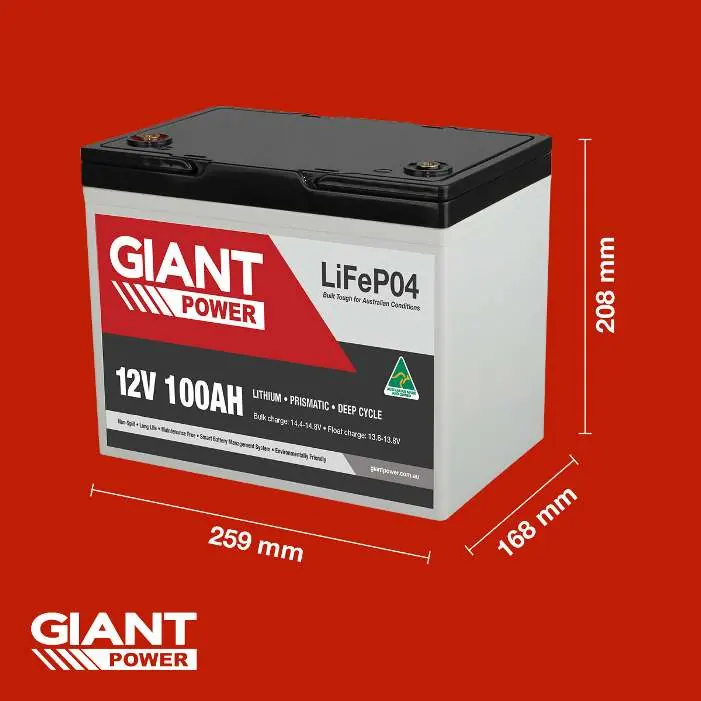
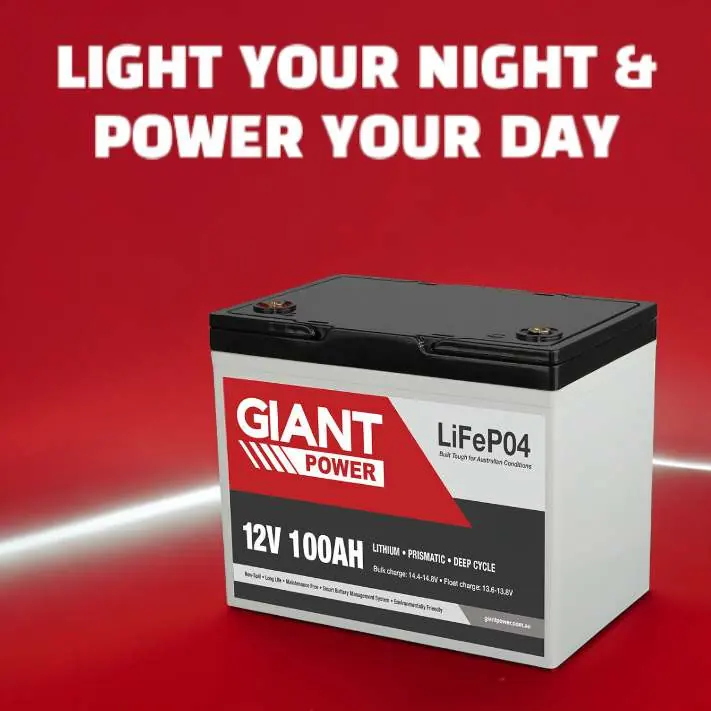
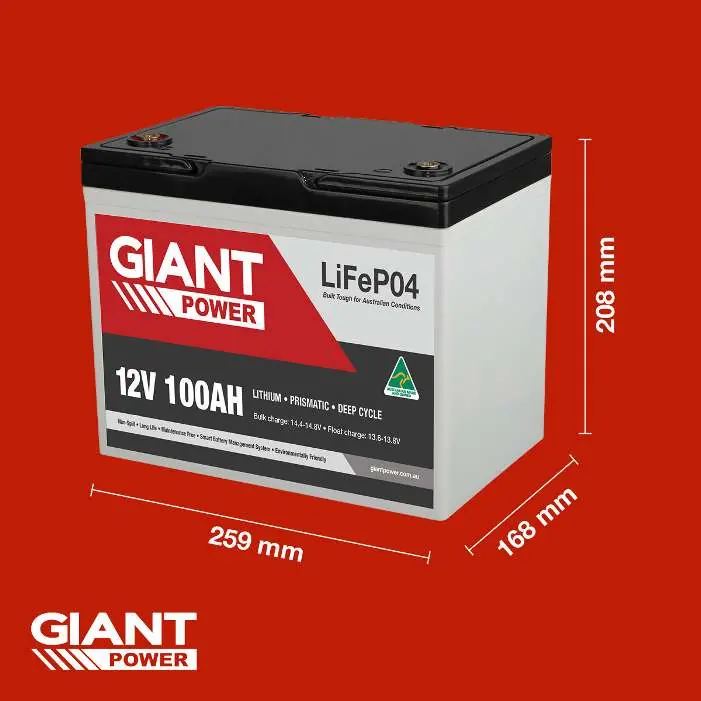
- Nominal voltage: 12.8V
- Capacity (C20): 100Ah
- Max discharge current (constant): 100A
- Pulse current (3s): 200A
- Weight: 12.0kg
- Dimensions: 330mm (l) x 173mm (w) x 216mm (h)
- Terminal type: M8
- Cycle life: 3000 cycles (100% DOD) / 6000 cycles (80% DOD)
- Operating temperatures: Charge 0°C to 45°C; Discharge -20°C to 60°C
Installation
Ensure the installation area is dry and secure. The battery can be installed in any orientation, including upside-down. Do not install in areas subject to water ingress or compartments dedicated to gas storage. Ensure the battery is secured firmly to prevent movement.
Connection Guidelines
- General: Do not connect more than four cable lugs directly to a battery terminal; use a fuse block and negative busbar for more connections.
- Stacking: Stack lugs from heaviest draw (thickest cables) at the bottom to lightest draw at the top.
- Hardware: Always use the provided spring washers on top of the cable lugs.
- Parallel Configuration: Up to six (6) batteries can be connected in parallel. Use appropriately rated busbars and ensure cables are the exact same length.
- Series Configuration: Up to four (4) batteries can be connected in series. Ensure cables are the exact same length.
Charging Methods
The battery must be charged using a device with a specific lithium charge profile. Suitable devices include DC-DC chargers, solar panels (with regulator), and AC (mains power) chargers. Charging current should be 30% or less of the battery capacity for optimum longevity. Do not charge directly from an alternator without a DC-DC charger.
Storage and Disposal
Store in a dry, clean, shaded, and well-ventilated environment. Aim for 40-50% state of charge. Do not allow voltage to drop below 11.5V. Check the state of charge regularly as the battery self-discharges at about 3% per month. Dispose of the battery at an authorized lithium battery recycling facility; do not dispose of with ordinary refuse.
Warranty
The product is covered by a 5-year warranty against defects in material and workmanship. The warranty is voided by negligence, improper installation, unauthorized repair, disassembly, or use of an unsuitable charger.
Practical help
Common problems
Battery not charging or performance issues
Ensure the charger has a specific lithium charge profile. Do not use 'Pulse' or 'Equalisation' settings.
Connection clutter
Do not connect more than 4 cable lugs to a single terminal. Use a fuse block and negative busbar instead.
Battery failure or reduced life
Do not install under the bonnet of a vehicle or in high-heat areas. Ensure the battery is not stored below 11.5V.
Before use
- Verify the installation area is dry and not used for gas storage.
- Ensure the charger is compatible with lithium batteries.
- Check that battery terminals are clean.
- Verify that cables are the correct gauge for the application.
- Ensure all cables are the same length when connecting multiple batteries.
- Confirm the battery is secured firmly to the mounting surface.
Specs in practice
- Nominal voltage
- 12.8V - The standard operating voltage of the battery.
- Capacity (C20)
- 100Ah - The total energy storage capacity.
- Max discharge current
- 100A - The maximum continuous current the battery can safely supply.
- Terminal type
- M8 - The size of the bolt required for terminal connections.
Model compatibility
- Max 4 batteries in series.
- Max 6 batteries in parallel.
- Do not connect to batteries with different chemistries.
- Do not charge in sub-zero temperatures.

Manual page author
David Miller
Documentation analyst
Organizes user manual content into clear summaries, with attention to model details, product context, and everyday usability.