Power / Batteries & Chargers
Smart Battery Technologies Lithium Deep Cycle Battery Installation Guide
A comprehensive installation and compliance guide for Smart Battery Technologies lithium deep cycle batteries, covering AS/NZS 3001.2:2022 standards, IEC 62619 certification, and safe installation practices for recreational vehicles.
Table of contents
Manual images
Click an image to enlargeQuick guide from the manual
This document provides essential guidance on installing lithium deep cycle batteries in compliance with the AS/NZS 3001.2:2022 standard. It focuses on ensuring safety, proper certification, and correct installation locations within recreational vehicles to prevent the ingress of gases into habitable areas.
Compliance and Certification
To ensure safety and compliance, all lithium-ion batteries must comply with the IEC 62619 standard. A battery includes both the cells and the Battery Management System (BMS). Having certified cells alone is insufficient; the entire battery unit, including the BMS, must be tested and certified.
- Certification: Always ask the manufacturer for a test certificate to prove compliance with IEC 62619.
- BMS Function: The BMS must continuously monitor voltage, current, and temperature, and provide automatic disconnection in case of over/under-voltage, over/under-temperature, or over-current.
Installation Location
According to the standard, lithium-ion batteries must be installed externally to the habitable area of the vehicle. This means they must be behind a wall, compartment, or barrier that prevents the egress of gases into the living space.
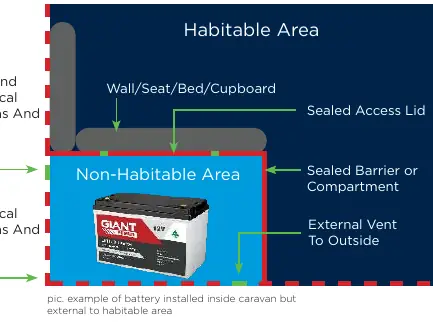

- Sealed Compartments: If installed inside a caravan, the battery must be in a sealed box or compartment.
- Venting: The battery compartment must be appropriately vented to the outside of the vehicle.
- Wiring: Cables entering the battery box must be sealed using cable glands or equivalent methods to prevent gas leakage.
Installation Checklist
Before finalizing the installation, ensure the following conditions are met:
- The battery is IEC 62619 certified.
- The manufacturer has provided a compliance certificate.
- The battery has an integrated BMS.
- A suitable monitoring device is in use.
- The system does not exceed 48V.
- If installed internally, the battery compartment is properly sealed.
- The battery is securely fastened within the compartment.
- Appropriate ventilation to the outside is provided.
- All electrical connections have been checked.
- The battery has been charged, discharged, and recharged to verify functionality.
Support and Contact
For questions regarding compliance with the standards, you can contact the support team at 1800 853 315 or via email at [email protected].
Practical help
Common problems
Battery compliance uncertainty
Request a test certificate from the manufacturer to confirm the battery (including BMS) is IEC 62619 certified.
Gases entering the habitable area
Install the battery in a sealed box or compartment with external venting and ensure all cable entries are sealed with glands.
Before use
- Verify IEC 62619 certification.
- Ensure the battery has an integrated BMS.
- Confirm the system voltage does not exceed 48V.
- Ensure the battery is securely fastened.
- Verify the battery compartment is sealed and vented to the outside.
- Check all electrical connections.
- Perform a charge/discharge/recharge cycle to check for faults.
Specs in practice
- Habitable Area
- The living space of a caravan or vehicle that must be protected from battery gases.
Images and diagrams
- The installation diagram illustrates a battery placed in a non-habitable area (e.g., under a seat or bed). It highlights the requirement for a sealed barrier, sealed access lid, and sealed cable glands, combined with an external vent to...
Model compatibility
- LiFePO4 batteries can be installed inside a caravan if a barrier prevents gases from entering the habitable area.
- The entire battery unit must be certified, not just the individual cells.

Manual page author
Emily Carter
User documentation editor
Prepares concise manual descriptions and highlights the most useful setup, operation, and maintenance information for readers.