General / Other Manuals
User Manual for Neuation iTHERM CH25 Incubator
Quick guide for the Neuation iTHERM CH25 mini incubator, covering installation, temperature control, calibration, and safety precautions for laboratory use.
Table of contents
Manual images
Jump to the sectionQuick guide from the manual
The Neuation iTHERM CH25 is a 22L mini incubator designed for laboratory use to provide a temperature-controlled environment for cell culture or biological samples. It operates best in cool indoor environments and is not intended for outdoor use or recessed installation. Ensure the unit is placed on a stable, level surface with 5 inches of clearance on all sides for proper air circulation.
Installation
After placing the unit on a level surface, allow it to stand for 2-3 hours (up to 10 hours in summer) before the first power-on to allow the system to settle. Connect the power supply to the 2-pin DC inlet on the back of the unit. The device features an internal power outlet for small shakers or mixers; to use it, plug the included power cable into the bottom power inlet on the back of the instrument.

Operation
To operate the incubator: 1. Place samples inside. 2. Connect the power supply. 3. Set the power switch to ON or COOL. 4. Use the UP and DOWN buttons to set the desired temperature between ambient -15°C and 60°C. Values are saved automatically.

Calibration
If the displayed temperature differs from the actual temperature, you can adjust the offset: 1. Press and hold the UP and DOWN buttons simultaneously until the display shows 00A. 2. Use the buttons to set the required offset value (within ±5°C). 3. Wait for the value to be stored automatically.
Cleaning and Maintenance
Always disconnect the power before cleaning. Use a damp cloth to wipe the unit. Do not use abrasive cleaners. For repairs, contact the supplier directly as this manual is intended for operation and care only.
Safety Precautions
- Do not use near water or in wet conditions.
- Ensure the power source matches the label specifications.
- Do not use unauthorized attachments.
- Keep power cords away from foot traffic to prevent damage.
- Do not overload power outlets.
- Unplug the unit if it will not be used for an extended period.
Practical help
Common problems
Temperature display does not match actual chamber temperature
Perform a temperature offset calibration by holding UP and DOWN buttons until 00A appears, then adjust the offset.
Unit fails to maintain temperature
Ensure the unit is not placed near heat sources (e.g., boilers, direct sunlight) and is used in a cool indoor room.
Before use
- Place on a clean, level, and stable surface.
- Allow the unit to stand for 2-3 hours (10 hours in summer) before first use.
- Ensure 5 inches of clearance around the sides for air circulation.
- Verify the power source matches the label requirements.
- Remove power supply from the internal white box before connection.
Specs in practice
- Temperature Range
- Ambient -15°C to 60°C.
- Temperature Accuracy
- 0.5°C at 37°C.
- Pollution Degree
- 2 (Standard for indoor laboratory environments).
Images and diagrams
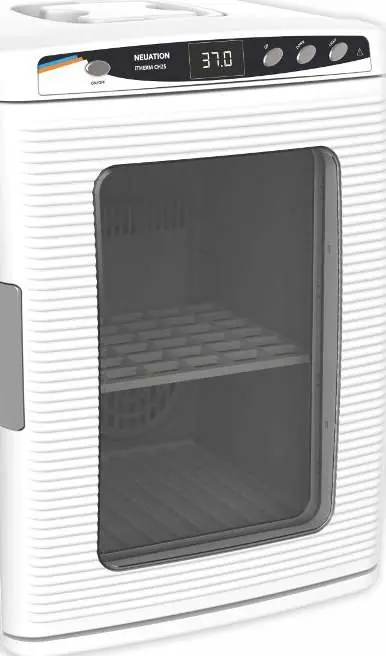
- The front panel features an ON/OFF switch, a digital temperature display, and buttons for UP, DOWN, and LIGHT control.
- The rear panel contains the DC power inlet (top) and the internal outlet power inlet (bottom).
Model compatibility
- Internal outlet voltage is dependent on the wall voltage (e.g., if wall voltage is 230V, internal outlet is 230V).
- Not designed for recessed or built-in installation.

Manual page author
Emily Carter
User documentation editor
Prepares concise manual descriptions and highlights the most useful setup, operation, and maintenance information for readers.