Power / Batteries Chargers
ROTHENBERGER Robend 4000 E Cordless Bending Machine User Guide
Quick guide for the ROTHENBERGER Robend 4000 E cordless bending machine. Includes setup, operation, battery charging, maintenance, and troubleshooting steps.
Table of contents
Manual images
Jump to the sectionQuick guide from the manual
The ROBEND 4000 E is a cordless bending machine designed for bending copper, stainless steel, and carbon steel pipes. This guide provides essential information for safe and efficient operation. Always ensure the work area is clear of obstacles before starting the bending process.
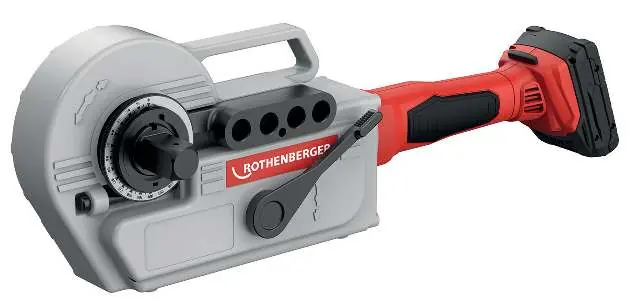
Device Overview
The device features a bending segment, a bending shoe (ROLUB), a direction lever, and a bending scale for precise angle settings. Ensure the battery is securely locked in place before operation.
Operation
- Select the appropriate bending segment and shoe for the pipe diameter.
- Ensure the machine is in the start position by running the motor with the direction lever in the reverse position until it switches to neutral.
- Place the bending segment into the holder, insert the pipe, and secure it in the counter-bearing.
- Attach the bending shoe and secure it with the locking pin.
- Verify the start position by aligning the '0' mark on the bending segment with the center of the bending shoe.
- Shift the direction lever to the working position and press the motor switch to begin bending.
- Hold the switch until the desired angle is reached, then release.
- After bending, shift the lever to the reverse position and briefly press the motor switch to release the pipe.
Battery and Charger
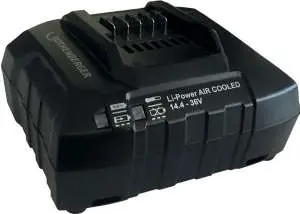
Use only original ROTHENBERGER or CAS (Cordless Alliance System) battery packs. Charge the battery before first use. The charger performs a self-test upon plugging in. LED indicators show the charging status: flashing indicates charging, continuous light indicates maintenance charge. If the warning light flashes, the battery is defective or not inserted correctly.
Maintenance
Remove the battery before any maintenance. Regularly check the motor switch for proper function. Replace the grease every 500 operating hours using approximately 300g of LGMT2 grease (or equivalent). Repairs must be performed by authorized service centers.
Troubleshooting
- Bending segment stops while motor runs: Direction lever not in the correct position or transmission issue.
- Bends are not round/circular: Incorrect bending segment/shoe for pipe size, worn parts, or poor pipe quality.
- Machine does not start: Check electrical connections or carbon brushes.
- Pre-set angle trigger fails: Screws not tightened properly.
Manufacturer information
ROTHENBERGER
Practical help
Common problems
Bending segment stops during operation while motor is running
Check if the direction lever is in the correct position. If it is, there may be a transmission problem; contact a technical service center.
Bends are not round or are wrinkled
Ensure the bending segment and shoe match the pipe diameter. Check for worn parts or poor pipe quality.
Machine does not start
Check all electrical connections and the plug wiring. Carbon brushes may need replacement.
Pre-set bending angle function does not work
Ensure all adjustment screws are properly tightened.
Before use
- Ensure the work area is clear of obstacles.
- Check that the battery is fully charged.
- Select the correct bending segment and shoe for the pipe size.
- Verify the machine is in the start position (0 mark aligned).
- Ensure the pipe is fully inserted into the counter-bearing.
Specs in practice
- Bending Capacity (Copper)
- 12-35 mm / 1/2 - 1.3/8"
- Bending Capacity (Steel/INOX)
- 12-28 mm / 1/2 - 1.1/8"
- Bending Angle
- 0º - 180º
- Recommended Battery Capacity
- ≥ 4.0 Ah for optimal performance with large diameters
Images and diagrams
- A: Overview of the machine components (1-11).
- B-1: Battery insertion and removal procedure.
- B-2: Setting the bending angle using the scale.
- C: Step-by-step bending operation sequence.
- D: Charger and battery status indicators.
Model compatibility
- Compatible with ROTHENBERGER and CAS (Cordless Alliance System) battery packs.
- Chargers must be used indoors and protected from moisture.
- Use Type F or better residual current circuit breakers (max 30 mA).

Manual page author
Michael Turner
Technical manual editor
Reviews PDF manuals for structure, safety notes, and practical product details so readers can find the right information quickly.