Industrial / Gasoline Engines
Operator's Manual for 179cc, 208cc, 243cc, and 272cc OHV Horizontal Shaft Engines
Comprehensive operator's manual for Sears OHV horizontal shaft engines (179cc, 208cc, 243cc, 272cc). Includes safety, setup, operation, maintenance, and troubleshooting instructions.
Quick answers from the manual
Quick answer
- This manual provides instructions for the safe operation, maintenance, and troubleshooting of Sears 179cc, 208cc, 243cc, and 272cc OHV horizontal shaft engines. p. 1
Key actions
- Check oil level p. 5
- Change engine oil p. 13
First start
- Check oil level, add fuel, insert safety key, set throttle to FAST, set choke to FULL CHOKE, and pull recoil starter or press electric start button. p. 5, 6, 9, 10
Problems and fixes
Engine Fails to start
Wait 10 minutes, connect spark plug wire, fill tank with fresh fuel, or move throttle to FAST/RUN.
p. 18Maintenance and reset
- Change oil after first 5 hours and every 50 hours thereafter. p. 13
Technical specifications
| Parameter | Value | Meaning | Pages |
|---|---|---|---|
| Oil Capacity | 600 ml / 20 oz | Required oil volume | p. 5 |
| Spark Plug Gap | 0.030 - 0.06 in. (0.76 - 1.5 mm) | Correct gap for spark plug | p. 14 |
Where to find it in the PDF
- Operation p. 7, 8, 9, 10
- Service and Maintenance p. 12, 13, 14, 15
- Troubleshooting p. 18
Table of contents
Manual images
Click an image to enlargeQuick Guide from the Manual
This manual covers the operation and maintenance of 179cc, 208cc, 243cc, and 272cc OHV horizontal shaft engines. Before operating, ensure you have read all safety rules. Always check the oil level and fuel requirements before starting the engine.
Safety Information
- Gasoline Handling: Gasoline is extremely flammable. Always refuel outdoors in a well-ventilated area with the engine off and cool. Never smoke or allow flames/sparks nearby.
- Carbon Monoxide: Never run the engine indoors or in poorly ventilated areas.
- Hot Surfaces: The muffler and engine become very hot. Allow them to cool for at least 5 minutes before touching or storing.
- Safety Key: If equipped, the safety key must be fully inserted to start the engine. Remove it when not in use.
Set-Up
Fuel & Oil: The engine is shipped without fuel. Use 4-stroke, high-detergent, premium quality motor oil (minimum SJ classification). Capacity is 600 ml (20 oz). Use unleaded gasoline with a minimum of 87 octane. Do not use E15 or E85 fuel.
Operation
Pre-Operation Check: Always check oil level, fuel requirements, air filter, and perform a general inspection for leaks or loose parts before starting.
Starting the Engine:
- Ensure the safety key is inserted (if equipped).
- Move throttle to FAST position.
- Set choke to FULL CHOKE.
- Prime 3-5 times if equipped.
- Pull recoil starter handle or press electric start button.
- Once started, move choke to 1/2 CHOKE, then to NO CHOKE.
Maintenance & Storage
Maintenance Schedule:
- Each Use: Check engine oil level, clean debris around muffler.
- First 5 Hours: Change engine oil.
- Every 25 Hours: Check spark plug.
- Every 50 Hours: Change engine oil.
- Every 100 Hours: Service air cleaner, replace spark plug, replace fuel filter.
Storage: If storing for 30-90 days, use a fuel stabilizer. For storage over 90 days, drain the fuel system completely. Always store in a clean, dry, well-ventilated area.
Troubleshooting
If the engine fails to start, check if it is flooded, the spark plug wire is disconnected, the fuel tank is empty, or the throttle is in the STOP position. If the engine runs erratically, check for a loose spark plug wire, stale fuel, or water/dirt in the fuel system.
Practical help
Common problems
Engine fails to start
Check if engine is flooded, spark plug wire is connected, fuel tank is empty, or throttle is in STOP position.
Engine runs erratically
Check for loose spark plug wire, stale fuel, or water/dirt in the fuel system.
Engine overheats
Check engine oil level and fill if low.
Before use
- Check engine oil level
- Check fuel requirements
- Check air filter
- Perform general inspection for fluid leaks
- Check for loose or damaged parts
Specs in practice
- Oil Capacity
- 600 ml (20 oz)
- Spark Plug Gap
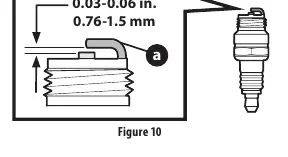
- 0.030 - 0.06 in. (0.76 - 1.5 mm)
Images and diagrams
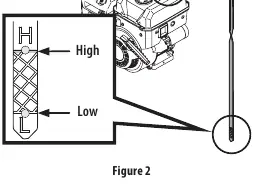
- Figure 2: Shows how to check oil level using the dipstick.
- Figure 4: Identifies engine features like throttle, choke, oil drain plug, and starter inlet.
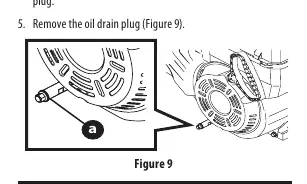
- Figure 9: Shows the location of the oil drain plug.
- Figure 10: Illustrates how to measure and adjust the spark plug gap.
Model compatibility
- Engine models are designed for outdoor power equipment only.
- Approved for use as replacement engines for snow throwers, log splitters, tillers, chipper/shredders, and wheeled blowers.

Manual page author
Emily Carter
User documentation editor
Prepares concise manual descriptions and highlights the most useful setup, operation, and maintenance information for readers.