Home / Security
Solight 1L70 / 1L70B Wireless Doorbell User Manual
Quick guide for the Solight 1L70 / 1L70B wireless doorbell. Learn how to pair transmitters, adjust volume, install the battery-free button, and troubleshoot signal issues.
Quick answers from the manual
Quick answer
- The Solight 1L70/1L70B is a battery-free wireless doorbell. To pair, plug in the receiver, hold the pairing button for 5 seconds until the LED lights up, then press the transmitter button within 25 seconds. p. 1
Key actions
- Pairing the transmitter p. 1
- Deleting paired buttons p. 2
First start
- Plug the receiver into a 230V socket and pair the transmitter. p. 1
Problems and fixes
Receiver does not ring
Check distance and signal interference (metal objects, concrete walls).
p. 2Maintenance and reset
- To clear memory, hold the pairing button while plugging the receiver into power. p. 2
Technical specifications
| Parameter | Value | Meaning | Pages |
|---|---|---|---|
| Transmission range | 150m | In open space | p. 1 |
| Frequency | 433.92 MHz | Operating frequency | p. 1 |
Where to find it in the PDF
- Receiver and Transmitter Description p. 1
- Installation and Troubleshooting p. 2
Table of contents
Manual images
Click an image to enlargeQuick guide from the manual
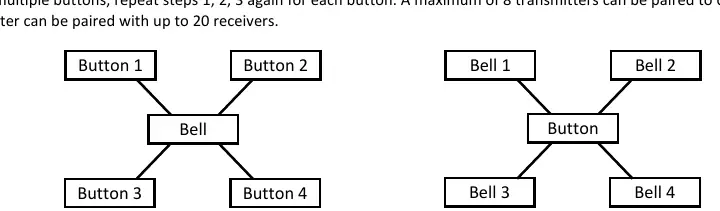
The Solight 1L70 / 1L70B is a battery-free wireless doorbell system. The transmitter generates energy mechanically when pressed, eliminating the need for batteries. The receiver connects to a 230V AC mains socket. The system supports pairing multiple transmitters (up to 8) to one receiver, and one transmitter can be paired with up to 20 receivers.
Device Description
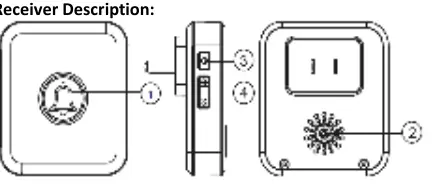
Receiver
- LED indicator: Visual signal for pairing and operation.
- Speaker: Outputs the selected melody.
- Change volume / Pairing button: Used for pairing and volume adjustment.
- Changing the ringtone button: Used to cycle through melodies.
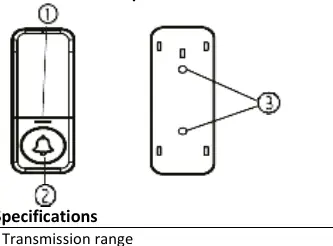
Transmitter
- LED indicator: Confirms signal transmission.
- Ring button: Mechanical button to trigger the bell.
- Mounting pad: Includes drill holes for installation.
Pairing the button with the bell
- Plug the doorbell receiver into a 230V AC/50 Hz socket.
- Long press the pairing button on the receiver for approximately 5 seconds.
- Release the button when the indicator light on the receiver turns on.
- The receiver enters pairing mode for 25 seconds. During this time, press the button on the transmitter.
- When the melody sounds, the button is successfully paired.
To delete paired buttons from memory: Hold the pairing button on the receiver, plug it into the electricity, wait for the LED to light up (approx. 5 seconds), release the button, and wait for the LED to go off.
Installation
- Test: Before permanent installation, test the range and reliability of the device in the chosen location.
- Mounting: Attach the installation pad to the substrate using double-sided tape or screws.
- Securing: Insert the button tabs on the back into the holes of the installation pad and push sideways to secure.
Note: Do not place the button directly on metal objects or materials containing metal (e.g., steel posts, metal-framed doors), as this may interfere with signal transmission.
Settings
- Ringtone: Use the ringtone buttons on the receiver to select a melody.
- Volume: Press the volume button repeatedly to select one of the four levels (25 - 110 dB).
Troubleshooting
If the receiver does not ring after pressing the transmitter button, check the following:
- Ensure the distance between the transmitter and the receiver is not too great.
- Check for strong sources of signal interference between the transmitter and receiver, such as radio/wireless networks, large metal objects, or reinforced concrete walls.
Technical Specifications
- Transmission range: Up to 150m in open space.
- Transmission frequency: 433.92 MHz.
- Ringtone volume: 4 levels (25 - 100 dB(A)).
- Number of melodies: 64.
- Receiver power supply: AC 230V/50Hz.
- Receiver protection class: IP56.
- Operating temperature (Receiver): -10 °C to +40 °C.
- Operating temperature (Transmitter): -20 °C to +50 °C.
Practical help
Common problems
Receiver does not ring after pressing the transmitter button.
Check if the distance is too great or if there is signal interference from metal objects, reinforced concrete walls, or other wireless networks.
Before use
- Test the range and reliability of the device in the chosen location before permanent installation.
- Ensure the receiver is plugged into a 230V AC socket.
- Avoid placing the transmitter directly on metal surfaces or metal-framed doors.
- Ensure the receiver is used indoors only.
Specs in practice
- Transmission frequency
- 433.92 MHz (standard radio frequency for this device).
- Receiver protection class
- IP56 (protected against dust and powerful water jets).
- Transmission range
- Up to 150m in open space; actual range depends on local conditions.
Images and diagrams
- The receiver features a pairing/volume button and a ringtone selection button.
- The transmitter is battery-free and uses mechanical energy to generate the signal.
- The pairing process requires holding the receiver button for 5 seconds until the LED lights up.
Model compatibility
- Maximum of 8 transmitters can be paired to one receiver.
- One transmitter can be paired with up to 20 receivers.
- The device has internal memory to store codes during power outages.

Manual page author
David Miller
Documentation analyst
Organizes user manual content into clear summaries, with attention to model details, product context, and everyday usability.