Home / Security
User Manual for Solight 1D22 Wireless Motion Detector and Gong
Quick guide for the Solight 1D22 wireless motion detector and gong. Learn how to install the sensor, set up the receiver, adjust volume and melodies, and optimize motion detection range.
Quick answers from the manual
Quick answer
- The Solight 1D22 is a wireless motion detector and gong. The receiver requires 3x AA batteries, while the transmitter requires 3x AAA batteries or a 5V Micro USB power source. p. 1
Key actions
- Adjust melody and volume p. 1
- Mount the sensor p. 1
First start
- Insert batteries into both units and test the detection angle before permanent installation. p. 1
Problems and fixes
Alarm not sounding
Ensure movement is parallel to the sensor (e.g., left to right) rather than approaching directly.
p. 1Technical specifications
| Parameter | Value | Meaning | Pages |
|---|---|---|---|
| Frequency | 433.92 ±1 MHz | Operating frequency | p. 1 |
| Signal Range | 40m | Maximum range in open area | p. 1 |
| Detection Range | 0 - 8m | Motion detection distance | p. 1 |
Where to find it in the PDF
- English User Manual p. 1
Table of contents
Manual images
Click an image to enlargeQuick guide from the manual
The Solight 1D22 is a wireless motion detector and gong system designed for indoor use. The system consists of a receiver (gong) and a transmitter (sensor). The receiver alerts you when the sensor detects movement within its range. Ensure the receiver is not placed in high humidity or exposed to liquids.
Receiver setup
The receiver is powered by 3x AA alkaline 1.5V batteries. To set it up:
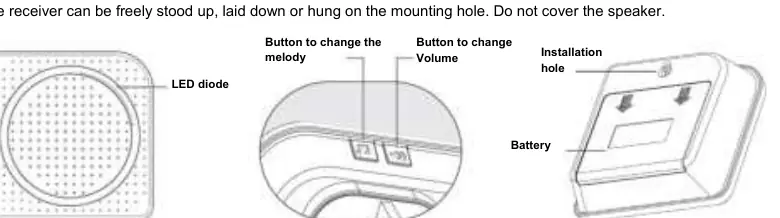
- Open the battery cover on the back of the receiver.
- Insert 3x AA batteries, observing the correct polarity.
- Use the control buttons on the receiver to adjust the melody and volume.
- The volume cycles from lowest to highest and back; a beep confirms each change.
- The receiver can be placed on a surface or hung using the mounting hole. Do not cover the speaker.
Transmitter setup
The transmitter can be powered by batteries or an external power source:
- Battery power: Open the battery cover and insert 3x AAA alkaline 1.5V batteries, observing the correct polarity.
- External power: Connect a Micro USB cable to the transmitter. Use an adapter with a DC 5V output.
- Important: Do not insert batteries if using USB power. The transmitter does not charge batteries.
- Use the power switch to turn the sensor on or off.
Installation and placement
The infrared sensor detects motion within a 100° horizontal and 15° vertical angle, with a range of 0 to 8 meters. To ensure optimal performance:
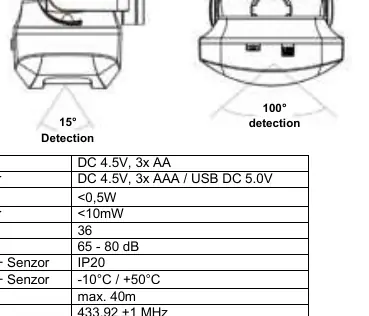
- Placement: Place the transmitter where people will pass by, rather than approaching the sensor directly. Movement parallel to the back cover is detected best.
- Mounting: The swivel base allows for 360° rotation, and the transmitter mount allows for 180° rotation to set the correct detection angle.
- Testing: Before permanently installing screws, test the detection capability from the chosen location.
- Interference: Avoid placing the transmitter near air conditioners, fans, chimneys, or in areas with dense fog, smoke, or high humidity. Wireless transmission can be affected by walls, metal structures, and other electromagnetic devices.
Technical specifications
- Signal range: Max 40m in open area.
- Frequency: 433.92 ±1 MHz.
- Melodies: 36 options.
- Volume: 65 - 80 dB.
- Protection class: IP20.
- Operating temperature: -10°C to +50°C.
Practical help
Common problems
Alarm does not sound when someone approaches
The sensor detects movement parallel to the back cover. Ensure the sensor is placed where people pass by, not walking directly towards it.
Poor motion detection
Check for environmental interference such as airflow from air conditioners, fans, or chimneys, as well as fog or smoke.
Signal range issues
Avoid placing the transmitter behind walls, metal structures, or near WiFi/Radio devices that may cause interference.
Before use
- Insert 3x AA batteries into the receiver.
- Insert 3x AAA batteries into the transmitter or connect via Micro USB (5V).
- Test the detection angle before permanent mounting.
- Ensure the receiver speaker is not covered.
- Verify the environment is free from high humidity or aggressive substances.
Specs in practice
- Detection Angle
- 100° horizontal and 15° vertical coverage.
- Detection Range
- 0 to 8 meters from the sensor.
- Signal Range
- Up to 40 meters in an open area.
- Protection Class
- IP20, suitable for indoor use only.
Images and diagrams
- The sensor base allows 360° rotation and the mount allows 180° rotation for precise aiming.
- The receiver features buttons for melody and volume adjustment.
Model compatibility
- The device operates on 433.92 MHz frequency.
- Not suitable for outdoor use in high humidity or extreme weather.

Manual page author
Emily Carter
User documentation editor
Prepares concise manual descriptions and highlights the most useful setup, operation, and maintenance information for readers.