Electronics / Speakers & Soundbars
User Guide for Tannoy VX Series Loudspeakers
Quick start guide for Tannoy VX Series loudspeakers. Includes installation, wiring, amplifier requirements, mounting instructions, and technical specifications.
Table of contents
Manual images
Click an image to enlargeQuick Start Guide
This guide provides essential information for the Tannoy VX Series loudspeakers, including installation, wiring, and amplifier requirements. Always refer to the full documentation for detailed safety and operational instructions.
Unpacking the Loudspeaker
Each Tannoy VX Series loudspeaker is tested and inspected prior to shipment. Upon unpacking, inspect the unit for any physical damage. Retain the carton and packaging materials in case the loudspeaker requires future transport.
System Requirements
The VX Series offers various sizes, power levels, and coverage patterns. Models with the .2 designation include a second matched LF driver for extended bass. The HP designation indicates extended power handling, and the Q suffix indicates the inclusion of the Q-Centric Waveguide (QCW) for asymmetrical coverage. The QCW horn can be rotated for horizontal or vertical orientation.
Amplifier Considerations
VX Series loudspeakers are optimized for use with Lab Gruppen PLM+ series amplifiers or Lake LM series controllers combined with Lab Gruppen FP amplifiers. Use high-quality power amplifiers capable of delivering long-term broadband power equal to half the loudspeaker's peak power rating at its nominal impedance. Avoid underpowered amplifiers to prevent permanent damage from clipped signals.
Connections
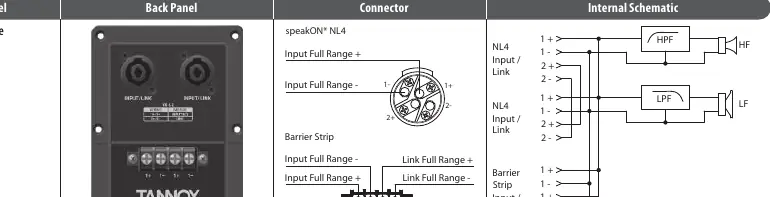
Neutrik speakON NL4 locking input connectors are provided for input, link, passive, and bi-amp operation. Always observe correct polarity when connecting cables. Use heavy-duty speaker cable with a minimum wire size of 1.5 mm² (16 AWG), preferably 2.5 mm² (14 AWG) for longer runs.
Mounting and Fixing
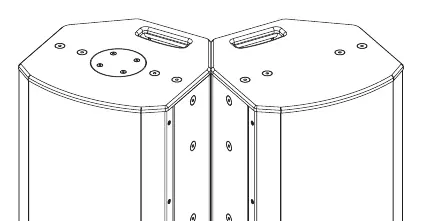
Arrays should be constructed to minimize coverage pattern overlap. Placing VXP cabinets with 30-degree angled rear panels together ensures a smooth transition. Cabinets can be stacked vertically for greater dispersion. Ensure all mounting hardware is installed by qualified personnel and that walls, floors, or ceilings can safely support the load.
Safety Information
- Do not install in confined spaces like bookcases.
- Do not place naked flame sources, such as candles, on the apparatus.
- Keep the apparatus away from water and heat sources.
- Use only attachments and accessories specified by the manufacturer.
- Refer all servicing to qualified service personnel.
- Loudspeakers create magnetic fields; keep sensitive materials (computers, monitors) at a safe distance of 1 to 2 meters.
Practical help
Common problems
Sound distortion or permanent loudspeaker damage
Avoid using underpowered amplifiers. Ensure the amplifier can deliver long-term broadband power equal to half the loudspeaker's peak power rating.
Combing frequencies in arrays
Construct arrays so individual coverage patterns combine with minimal overlap. Use 30-degree angled rear panels to achieve a smooth transition.
Before use
- Inspect the loudspeaker for exterior physical damage after unpacking.
- Verify the amplifier power matches the loudspeaker's nominal impedance.
- Use high-quality professional speaker cables with 1/4" TS or twist-locking plugs.
- Ensure correct polarity when connecting cables.
- Confirm that mounting surfaces can safely support the actual load.
- Ensure the area underneath flown speakers is free of human traffic.
Specs in practice
- Nominal Dispersion
- The coverage pattern of the speaker (e.g., 90° conical or 75°x40°), defining the area the sound covers.
- Directivity Factor (Q)
- A measure of the speaker's directional focus; higher values indicate a more focused sound.
Images and diagrams
- Wiring diagrams illustrate pin configurations for speakON NL4 connectors (1+/1- for input, 2+/2- for link).
- Mounting diagrams show how to stack cabinets vertically and invert them for optimal splay angles.
Model compatibility
- VX 'HP' and 'Q' versions feature switchable inputs for passive or bi-amp operation.
- Optimized for Lab Gruppen PLM+ series amplifiers or Lake LM series controllers.

Manual page author
Emily Carter
User documentation editor
Prepares concise manual descriptions and highlights the most useful setup, operation, and maintenance information for readers.