Automotive / Parts & Accessories
User Manual for Vevor Golf Cart Wheels
Quick guide for Vevor Golf Cart Wheels (Models: 18x8.5-8, 205/50-10, 20x10-12). Includes installation steps, safety rules, maintenance schedules, and troubleshooting.
Quick answers from the manual
Quick answer
- These golf cart wheels are designed for low-speed use on smooth, paved surfaces. Installation requires a torque wrench, hydraulic jack, and jack stands. Always follow the crisscross tightening pattern to ensure the wheel sits evenly. p. 2, 4, 5
Key actions
- Install wheels using a crisscross tightening pattern. p. 5
- Perform weekly inspections for damage and bolt tightness. p. 5
First start
- Ensure the cart is turned off, parking brake is engaged, and wheel chocks are used before lifting. p. 4
Show 4 more answers Show less
Problems and fixes
Wheel wobbles or makes a thumping noise
Inspect rim for bending, check for uneven tire tread wear, or re-torque loose rim bolts.
p. 7Maintenance and reset
- Clean wheels monthly to remove debris and check valve stems for leaks. p. 5
Technical specifications
| Parameter | Value | Meaning | Pages |
|---|---|---|---|
| 18x8.5-8 Max Load | 800lbs | Maximum weight capacity | p. 3 |
| 205/50-10 Max Load | 675lbs | Maximum weight capacity | p. 3 |
| 20x10-12 Max Load | 800lbs | Maximum weight capacity | p. 3 |
Where to find it in the PDF
- Specifications p. 3
- Installation Guide p. 4, 5
- Troubleshooting p. 7
Table of contents
Quick guide from the manual
These golf cart wheels are designed for low-speed use on smooth, paved surfaces. Before use, ensure you have read all safety rules. Never exceed the rated load capacity, as overloading can cause deformation, tire blowouts, or loss of control. Always keep hands, feet, and clothing clear of moving wheels.
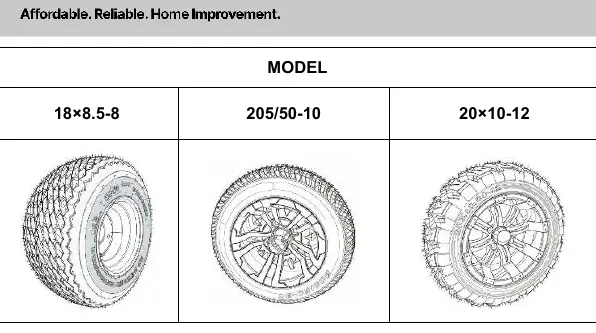
Specifications
The following specifications apply to the available models:
- 18x8.5-8: 800lbs Max Load, 22 PSI, 8in Rim Diameter.
- 205/50-10: 675lbs Max Load, 30 PSI, 10in Rim Diameter.
- 20x10-12: 800lbs Max Load, 20 PSI, 12in Rim Diameter.
Installation Guide
Follow these steps to install your new wheels safely:
- Preparation: Use a socket wrench set (17-19mm), torque wrench (30-80 N·m), hydraulic jack, jack stands, wire brush, tire pressure gauge, and wheel chocks.
- Secure the Cart: Turn off the engine/power, engage the parking brake, and use wheel chocks on wheels not being replaced.
- Lift: Position the jack under the frame (not the axle). Lift until the wheel is 2-3 inches off the ground and secure with jack stands.
- Remove Old Wheel: Loosen bolts in a crisscross sequence, remove bolts, and pull the wheel off.
- Clean: Use a wire brush to clean the axle hub and bolt threads.
- Install New Wheel: Align bolt holes, slide the wheel onto the hub, and ensure a flush fit.
- Tighten: Hand-tighten bolts in a crisscross pattern. Lower the cart and finalize tightening with a torque wrench to the manufacturer's specified value.
- Verify: Check tire pressure with a gauge.
Maintenance and Care
- Weekly: Inspect for damage (cuts, bulges, uneven wear), check rims for cracks/dents, and verify bolt tightness.
- Monthly: Clean the wheel surface to remove debris. Check valve stems for leaks using soapy water. For steel rims, apply rust-preventive oil if stored outdoors.
- Storage: For short-term storage (1-3 months), inflate tires 2-3 PSI above recommended pressure. For long-term storage (3+ months), lift the cart to relieve pressure, remove wheels, and store in a cool, dry area.
Troubleshooting
If you experience issues, refer to the following:
- Wheel wobbles/thumping: Check for bent rims, uneven tread wear, or loose bolts.
- Tire loses pressure: Check for damaged valve stems, punctures, or leaks at the tire-rim interface.
- Wheel feels stiff: Check for overinflated tires, rim offset mismatch, or seized axle bearings.
- Uneven tread wear: Check wheel alignment, load distribution, or bent axles.
Manufacturer information
VEVOR
Practical help
Common problems
Wheel wobbles or makes a thumping noise
Inspect rim for bending, check for uneven tire tread wear, or re-torque loose rim bolts.
Tire loses pressure rapidly
Replace damaged valve stem, repair tread punctures, or inspect/replace the rim seal.
Wheel feels stiff when turning
Deflate tire to recommended pressure, verify correct rim offset, or inspect axle bearings.
Uneven tread wear
Have a professional adjust wheel alignment, distribute load evenly, or inspect for a bent axle.
Before use
- Inspect each rim for damage (bending, cracks, rust).
- Check tire tread depth (must be at least 1.6mm).
- Verify tire pressure matches manufacturer recommendations.
- Check tightness of wheel lug nuts using a torque wrench.
- Ensure wheel chocks are in place before lifting the cart.
Show more Show less
Specs in practice
- Max. Load Capacity
- The maximum weight the wheel is rated to support; exceeding this can cause blowouts.
- Maximum Pressure
- The recommended PSI for the tire; over-inflation reduces contact area, under-inflation causes overheating.
- Rim Diameter
- The size of the wheel rim, which must match your cart's requirements.
Images and diagrams
- The manual provides a table of specifications for three different models (18x8.5-8, 205/50-10, 20x10-12).
- Troubleshooting table lists common symptoms, causes, and remedies.
Model compatibility
- Compatible with various vehicles including ATV, Go Kart, Golf Cart, and UTV (e.g., EZGO-Marathon, RVX, TXT; WORKHORSECLUB CAR-TEMPO, PRECEDENT; YAMAHA-G29 DRIVE&DRIVE2, ALL G SERIES).

Manual page author
Emily Carter
User documentation editor