Industrial / Pumps & Motors
User Manual for VEVOR Universal AC Motor
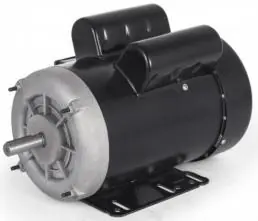
Quick guide for VEVOR Universal AC Motors. Includes wiring diagrams, technical specifications, safety precautions, maintenance tips, and troubleshooting steps for models SYT-0.5HP-4P-B34, SYT-1HP-4P-B34, SYT-3HP-4P-B3, SYO-5HP-4P-B3, and...
Quick answers from the manual
Quick answer
- This manual covers the installation, wiring, and maintenance of VEVOR Universal AC Motors (models SYT-0.5HP-4P-B34 through SYT-5HP-2P-B3). p. 1, 3
Key actions
- Perform regular maintenance every six months, including changing bearing grease and cleaning the motor. p. 4
- Reset the motor using the red protector button after an overload shutdown. p. 8
First start
- Ensure the shaft rotates flexibly by hand before starting. p. 4
Problems and fixes
Motor overheats and stops
Allow to cool for 30 minutes, then press the red reset button.
p. 8Maintenance and reset
- Press the red protector button to reset the motor after an overload trip. p. 8
Technical specifications
| Parameter | Value | Meaning | Pages |
|---|---|---|---|
| Rated Speed | 1725 RPM / 3450 RPM | Rotational speed of the motor. | p. 5, 6 |
Where to find it in the PDF
- Safety Warnings p. 3, 4
- Technical Info p. 5, 6
- Connection Method p. 6, 7
Table of contents
Manual images
Click an image to enlargeQuick Guide from the Manual
This manual provides essential information for the installation, operation, and maintenance of VEVOR Universal AC Motors. Before operating, ensure the voltage and frequency match the motor nameplate. The motor must be properly grounded and operated in an environment not exceeding 45°C and 1000 meters above sea level. Always verify that the shaft rotates freely before the first start.
Safety Warnings and Precautions
- Electrical Safety: Voltage and frequency must be consistent with the motor nameplate. Power supply voltage should be maintained within ±5% of the rated range.
- Grounding: The motor must have a good grounding device.
- Environment: Keep the surrounding area clean, dry, and well-ventilated. Do not operate in environments exceeding 45°C.
- Insulation: Before operation, measure the winding insulation resistance to ground using a 500-volt megohm meter; it should be greater than 0.2 megohm.
Technical Specifications
The motors are available in various configurations. Key specifications include:
- Horsepower: Ranges from 0.5HP to 5HP depending on the model.
- Rated Speed: 1725 RPM or 3450 RPM.
- Duty: Continuous S1.
- Protection: IP23 class of protection with manual reset overload protection.
- Enclosure: TEFC (Totally Enclosed Fan Cooled) or ODP.
Connection Method
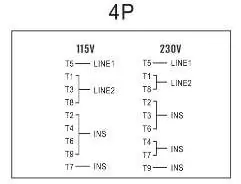
The manual provides specific wiring diagrams for 2P and 4P motors. T1 through T9 represent motor lead wire numbers. Factory settings are typically 115V/60Hz. For 230V configurations, follow the specific parallel connection instructions provided in the wiring diagrams. Ensure the lead wire used is above 10AWG and the power cord does not exceed 10 meters.
Maintenance
- Bearing Grease: Change every six months. Fill the bearing chamber to approximately 60% of the gap.
- Routine Checks: Every six months, clean the motor, remove dust and oil, and check for abrasion.
- Electrical Contacts: Keep the electrical outlet box contacts clean and ensure good connections.
- Inspection: Regularly check for abnormal sounds, overheating, or burning smells. If detected, stop the motor immediately for inspection.
Troubleshooting
If the motor does not start, check the power supply and wiring. If the motor rotates slowly, verify the capacitance. If the motor stops due to overheating, it may be overloaded; allow it to cool for half an hour, then press the red protector button to reset.
Manufacturer information
VEVOR
Practical help
Common problems
Shaft does not rotate manually
The concentricity may be damaged during transport. Use a wooden or rubber hammer to gently adjust the shaft, front end cover, and back end cover until it rotates flexibly.
Motor does not work when powered on
Check power supply voltage, verify wiring against the diagram, and press the red protector button to reset.
Motor rotates slowly or fails to start
Check power supply, verify wiring, and ensure the motor capacitance is in good condition.
Motor overheats and stops
Indicates overload. Allow the motor to cool for 30 minutes, then press the red protector button to reset.
Before use
- Verify voltage and frequency match the motor nameplate
- Ensure the motor is properly grounded
- Check that the shaft rotates freely by hand
- Measure winding insulation resistance (must be >0.2 megohm)
- Ensure the environment is clean, dry, and well-ventilated
Specs in practice
- Duty: cont. S1
- The motor is designed for continuous operation at a constant load.
- Enclosure: TEFC
- Totally Enclosed Fan Cooled; protects internal components from dust and moisture.
- Service Factor: 1.15
- The motor can handle 15% overload capacity under specific conditions.
Images and diagrams
- Wiring diagrams illustrate connections for 115V and 230V power supplies.
- T1-T9 labels correspond to the motor lead wires.
- INS indicates a parallel connection.
Model compatibility
- Use lead wire above 10AWG.
- Power cord length must not exceed 10 meters.
- Ambient temperature must not exceed 45°C.

Manual page author
David Miller
Documentation analyst
Organizes user manual content into clear summaries, with attention to model details, product context, and everyday usability.