Health / Medical Devices
User Manual for Abbott i-STAT TBI Cartridge 03S09-25
Quick guide for the Abbott i-STAT TBI Cartridge (03S09-25). Learn about specimen collection, test procedure, result interpretation, and storage requirements for this diagnostic test.
Table of contents
Manual images
Click an image to enlargeQuick guide from the manual
The i-STAT TBI cartridge is an in vitro diagnostic test designed for use with the i-STAT Alinity instrument. It provides quantitative measurements of GFAP and UCH-L1 in venous whole blood to aid in the evaluation of patients 18 years or older with suspected mild traumatic brain injury. The test is intended for use by healthcare professionals in point-of-care or clinical laboratory settings.
Product Description
The cartridge is a single-use test containing a biosensor chip and all necessary reagents. It utilizes the sandwich enzyme-linked immunosorbent assay (ELISA) method with electrochemical detection. The test yields results in approximately 15 minutes.
Storage and Handling
- Store cartridges at 2 to 8 °C (35 to 46 °F).
- The expiration date is printed on the packaging.
- Cartridges may be stored at room temperature (18 to 30 °C) for up to 14 days.
- Allow refrigerated cartridges to equilibrate at room temperature for 5 minutes (single cartridge) or 1 hour (entire box) before use.
- Do not use if the portion pack is damaged or punctured.
Specimen Collection
- Use venous whole blood collected with EDTA anticoagulant.
- Sample volume required: 20 µL.
- Test timing: Perform the test within 1 hour of collection.
Test Procedure
- Power on the i-STAT Alinity instrument.
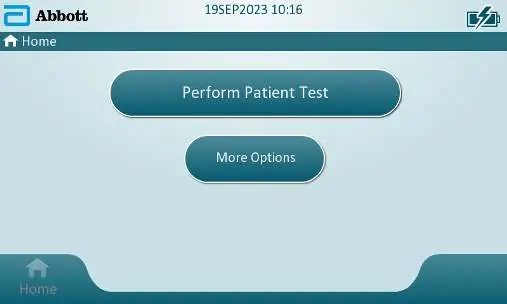
- Select Perform Patient Test on the home screen.
- Follow on-screen prompts to scan or enter Operator and Patient IDs.
- Scan the cartridge pouch barcode.
- Invert the EDTA blood collection tube at least 10 times.
- Fill the cartridge by directing the transfer device tip into the sample well until the sample reaches the fill-to mark.
- Slide the closure clip over the sample well.
- Immediately insert the cartridge into the instrument port until it clicks.
- Wait for the test to complete (15 minutes).
Interpretation of Results
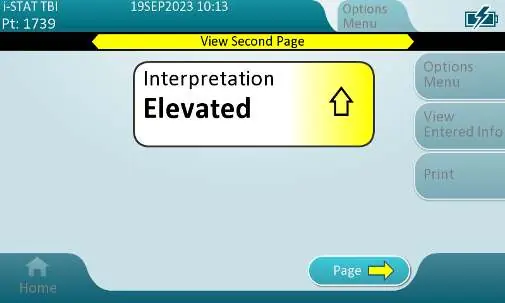
Results are displayed on two pages on the instrument. The first page shows the interpretation (Elevated, Not Elevated, or Repeat Test). The second page provides quantitative results for GFAP and UCH-L1. An audible cue indicates when results are ready.
Limitations and Interference
- The test is not a stand-alone device; it is an adjunct to other clinical information.
- Testing at altitudes above 7,500 feet (2,286 meters) may increase the frequency of suppressed results.
- Grossly hemolyzed samples can cause erroneous results.
- Avoid vortexing or mechanically rotating blood samples, as this may affect biomarker concentrations.
- The instrument must remain on a flat, level surface during testing.
Manufacturer information
Abbott Laboratories
Practical help
Common problems
Quality Check Failure (QCF)
Check the instrument display for the specific error code and follow the indicated next steps. If the issue persists, replace the cartridge or instrument.
Suppressed results
Often caused by high altitude (>7,500 ft) or movement of the instrument during testing. Ensure the instrument is on a level surface.
Erroneous results due to hemolysis
Avoid using grossly hemolyzed samples. Ensure proper sample handling without excessive agitation.
Before use
- Verify the cartridge expiration date.
- Ensure the cartridge is at room temperature (18-30°C) before use.
- Check that the portion pack is not damaged or punctured.
- Ensure the venous whole blood sample is collected with EDTA anticoagulant.
- Verify the instrument is on a level surface.
Specs in practice
- Sample Volume
- 20 µL of venous whole blood.
- Storage Temperature
- 2 to 8 °C (35 to 46 °F) for optimal performance.
- Analysis Time
- Approximately 15 minutes.
- Reportable Range (GFAP)
- 47 - 10,000 pg/mL.
- Reportable Range (UCH-L1)
- 87 - 3,200 pg/mL.
Images and diagrams
- Home Screen: Shows the 'Perform Patient Test' button to initiate the testing pathway.
- Interpretation Screen: Displays 'Elevated' or 'Not Elevated' status.
- Results Screen: Shows quantitative values for GFAP and UCH-L1 with cutoff levels.
Model compatibility
- Designed for use only with the i-STAT Alinity instrument.

Manual page author
Michael Turner
Technical manual editor
Reviews PDF manuals for structure, safety notes, and practical product details so readers can find the right information quickly.