Hvac / Air Conditioners
ACiQ Ceiling Cassette Air Handler Remote Controller Owner’s Manual
Comprehensive owner's manual for the ACiQ Ceiling Cassette (9K-18K) air handler remote controller, covering setup, operation, advanced functions, and troubleshooting.
Table of contents
Manual images
Jump to the sectionOverview
This manual provides instructions for the remote controller used with ACiQ Ceiling Cassette (9K-18K) air handler units. It is designed to help users understand the various functions, settings, and maintenance requirements to ensure optimal performance and comfort.
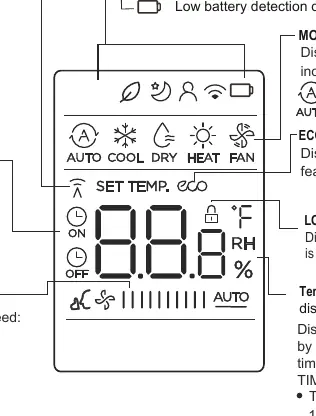
Getting Started
Before using the remote controller, ensure that two R03/LR03 dry batteries are correctly installed in the battery compartment, matching the polarity symbols. The remote has an effective signal range of 8 meters. Keep the infrared receiver on the indoor unit free from obstructions like curtains or direct sunlight to ensure reliable communication.
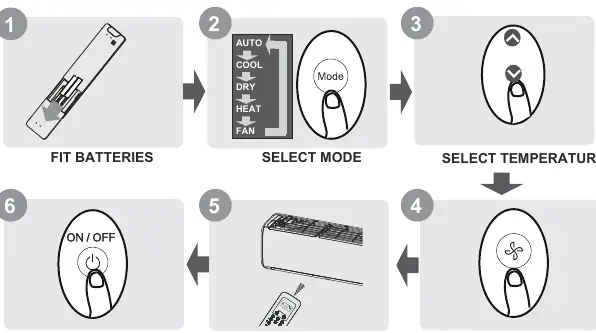
Basic Operation
The remote controller allows you to select between several operating modes: AUTO, COOL, DRY, HEAT, and FAN. In AUTO mode, the unit automatically selects the operation based on the set temperature. In COOL, DRY, and HEAT modes, you can adjust the temperature and fan speed to suit your preferences. The temperature can be set between 17°C and 30°C (62°F-86°F) in 1°C increments. Note that HEAT mode is not available on cooling-only models.
Advanced Functions
The remote includes several advanced features to enhance comfort and efficiency. The TIMER function allows you to schedule the unit to turn on or off automatically. The SWING button controls the horizontal louver movement, with an option for vertical swing on supported models. The SLEEP function adjusts settings to save energy during sleeping hours. Other features include TURBO for rapid cooling or heating, CLEAN to help evaporate moisture from the heat exchanger, and FOLLOW ME, which allows the remote to act as the temperature sensor for more precise climate control.
Maintenance and Safety
To maintain optimal performance, do not mix old and new batteries or different types of batteries. If the remote will not be used for more than two months, remove the batteries. Dispose of used batteries according to local regulations. If the indoor unit does not support a specific function, pressing the corresponding button on the remote will have no effect.
Manufacturer information
ACiQ
Practical help
Common problems
Remote signal not received
Ensure you are within 8 meters of the unit and that there are no obstructions like curtains or direct sunlight blocking the infrared receiver.
Function button has no effect
The indoor unit may not support that specific function. Refer to the user's manual for your specific indoor unit model.
Insufficient cooling or heating
Check if the unit is in ECO mode or if the Silence function is active, as these may limit capacity. Ensure the air filter is clean.
Remote display is blank or flashing
Check if the batteries are low or installed incorrectly. Replace with fresh batteries if necessary.
Before use
- Ensure the air conditioner is plugged in and power is available.
- Install two R03/LR03 batteries in the remote controller.
- Check that the remote is within 8 meters of the indoor unit.
- Remove any obstructions blocking the infrared signal receiver.
- Verify the desired operating mode (AUTO, COOL, DRY, HEAT, FAN).
Specs in practice
- Rated Voltage
- 3.0V (requires two R03/LR03 dry batteries).
- Signal Receiving Range
- Maximum distance of 8 meters for reliable operation.
Images and diagrams
- The remote features a central OK button for confirming settings.
- The MODE button cycles through operation modes.
- TEMP up/down buttons adjust the target temperature.
- The FAN SPEED button cycles through fan intensity levels.
- The SWING button controls louver movement.
Model compatibility
- HEAT mode is not supported by cooling-only appliance models.
- Button designs and available functions may vary depending on the specific indoor unit model.
- If there is a conflict between this manual and the indoor unit's user manual, the indoor unit's manual prevails.
- Some features like Fresh or Sleep may not be available on all models.

Manual page author
Michael Turner
Technical manual editor
Reviews PDF manuals for structure, safety notes, and practical product details so readers can find the right information quickly.