Music / Guitar Effects
User Manual for Amazon Basics Compressor Guitar Pedal
Quick guide for the Amazon Basics Compressor Guitar Pedal. Learn how to connect, adjust sound settings, and maintain your pedal for optimal performance.
Table of contents
Quick guide from the manual
This document provides instructions for the Amazon Basics Compressor Guitar Pedal. It is intended for modifying the sound and volume of an electric guitar or bass in dry, indoor environments. Always ensure you are using a compatible 9V DC 300mA power adapter (not included) and follow all safety precautions to prevent hearing loss or electrical hazards.
Product Description
The pedal features a simple interface for sound shaping:
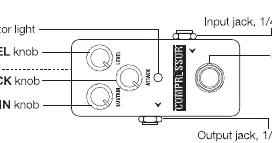
- LEVEL knob: Adjusts the volume of the signal.
- ATTACK knob: Sets the attack time of the compression effect.
- SUSTAIN knob: Sets the compression ratio to suppress loud notes.
- Input/Output jacks: 1/4 inch (6.35 mm) jacks for connecting your instrument and amplifier.
- On/Off switch: Toggles the pedal effect.
Before First Use
Before using the pedal, perform the following steps:
- Inspect the product for any transport damage.
- Remove all packaging materials.
- Verify that your power adapter meets the required specifications (9V DC 300mA).
Connecting to power
The pedal requires an external power adapter. Connect the adapter to the power socket on the pedal and then plug it into a suitable wall outlet.
Switching on/off
- Connect the pedal to your instrument and amplifier before switching it on.
- Set the volume controls on your instrument and amplifier to the desired level.
- Press the On/Off switch to activate or deactivate the pedal.
- The indicator light will show the status of the pedal.
- Adjust the knobs to achieve your desired sound.
Adjusting sound
Use the three knobs to shape your tone:
- SUSTAIN: Turn to adjust the compression ratio. Higher settings will suppress louder notes more aggressively.
- ATTACK: Turn to adjust how quickly the compression effect engages.
- LEVEL: Turn to increase or decrease the output volume.
Cleaning and Storage
To maintain the pedal:
- Cleaning: Wipe with a soft, dry cloth. Never use corrosive detergents, abrasive scourers, or metal utensils. Do not immerse the product in water or hold it under running water.
- Storage: Store in the original packaging in a dry area, away from children and pets.
Safety Information
Always follow these precautions:
- Do not use near water (bathtubs, sinks, swimming pools).
- Avoid using near heat sources like radiators or stoves.
- Be aware that high volume levels through amplifiers or headphones can cause permanent hearing loss.
- If the product is damaged, exposed to liquid, or dropped, refer all servicing to qualified personnel.
Practical help
Common problems
No sound output
Ensure the power adapter is connected, the pedal is switched on, and all cables are securely connected to the instrument and amplifier.
Interference or noise
Operate the pedal at a suitable distance from radios and TVs to avoid reception interference.
Hearing discomfort
Do not operate the pedal at high volume levels for extended periods.
Before use
- Check for transport damage
- Remove all packaging materials
- Verify power adapter voltage (9V DC 300mA)
- Ensure the environment is dry and indoors
Specs in practice
- Power supply
- 9V DC 300mA (adapter not included)
- Protection class
- Class III
Images and diagrams
- The pedal layout includes three control knobs: LEVEL, ATTACK, and SUSTAIN.
- Input and output jacks are standard 1/4 inch (6.35 mm) connections.
- The power socket is located on the side of the unit.
Model compatibility
- Intended for electric guitar or bass.
- Requires a 9V DC 300mA power adapter (not included).
- For private, indoor use only.

Manual page author
David Miller
Documentation analyst
Organizes user manual content into clear summaries, with attention to model details, product context, and everyday usability.