Toys / RC Models & Drones
User Manual for ARRMA VORTEKS 23S BLX RC Car
Quick start guide and user manual for the ARRMA VORTEKS 23S BLX RC car. Includes setup, driving instructions, maintenance, DSC mode adjustments, and troubleshooting.
Quick answers from the manual
Quick answer
- The ARRMA VORTEKS 23S BLX is a high-performance RC car. To start, install 4x AA batteries in the transmitter and a charged battery in the car. Always turn on the transmitter before the car. p. 13, 14
Key actions
- Power On: Turn on transmitter first, then the car. p. 14
- Power Off: Turn off car first, then the transmitter. p. 16
- Adjust DSC: Stop vehicle, hold full right steering, press DSC button. p. 21
First start
- Install batteries and power on in the correct sequence. p. 13, 14
Show 4 more answers Show less
Problems and fixes
Vehicle does not move
Check batteries, wires, and ESC temperature.
p. 23Maintenance and reset
- Re-oil motor bearings every 10-15 runs. p. 17
Technical specifications
| Parameter | Value | Meaning | Pages |
|---|---|---|---|
| Input Voltage | 2S/3S LiPo (7.4v/11.1v) | Supported battery types. | p. 18 |
| BEC Output | 6.0v/4A Max | Power output for electronics. | p. 18 |
Where to find it in the PDF
- Quick Start Guide p. 13, 14
- Maintenance p. 17
- Troubleshooting p. 23, 24
Table of contents
Manual images
Click an image to enlargeQuick Guide
The ARRMA VORTEKS 23S BLX is a high-performance RC vehicle. This manual provides essential instructions for safe operation, maintenance, and troubleshooting. Always operate the vehicle in open spaces away from people, traffic, and full-size vehicles. Never operate in wet conditions without performing the required maintenance.
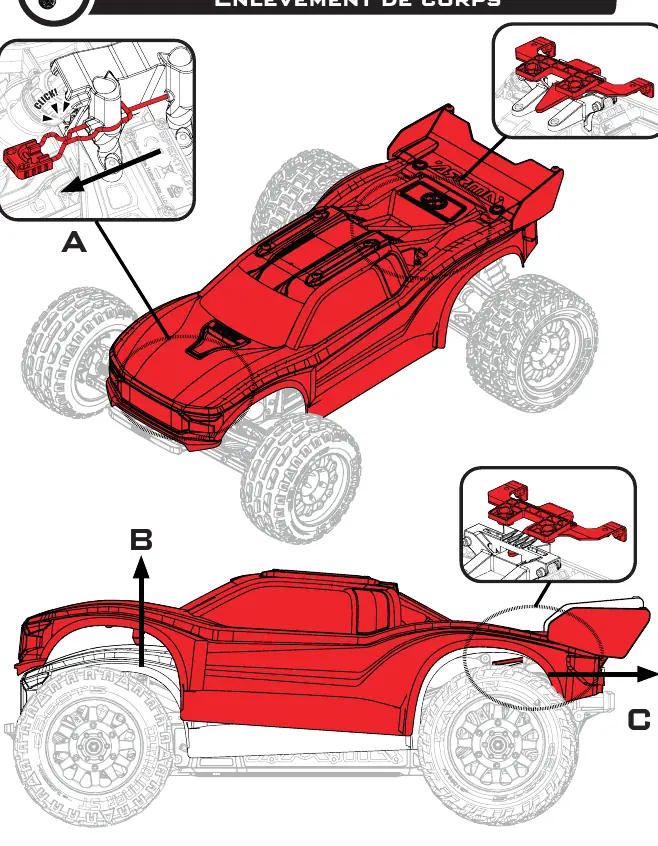
Getting Started
Before operating the vehicle, ensure you have installed the batteries correctly:
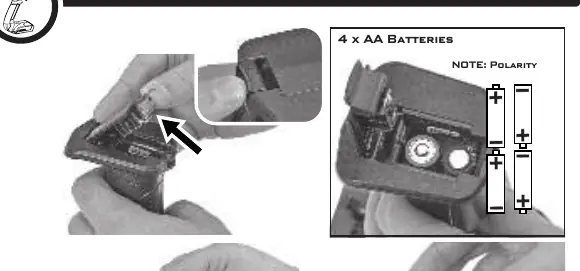
- Controller: Install 4x AA batteries, ensuring correct polarity.
- Vehicle: Install a fully charged battery pack into the vehicle.
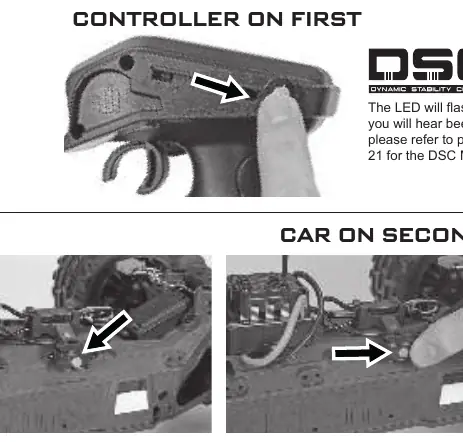
- Power On Sequence: Always turn on the transmitter first, then the vehicle.
- Power Off Sequence: Always turn off the vehicle first, then the transmitter.
Driving Instructions
The transmitter controls the vehicle's movement:
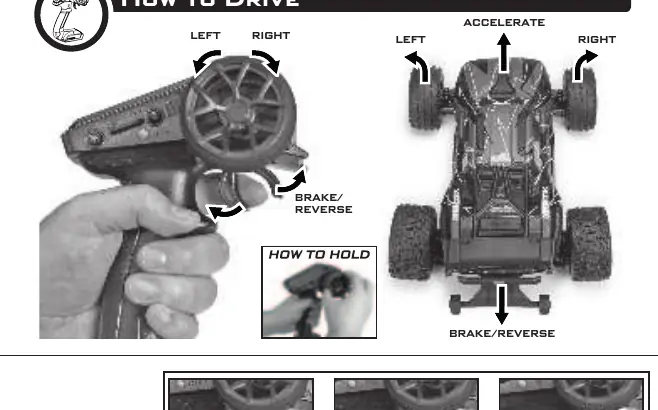
- Steering: Use the steering wheel to turn left or right.
- Throttle: Pull the trigger to accelerate, push to brake/reverse.
- Throttle Limit: The transmitter features a 3-position switch (50/75/100) to limit speed, which is helpful for beginners.
DSC (Dynamic Stability Control)
The DSC system helps control the vehicle by applying steering correction. You can adjust the DSC mode directly from the transmitter:
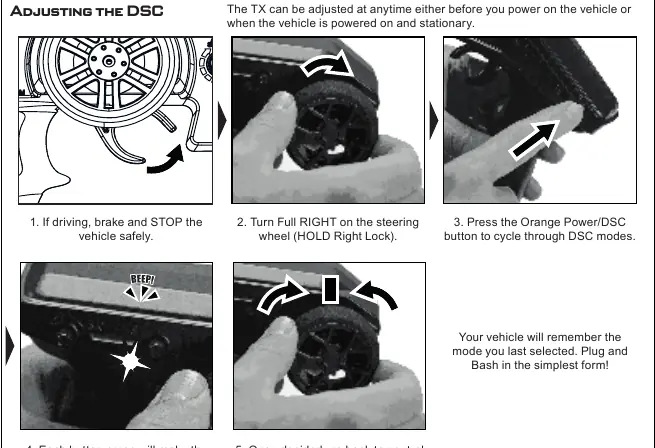
- Stop the vehicle safely.
- Turn the steering wheel to full RIGHT and hold it.
- Press the orange Power/DSC button to cycle through the 4 modes.
- The transmitter will beep and flash to indicate the selected mode.
- Return steering to neutral to resume driving.
Maintenance
Regular maintenance is required to keep the vehicle in top condition:
- After every few runs: Check tire gluing, check for loose screws, and remove debris from rotating parts.
- After 10-15 runs: Remove the motor, re-oil shaft bearings with lightweight oil, and check the gear mesh.
- Wet Conditions: If running in wet conditions, remove the battery, dry the vehicle, and spray metal parts (excluding the motor) with water-displacing lubricant. Never use a pressure washer.
Troubleshooting
If the vehicle does not move, check the transmitter batteries, ensure the ESC/motor wires are connected, and verify the battery is charged. If the vehicle wanders, adjust the steering trim on the transmitter. If the ESC overheats, stop driving and allow it to cool.
Specifications
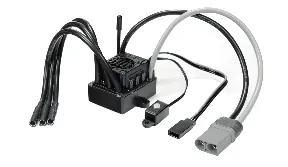
The vehicle features a 2-in-1 ESC and receiver unit. Input voltage is 2S/3S LiPo (7.4v/11.1v) with a BEC output of 6.0v/4A Max.
Practical help
Common problems
Vehicle does not move
Check transmitter batteries, ensure drive battery is charged, check for frayed/broken wires, or allow ESC to cool if overheated.
Short runtime
Check if the battery is damaged or not fully charged. Clean or replace the electric motor if dirty or damaged.
Vehicle wanders left/right
Adjust the steering trim on the transmitter or check for damaged steering components.
Steering/Throttle reversed
Check that the wires from the ESC to the motor are connected in the correct orientation (A to A, B to B, C to C).
Before use
- Install 4x AA batteries in the transmitter
- Install a fully charged battery pack in the vehicle
- Turn on the transmitter first
- Turn on the vehicle second
- Check steering neutral position
- Ensure the body is properly secured
Show more Show less
Specs in practice
- Input Voltage
- Supports 2S (7.4v) or 3S (11.1v) LiPo batteries.
Images and diagrams
- Body removal: Shows how to release the body clips.
- Transmitter layout: Identifies steering trim, throttle limiter, and DSC button.
- ESC/Receiver: Shows connections for motor, battery, and steering servo.
Model compatibility
- Use only compatible batteries in the correct program mode.
- Transmitter is not water-resistant.
- Do not use incompatible components.

Manual page author
Emily Carter
User documentation editor