Automotive / Transmission Systems
Audi 2.8L and 3.2L FSI Engines Service Training
Technical service training guide for Audi 2.8L and 3.2L FSI engines with Audi valvelift system. This document covers engine mechanics, oil circulation, cooling, air intake, and fuel systems.
Quick answers from the manual
Quick answer
- This document is a technical training manual (Self-Study Programme 411) for Audi 2.8L and 3.2L FSI engines, detailing their design, mechanical components, and management systems. p. 1
Key actions
- Checking valve lift changeover p. 22
- Checking oil level p. 38, 39
Problems and fixes
Engine speed limited to 4000 rpm
If not all cylinders can be switched to large stroke, they all remain at small stroke and engine speed is reduced.
p. 22Maintenance and reset
- Oil change interval p. 63
Technical specifications
| Parameter | Value | Meaning | Pages |
|---|---|---|---|
| 2.8L FSI Max Power | 154 kW (210 bhp) | At 5500–6800 rpm | p. 6 |
| 3.2L FSI Max Power | 195 kW (265 bhp) | At 6500 rpm | p. 7 |
Where to find it in the PDF
- Specifications p. 6, 7
- Engine Mechanics p. 8, 25
- Oil Circulation p. 28, 39
- Cooling System p. 40, 44
- Air Circulation p. 45, 52
- Fuel System p. 53, 55
- Engine Management p. 57, 61
Table of contents
Manual images
Click an image to enlargeQuick guide from the manual
This Self-Study Programme (SSP 411) provides technical training on the design and function of Audi 2.8L and 3.2L FSI engines. It is intended for reference purposes and training, not as a repair manual. Key technologies featured include the Audi valvelift system, flow-regulated oil pumps, and trioval sprockets.
Engine Overview
The 2.8L FSI engine (Engine code: BDX) and 3.2L FSI engine (Engine code: CALA) are 6-cylinder V-engines with a 90-degree included angle. Both engines utilize the Audi valvelift system to improve fuel efficiency and reduce friction.
Engine Mechanics
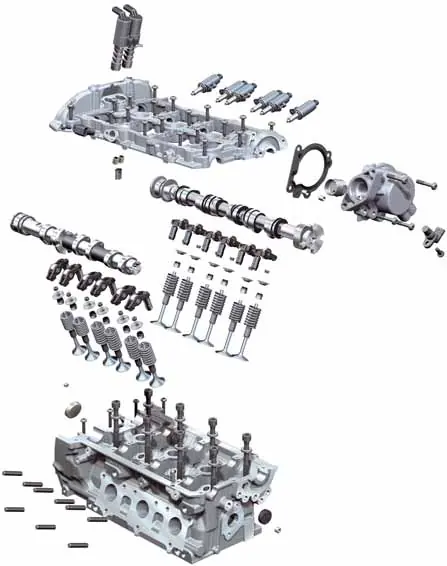
The engine block is a homogeneous monoblock of supereutectic AlSi17Cu4Mg alloy. The chain drive features trioval sprockets, which are acircular in shape to reduce forces acting on the chain and minimize vibration. The Audi valvelift system allows for dual-stage valve lift control by axially displacing cam elements on the intake camshafts.
Oil Circulation System
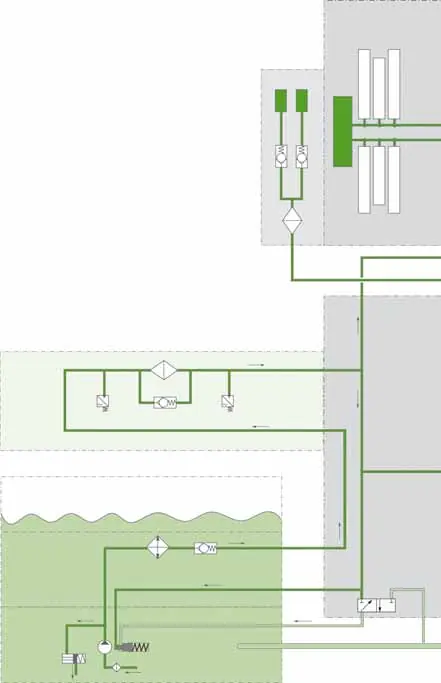
The lubrication system uses a flow-regulated oil pump with dual-stage pressure control. The pump is driven by a chain and is demand-driven to improve fuel economy. Oil pressure is monitored by two switches (F22 and F378). The oil level is measured using an ultrasonic sensor (PULS), and there is no physical dipstick; levels are checked via the MMI or dash panel.
Cooling System
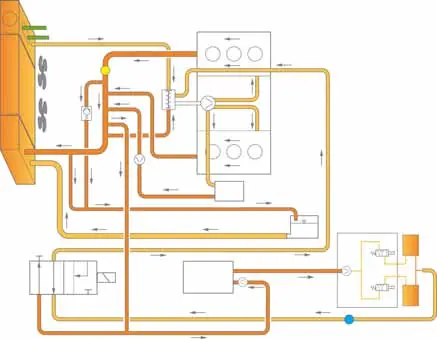
The cooling system includes a thermostat that opens at temperatures higher than 95 °C to reduce engine friction. Cooling run-on is controlled by the engine control unit based on a mathematical model using coolant, oil, and ambient temperature sensors.
Air Circulation System
The air intake features a dual-stage variable intake manifold. The throttle valve control unit (J338) uses magnetoresistive sensors for precise angle measurement. Intake manifold flaps are not required due to the charge motion produced by the partial lift of the valvelift system.
Fuel System
The high-pressure fuel system uses a demand-controlled single-piston pump driven by a triple cam. The pressure limiting valve is integrated into the pump, eliminating the need for a low-pressure return line.
Engine Management
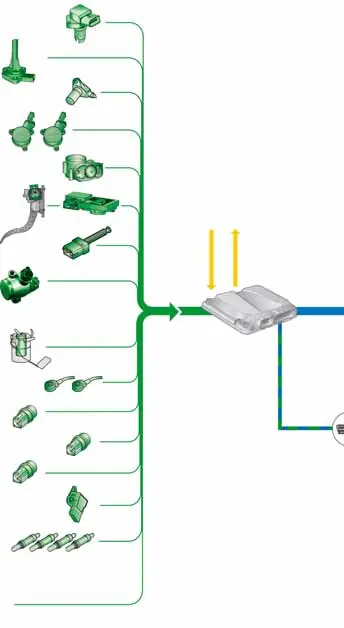
The SIMOS 8.1 engine management system controls the engines. It features a de-restricted operating concept in part-throttle mode and uses p/n control (pressure/intake camshaft position) to manage engine load.
Manufacturer information
Audi AG
Practical help
Common problems
Engine speed limited to 4000 rpm
Occurs if not all cylinders can switch to large stroke; check fault memory.
Rough idling
Occurs if not all cylinders can switch to small stroke; the engine defaults to large stroke.
Before use
- Check oil level via MMI or dash panel (no physical dipstick).
- Use 95 RON fuel or higher.
- Ensure engine is at operating temperature for accurate oil level measurement.
Specs in practice
- Engine code BDX
- 2.8L FSI engine.
- Engine code CALA
- 3.2L FSI engine.
- Compression ratio 12:1
- High compression ratio for FSI engines.
Images and diagrams
- Oil circulation diagram: Shows the flow-regulated oil pump and dual-stage pressure control.
- Coolant circuit: Shows the path of coolant through the engine, radiator, and heat exchanger.
Model compatibility
- 3.2L engine with Audi valvelift system is used in the A5.
- 2.8L engine is used in the A6.

Manual page author
David Miller
Documentation analyst
Organizes user manual content into clear summaries, with attention to model details, product context, and everyday usability.