Electronics / Speakers & Soundbars
boAt Aavante Bar 1150D Soundbar User Manual
Quick guide for the boAt Aavante Bar 1150D soundbar. Includes setup, wall mounting, connection instructions (Bluetooth, USB, AUX, Optical, HDMI ARC), and troubleshooting.
Quick answers from the manual
Quick answer
- This manual provides instructions for setting up, connecting, operating, and troubleshooting the boAt Aavante Bar 1150D soundbar. p. 1, 9
Key actions
- Wall mounting the soundbar p. 8
- Connecting via Bluetooth p. 9
- Connecting via HDMI (ARC) p. 11
- Connecting via Optical cable p. 11
First start
- Unpacking and initial setup p. 5
- Powering on the device p. 9
Show 4 more answers Show less
Problems and fixes
No sound output
Check input source, mute function, volume levels, power cable, or connections.
p. 12
Remote control not working
Replace batteries, use within operating range, or ensure sensor is not obstructed.
p. 13
Noise is heard
Move the sound bar away from other digital or high-frequency devices.
p. 13Maintenance and reset
- Reset to factory defaults p. 6
Technical specifications
| Parameter | Value | Meaning | Pages |
|---|---|---|---|
| Audio Output Power | 80W R.M.S | Total power output | p. 15 |
| Bluetooth Version | 5.0 | Bluetooth connectivity version | p. 15 |
| Power Input | AC 110V-240V 50/60Hz | Required power supply | p. 15 |
| Dimensions | 72H*87.5D*900L mm | Physical size of the unit | p. 15 |
Where to find it in the PDF
- Product Diagram p. 6
- Wall Mounting Instructions p. 8
- Operating Instructions p. 9
- Troubleshooting p. 12, 13, 14
- Technical Specifications p. 15
Table of contents
Manual images
Click an image to enlargeQuick Guide from the Manual
The boAt Aavante Bar 1150D is a 2.0 channel 80W RMS soundbar designed for immersive audio. Before using, ensure the unit is placed on a stable surface or mounted securely on the wall. The device supports multiple input modes including Bluetooth, USB, AUX, Optical, and HDMI (ARC). Always ensure the power supply voltage matches your local outlet.
Components List
- Soundbar
- AUX Cable
- Power Adaptor
- Remote Control
- Wall-Mount Kit
Safety and Warnings
- Do not expose the unit to rain, moisture, or dripping liquids.
- Ensure at least 20 cm of space above and 5 cm on each side for proper ventilation.
- Do not place the unit near heat sources, strong magnetic fields, or on top of other stereo equipment.
- Use only the provided power adaptor.
- Do not attempt to open the casing; there are no user-serviceable parts inside.
Positioning and Wall Mounting
Placement: Place the soundbar horizontally on a solid surface, centered with the TV screen. For best performance, maintain at least 25mm distance between the soundbar and the TV.
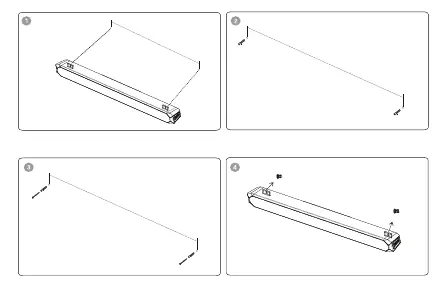
Wall Mounting Steps:
- Mark and drill 2 holes on the wall matching the bracket holes on the soundbar.
- Insert plastic anchors and secure screws, leaving some space.
- Attach the 2 EVA pads to the wall mount bracket to ensure a minimum 15mm gap from the wall.
- Hang the soundbar onto the screws.
Operating Instructions
Powering On/Off
Plug the power cord into a wall outlet. The unit will enter standby mode. Press the STANDBY/POWER button on the soundbar or remote to turn it on.
Input Modes
Press the INPUT button on the remote or the power button on the soundbar to cycle through modes:
- Bluetooth (bt): Activate pairing on your device and select 'AAVANTE BAR 1150D'.
- USB (USB): Insert a USB flash drive containing MP3 files. The unit will switch automatically.
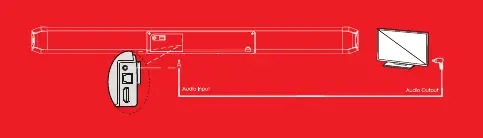
- AUX (AUX): Connect via AUX cable to your audio device.
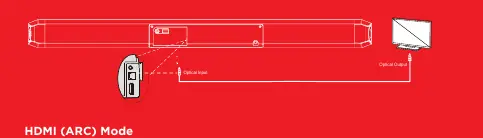
- Optical (OPT): Connect via optical cable. Set TV audio output to 'Dolby' or 'Auto'.
- HDMI (ARC) (Hd): Connect via high-speed HDMI cable. Ensure TV is ARC compliant and set to 'External Dolby' or 'Auto'.
Troubleshooting
If you encounter issues, check the following:
- No Sound: Verify input source, ensure mute is off, check volume levels, and confirm cable connections.
- Distorted Sound: If playing from TV, ensure the TV is muted.
- Bluetooth Issues: Ensure the device is within range, not connected to another device, and that Bluetooth is selected as the input.
- Remote Not Working: Check batteries and ensure the sensor is not obstructed or exposed to direct sunlight.
Technical Specifications
- Power Output: 80W RMS
- Connectivity: BT 5.0, AUX, HDMI (ARC), Optical, USB
- Frequency Response: 55Hz-20KHz
- Power Input: AC 110V-240V 50/60Hz
Manufacturer information
boAt Lifestyle
Practical help
Common problems
No sound output
Check if the correct input source is selected, ensure mute is off, increase volume, and verify all cable connections.
Sound is distorted or echoed
If playing audio from a TV, ensure the TV speakers are muted.
Cannot connect via Bluetooth
Ensure Bluetooth is selected as the input, the device is within 10m range, and the soundbar is not already paired with another device.
Remote control not working
Replace batteries, ensure the sensor is not blocked, and avoid direct sunlight on the sensor.
Before use
- Unpack and remove all packing materials.
- Place on a level, stable surface or mount securely on the wall.
- Ensure at least 20cm space above and 5cm on sides for ventilation.
- Check that local voltage matches the device requirements.
- Connect necessary cables (HDMI, Optical, AUX) before powering on.
Show more Show less
Specs in practice
- Power Output
- 80W RMS total output for cinematic sound.
- Bluetooth Version
- Version 5.0 for stable wireless connectivity up to 10m.
- Frequency Response
- 55Hz-20KHz range for balanced audio performance.
Images and diagrams
- The product diagram identifies the display, USB port, AUX, Optical, and HDMI (ARC) ports.
- Remote control buttons include Power, Input, Volume, EQ modes (Music, Movie, News, 3D), and Playback controls.
Model compatibility
- Compatible with LED/LCD/Plasma TVs.
- Not recommended for use with CRT TVs to avoid image interference.
- USB mode supports MP3 files only.
- HDMI (ARC) requires an ARC-compliant TV.

Manual page author
David Miller
Documentation analyst