Tools / Saws
User Manual for Bosch GCM 18V-216 D Cordless Sliding Mitre Saw
Quick guide and user manual for the Bosch GCM 18V-216 D Professional Cordless Sliding Mitre Saw. Includes setup, operation, maintenance, and safety instructions.
Table of contents
Manual images
Jump to the sectionQuick guide from the manual
This manual provides essential information for the safe and efficient operation of the Bosch GCM 18V-216 D Professional Cordless Sliding Mitre Saw. Always read the full safety instructions before use.
Safety Instructions
- Personal Protection: Always wear eye protection, hearing protection, and a dust mask.
- Work Area: Keep the work area clean and well-lit. Do not operate in explosive atmospheres.
- Operation: Keep hands at least 100mm away from the saw blade. Never cross your hands over the cutting line.
- Workpiece: Ensure the workpiece is stationary and clamped or held against both the fence and the table.
Assembly
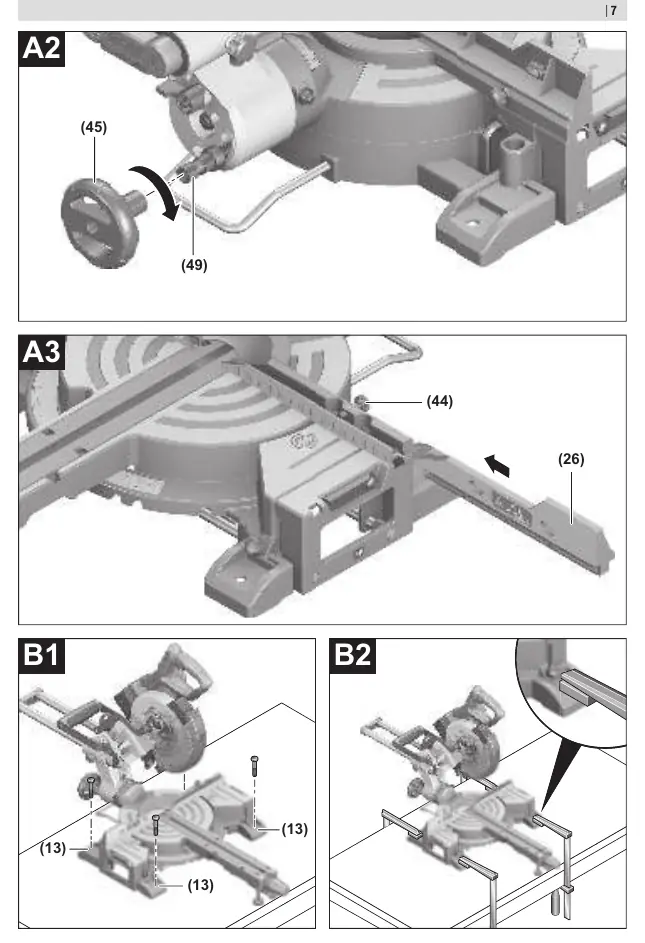
Installing Workpiece Supports
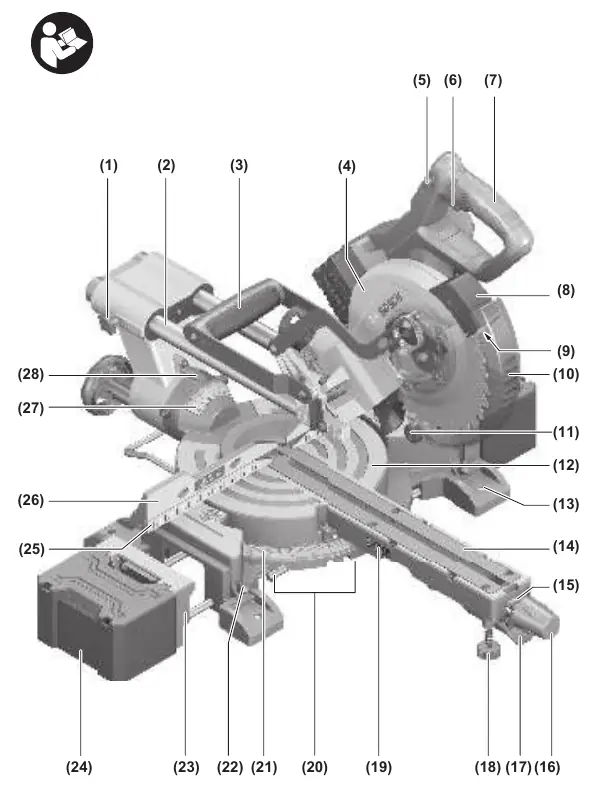
The workpiece supports (24) can be positioned left, right, or in front of the power tool. Insert them into the openings (47) on the power tool or into the openings (48) of the second workpiece support as required.
Fitting the Clamping Wheel
The clamping wheel (45) fixes the selected bevel angle and is required for safe operation. Screw it clockwise onto the threaded bolts (49) and tighten.
Operation
Adjusting Mitre Angles
For standard mitre angles, use the detents (20) on the saw table. For arbitrary angles, loosen the locking knob (16), pull the lever (17), and rotate the saw table (12) to the desired angle.
Adjusting Bevel Angles
The bevel angle can be set between 47° (left) and 47° (right). Release the clamping wheel (45), pull the locking lever (46) out, and set the desired angle using the handle (7).
Sawing
Ensure the transport safety lock (34) is released. For cuts with the slide device (2), loosen the locking screw (1). Press the workpiece firmly against the fences (25) and (26) and clamp it securely. Switch on the tool, guide the tool arm slowly downwards, and saw through the workpiece with uniform feed.
Maintenance
Keep the power tool and ventilation slots clean. The retracting blade guard must always be able to move freely and close automatically. Regularly clean the guide roller (11).
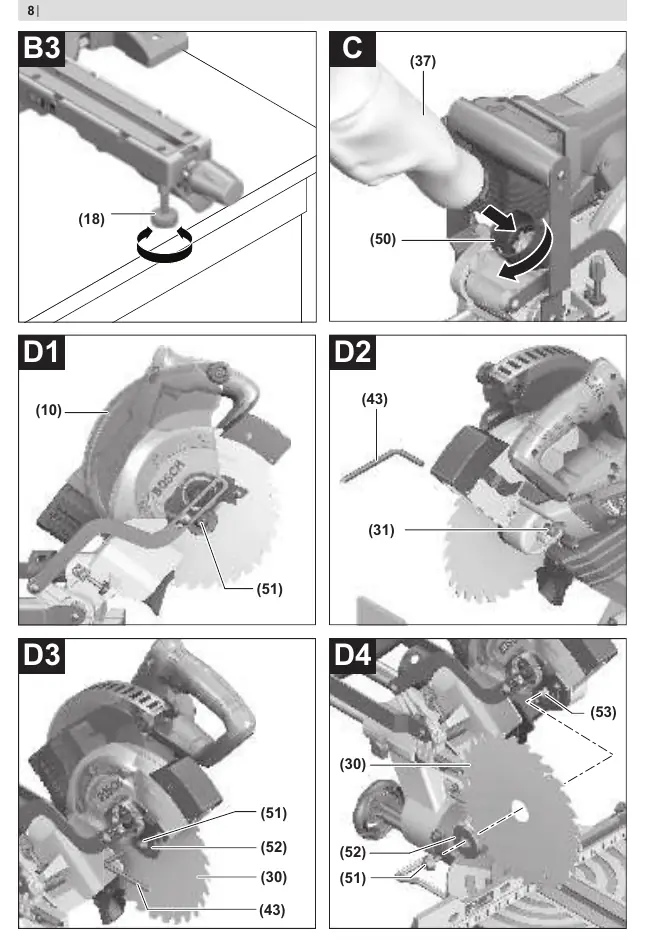
Transport
Before transport, remove the battery. Secure the tool arm in the transport position using the transport safety lock (34). Carry the tool by the transport handle (3) or the recessed handles (61).
Manufacturer information
Bosch
Practical help
Common problems
Saw blade jams during operation.
Turn off the mitre saw immediately. Wait for all moving parts to stop, remove the battery, and then free the jammed material.
Laser line is misaligned.
Check and adjust the laser beams as described in the 'Adjusting the laser' section of the manual.
Dust bag not collecting dust effectively.
Empty the dust bag (37) regularly. Check for blockages in the extraction adapter (50).
Before use
- Check battery charge level.
- Ensure the saw is mounted on a stable, level surface.
- Check the saw blade for damage or dullness.
- Ensure all protective devices are functioning correctly.
- Check the workpiece for nails or foreign objects.
Specs in practice
- No-load speed
- 5000 min-1
- Saw blade diameter
- 216 mm
- Max. cutting depth (0°/0°)
- 66 mm
Images and diagrams
- (1)-(28) Main components of the saw
- (41) Screw clamp
- (45) Clamping wheel for bevel angle
Model compatibility
- Compatible with Bosch 18V batteries (GBA 18V, ProCORE18V).
- Compatible with Bosch GTA saw stands.

Manual page author
David Miller
Documentation analyst
Organizes user manual content into clear summaries, with attention to model details, product context, and everyday usability.