General / Accessories
Clarke Rebel 65 110V Air Compressor Operation and Maintenance Instructions
Comprehensive operation and maintenance guide for the Clarke Rebel 65 110V air compressor, covering safety, assembly, usage, and troubleshooting.
Table of contents
Product Overview
The Clarke Rebel 65 is a 110V air compressor designed for various pneumatic applications. It features a 50L receiver capacity and is built for reliable service when operated according to these instructions. The unit is equipped with a thermal overload device to protect the motor from overheating.
Safety Precautions
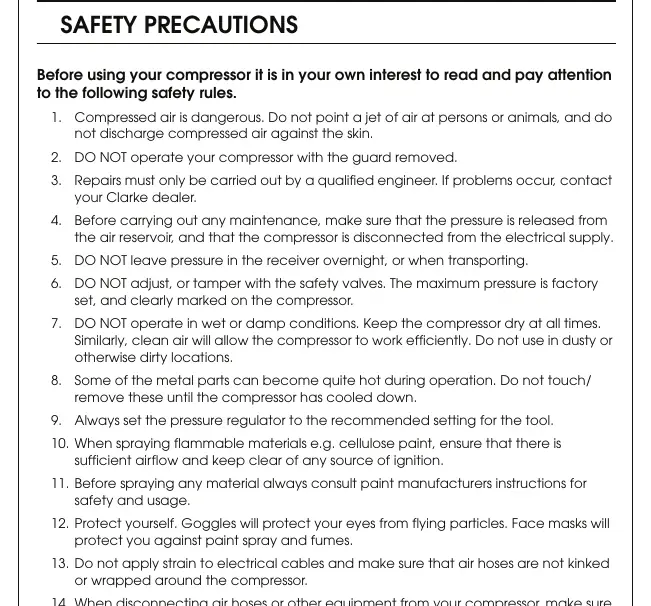
Compressed air is dangerous; never point the air jet at people or animals. Always wear eye and ear protection, as the unit produces noise levels exceeding 70dB(A). Ensure the compressor is used in a dry, clean environment and never operate it with the guard removed. Always release pressure from the reservoir before performing maintenance or transporting the unit.
Assembly
The compressor requires basic assembly before use. Attach the wheels to the frame using the provided axle, washers, and nuts. Secure the support feet to the base and install the handle using the bolts provided. Always seek assistance when lifting the compressor to prevent injury.
Operation
Before starting, ensure the compressor is on level ground and the supply voltage matches the data label. Check the oil level using the dipstick; it must be between the min and max marks. Use only SAE30 compressor oil. To start, plug in the unit and lift the On/Off button. The compressor will automatically shut down when the reservoir is fully pressurized and restart as pressure drops.
Maintenance
Daily maintenance includes draining condensate from the reservoir via the drain valve and checking the oil level. Monthly, examine and clean the air filter element with a soft brush or warm soapy water if necessary. Replace the oil after the first 100 hours of use, and subsequently every 500 hours or every 6 months. Every 6 months, inspect the non-return valve for leaks.
Troubleshooting
If the compressor fails to start, check electrical connections or the thermal overload switch. If the unit is noisy or fails to reach pressure, it may indicate a mechanical fault or a blown gasket, requiring professional service. For technical support, contact Clarke at 020 8988 7400 or email [email protected].
Manufacturer information
Clarke International
Practical help
Common problems
Compressor stopped and will not start
Check electrical connections or reset the thermal overload switch after 5 minutes of cooling.
Air leaking from non-return valve when off
Drain the reservoir, remove the valve end plug, and clean the valve seat and gasket.
Compressor does not reach set pressure
Check for a blown head gasket or broken valve; return to a service agent if necessary.
Air pressure from regulator will not adjust
The internal diaphragm is likely broken; replace the regulator.
Before use
- Ensure the compressor is on level ground.
- Push down the OFF button before connecting to power.
- Verify supply voltage matches the data label.
- Check that the oil level is between min and max marks on the dipstick.
- Drain any accumulated condensate from the reservoir.
Specs in practice
- Max Pressure
- 10 Bar; the maximum pressure the tank is designed to hold.
- Air Displacement
- 250 l/min; the volume of air the compressor can deliver.
- Receiver Capacity
- 50 L; the volume of the air storage tank.
Images and diagrams
- The exploded diagram identifies all internal components including the motor, piston, and valve assembly for repair reference.
- The parts list provides specific part numbers for ordering replacements.
Model compatibility
- Only use SAE30 compressor oil.
- Ensure all connected air tools have a safe working pressure exceeding the compressor's output.
- If using a 110V transformer, ensure it has sufficient rated capacity for the compressor load.

Manual page author
David Miller
Documentation analyst
Organizes user manual content into clear summaries, with attention to model details, product context, and everyday usability.