Hvac / Air Conditioners
Danfoss Pilot Valve CVQ Installation Guide
Installation guide for the Danfoss CVQ pilot valve. Includes technical specifications, mounting instructions, torque requirements, and orientation limits for proper system integration.
Table of contents
Manual images
Jump to the sectionImportant Information
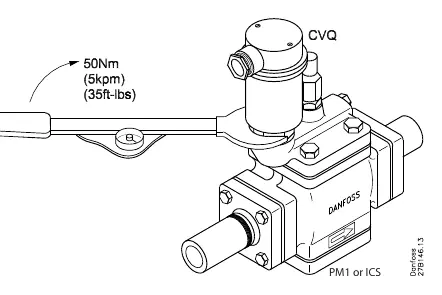
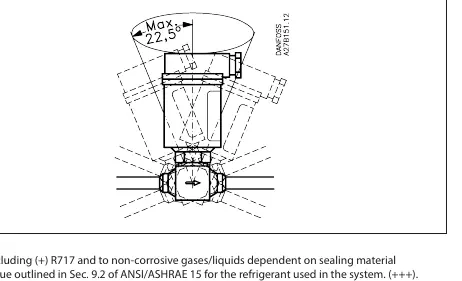
The Danfoss CVQ pilot valve is designed for specific HVAC applications. When installing, ensure the valve is oriented correctly, as the maximum allowable tilt is 22.5°. Proper installation requires a tightening torque of 50 Nm (35 ft-lbs) to ensure a secure seal. Always verify that the system refrigerant is compatible with the valve's sealing materials before installation.
Technical Specifications
- Operating Temperature: -30°C to 50°C (-22°F to 120°F)
- Maximum Working Pressure (PS/MWP): 17 bar (250 psig)
- Ingress Protection: IP55
- Connection Type: Pg 13.5
Installation and Mounting
Follow these steps to correctly install the CVQ pilot valve:
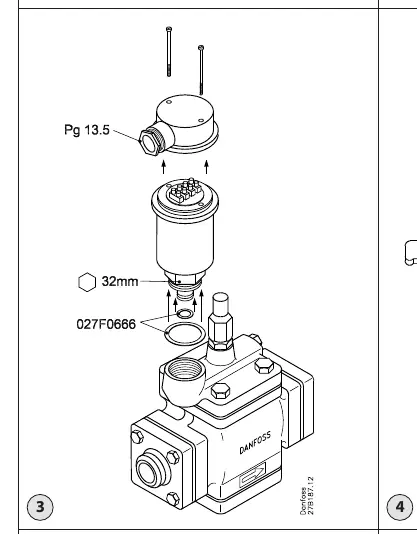
- Preparation: Ensure you have a 32mm wrench for the installation process.
- Mounting: Position the valve onto the PM1 or ICS valve body.
- Tightening: Secure the valve using a torque wrench set to 50 Nm (35 ft-lbs).
- Orientation: Ensure the valve is installed within the maximum 22.5° tilt limit to maintain proper functionality.
- Connection: Connect the CVQ to the CVH as required by your specific system configuration.
System Compatibility
This text is applicable to UL listed CVQ products. The valve is compatible with all common non-flammable refrigerants, including or excluding R717, and non-corrosive gases or liquids, depending on the sealing material compatibility. The design pressure of the system must not be less than the value outlined in Section 9.2 of ANSI/ASHRAE 15 for the refrigerant used.
Manufacturer information
Danfoss A/S
Practical help
Common problems
Valve orientation exceeds 22.5°
Adjust the valve position to ensure it is within the maximum 22.5° tilt limit to prevent operational issues.
Insufficient tightening torque
Use a torque wrench to tighten the valve to exactly 50 Nm (35 ft-lbs) to ensure a proper seal.
Before use
- Verify that the system refrigerant is compatible with the valve sealing materials.
- Check that the system design pressure meets the requirements of ANSI/ASHRAE 15.
- Ensure a 32mm wrench is available for installation.
- Confirm the valve is being installed on a compatible PM1 or ICS system.
Specs in practice
- PS/MWP 17 bar (250 psig)
- The maximum working pressure the valve can safely withstand.
- 50 Nm (35 ft-lbs)
- The required torque for proper installation of the valve.
Images and diagrams
- The system diagram illustrates the connection of the CVQ pilot valve to a PM1 or ICS main valve.
- The orientation diagram shows the maximum allowable tilt angle of 22.5° for the valve assembly.
Model compatibility
- Applicable to all common non-flammable refrigerants.
- Compatible with non-corrosive gases and liquids depending on sealing material.
- Design pressure must comply with ANSI/ASHRAE 15, Section 9.2.

Manual page author
Michael Turner
Technical manual editor
Reviews PDF manuals for structure, safety notes, and practical product details so readers can find the right information quickly.