Computers / Laptops
Re-imaging Guide for Dell Latitude 5340 and Latitude 5340 2-in-1
A comprehensive re-imaging and driver installation guide for the Dell Latitude 5340 and 5340 2-in-1. This guide provides the recommended sequence for installing BIOS, operating system, chipset, network, and security drivers to ensure...
Quick answers from the manual
Quick answer
- The re-imaging process requires installing software in a specific sequence: BIOS, Windows OS, Chipset drivers, Network drivers, Windows updates, IRST, Graphics, Audio, Security drivers, and finally Dell applications. p. 6
Key actions
- Follow the recommended reinstallation sequence starting with BIOS, then OS, then drivers. p. 6
- Update BIOS and Docking Station drivers before using the Dell Thunderbolt Dock WD22TB4. p. 14
First start
- Ensure BIOS settings are appropriately set and the latest drivers are used when re-imaging. p. 5
Problems and fixes
Computer fails to boot after BIOS update
Perform a BIOS reset by clearing the CMOS settings.
p. 7Maintenance and reset
- Clear CMOS settings to reset BIOS to factory defaults. p. 7
Where to find it in the PDF
- Installation overview p. 4
- Order of reinstallation p. 6
- Updating or resetting the BIOS p. 7
Table of contents
Quick guide from the manual
This guide is intended for system administrators performing a re-image of the Dell Latitude 5340 or 5340 2-in-1. It outlines the critical sequence for installing drivers and applications to ensure the system functions correctly. Always back up your data before beginning the re-imaging process.
Installation overview
Re-imaging involves removing all software and reinstalling it, which is necessary if the system software is corrupted or damaged. This guide is applicable only to computers shipped with Windows 10 or Windows 11. Dell strongly recommends downloading all drivers directly from the Dell Drivers & Downloads website to avoid performance issues or system instability.
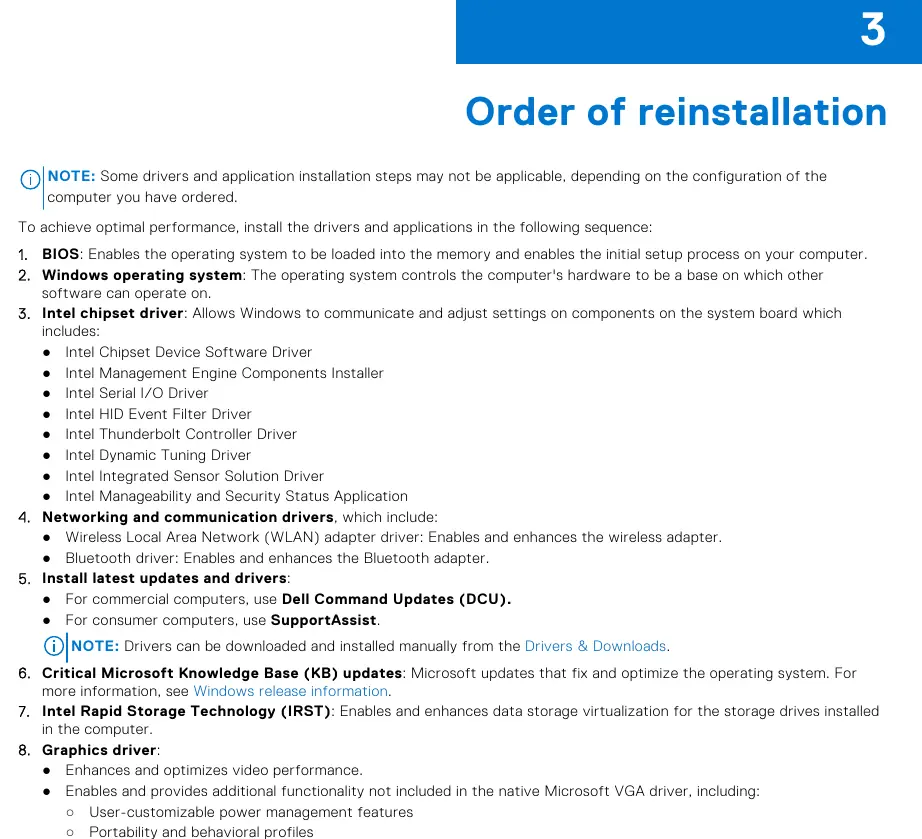
Recommended reinstallation sequence
To achieve optimal performance, install drivers and applications in the following order:
- BIOS: Enables the operating system to load and initializes setup.
- Windows operating system: The base for all other software.
- Intel chipset driver: Includes device software, management engine, serial I/O, HID event filter, Thunderbolt controller, dynamic tuning, integrated sensor solution, and manageability/security status.
- Networking and communication drivers: WLAN and Bluetooth drivers.
- Latest updates and drivers: Use Dell Command Updates (commercial) or SupportAssist (consumer).
- Critical Microsoft Knowledge Base (KB) updates: Fixes and optimizations for the OS.
- Intel Rapid Storage Technology (IRST): Enables data storage virtualization.
- Graphics driver: Enhances video performance and multi-monitor support.
- Audio driver: Enhances the audio controller.
- Security drivers: Goodix Fingerprint Sensor and Dell ControlVault3 driver/firmware.
- Dell applications: Dell Command, Digital Delivery, Optimizer, Update, and SupportAssist.
Updating and resetting the BIOS
If you need to update the BIOS, visit the Dell support website, enter your Service Tag, and select the BIOS category under Drivers & downloads. If a BIOS update causes the computer to fail to boot, a CMOS reset is necessary. To enable TPM security, enter the BIOS setup (F2 during startup), navigate to Security, and configure the TPM state and 2.0 security settings.
Reinstalling drivers and applications
Drivers for specific hardware (video, sound, etc.) must be downloaded from the Dell support site. To find the correct drivers, visit the Dell support website, enter your Service Tag, and select the appropriate category (Chipset, Storage, Video, Audio, Security, Network) under Drivers & downloads.
Dell Thunderbolt Dock WD22TB4
If using the WD22TB4 docking station, you must update your computer's BIOS and the Dell Docking Station drivers to the latest versions before connecting the dock. Failure to do so may result in the dock not being recognized or functioning optimally.
Manufacturer information
Dell Inc.
Practical help
Common problems
Computer fails to boot after BIOS update
Perform a BIOS reset by clearing the CMOS settings.
Docking station not recognized or functioning poorly
Ensure the computer's BIOS and the Dell Docking Station drivers are updated to the latest versions available on the Dell support site.
System performance issues or blue screen errors
Ensure all device drivers are downloaded from the official Dell Drivers & Downloads website, not third-party sources.
Before use
- Backup all important data before starting the re-imaging process.
- Ensure you have administrator rights on the computer.
- Verify the computer is running Windows 10 or Windows 11.
- Locate your Service Tag or Express Service Code for support access.
- Remove any enrolled user information (e.g., fingerprints) stored in Windows Settings.
Model compatibility
- This guide is only applicable to computers shipped with Windows 10 or Windows 11.
- Dell Thunderbolt Dock WD22TB4 requires updated BIOS and docking station drivers.

Manual page author
Emily Carter
User documentation editor
Prepares concise manual descriptions and highlights the most useful setup, operation, and maintenance information for readers.