Tools / Air Compressors Pneumatics
User Manual for Einhell TE-AC 270/50/10 Air Compressor
Quick guide for the Einhell TE-AC 270/50/10 air compressor. Includes assembly instructions, operation, maintenance, and troubleshooting.
Table of contents
Manual images
Click an image to enlargeQuick guide from the manual
This manual provides essential information for the safe and correct operation of the Einhell TE-AC 270/50/10 air compressor. Before first use, ensure the unit is fully assembled. Always check the oil level and ensure the compressor is placed on a stable, level surface in a well-ventilated area.
Device Description
The compressor features a 50-liter pressure tank, an intake air filter, a pressure regulator, and two quick-lock couplings (one regulated, one unregulated). It is equipped with an overload switch to protect the motor from overheating.
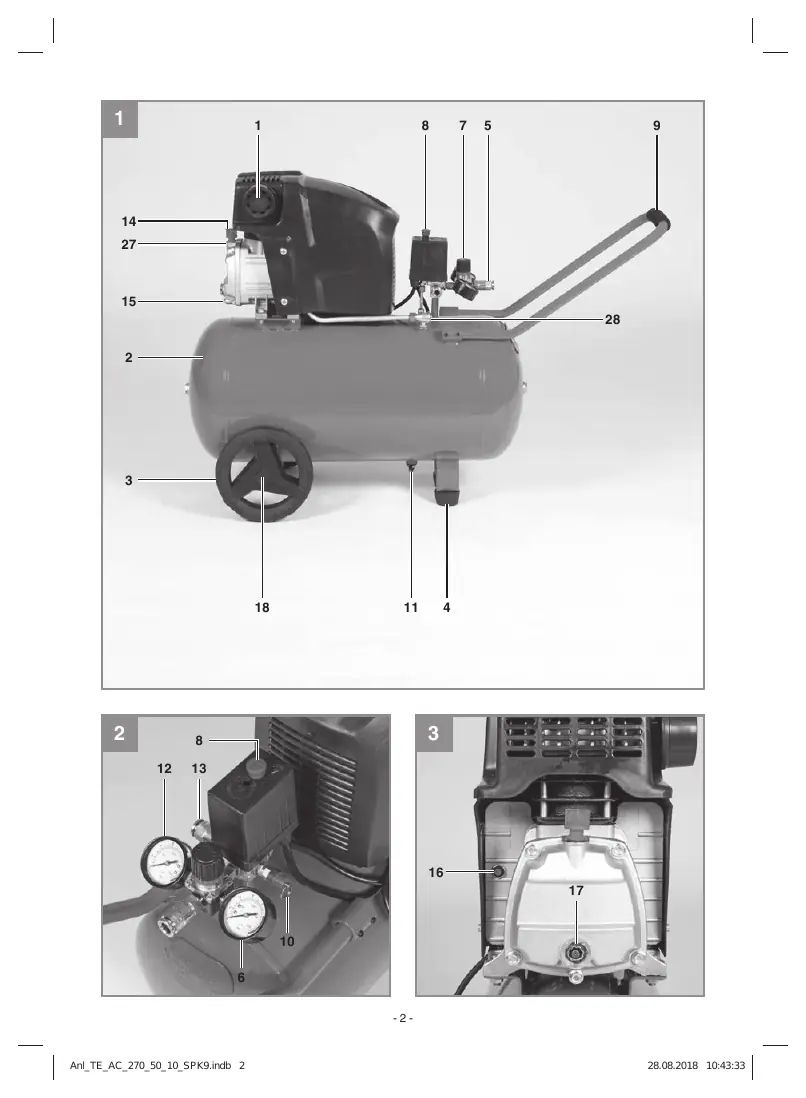
Assembly and Installation
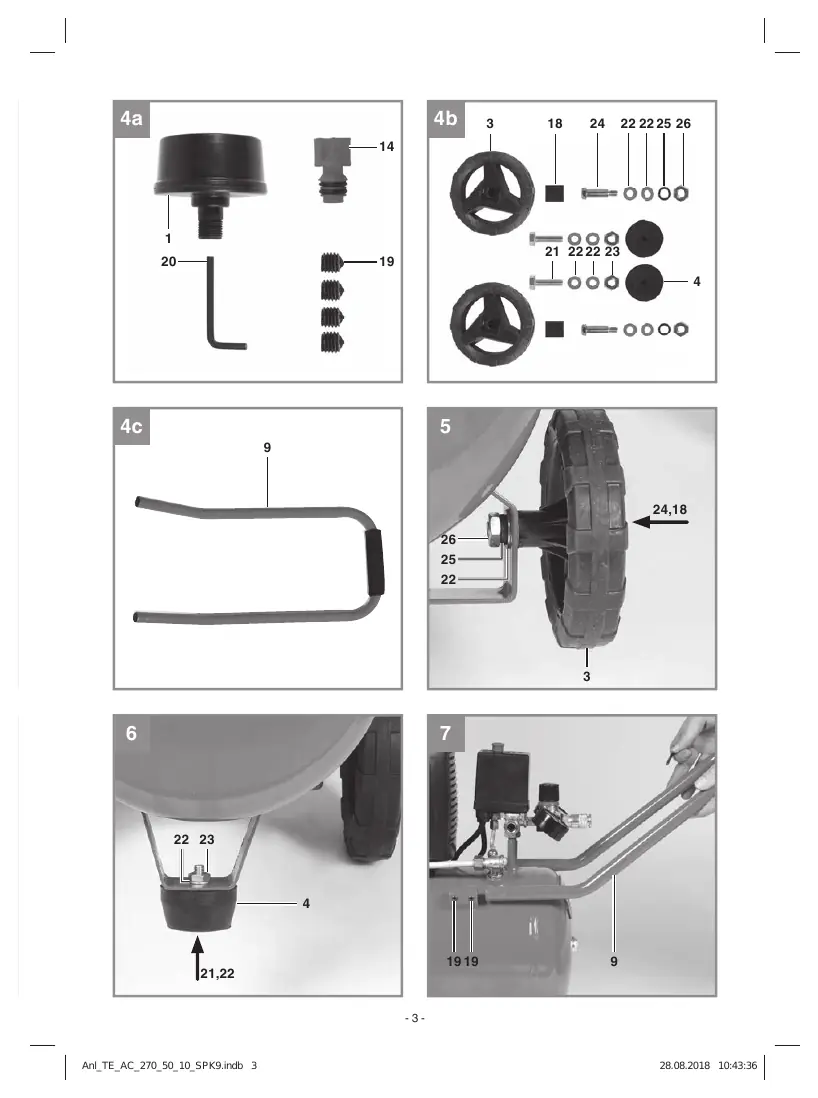
- Wheels: Attach the wheels to the tank as shown in the assembly diagrams.
- Supporting Feet: Install the supporting feet to ensure stability.
- Transport Handle: Secure the transport handle to the compressor frame.
- Air Filter: Remove the transport cover and screw in the supplied air filter.
- Oil Sealing Plug: Replace the transport cover on the oil filler opening with the supplied oil sealing plug.
Operation
To switch on the compressor, pull out the On/Off switch. To switch it off, press the switch back in. The pressure can be adjusted using the pressure regulator and monitored via the pressure gauge. The pressure switch is factory-set to switch on at approximately 8 bar and off at 10 bar.
Maintenance and Cleaning
- Condensation Water: Drain the condensation water from the pressure vessel after every use by opening the drainage screw.
- Oil Level: Regularly check the oil level using the oil level window. It must be between the MAX and MIN marks.
- Oil Change: The first oil change should be performed after 100 operating hours, and subsequently every 500 operating hours. Use SAE 5W/40 or equivalent oil.
- Air Filter: Clean the intake air filter at least every 300 operating hours to maintain performance.
Safety
Always disconnect the power plug before performing any cleaning or maintenance. Ensure the tank is depressurized before maintenance. Do not operate the compressor in damp or wet rooms, or in areas with explosive gases or dust.
Manufacturer information
Einhell
Practical help
Common problems
Compressor does not start
Check power supply, plug, and fuse. Ensure the extension cable is not too long or too thin. Ensure ambient temperature is above +5°C. If the motor is overheated, let it cool down and press the overload switch.
Compressor runs but no pressure
Check if the non-return valve is leaking. Check seals for damage. Ensure the condensation drainage screw is tightened.
Compressor runs, pressure is shown, but tools do not start
Check hose connections for leaks. Check the quick-lock coupling. Increase the pressure setting on the pressure regulator.
Before use
- Check for transport damage.
- Check oil level (must be between MAX and MIN).
- Ensure the compressor is on a stable, level surface.
- Ensure the air filter is installed.
- Ensure the area is well-ventilated and dry.
- Check that the condensation drainage screw is closed.
Specs in practice
- Motor rating
- 1800 W
- Pressure vessel capacity
- 50 liters
- Max operating pressure
- 10 bar
- Theoretical suction rate
- 270 l/min
Images and diagrams
- Fig 1: Overview of compressor components (1-28).
- Fig 5: Wheel assembly procedure.
- Fig 6: Supporting feet assembly procedure.
- Fig 7-8: Transport handle assembly.
- Fig 12: Oil level window showing MAX/MIN levels.
Model compatibility
- Suitable for use in dry rooms only.
- Not designed for commercial, trade, or industrial applications.
- Requires ambient temperature between +5°C and +40°C.

Manual page author
David Miller
Documentation analyst
Organizes user manual content into clear summaries, with attention to model details, product context, and everyday usability.