Music / Instruments
User Manual for Fender 1225HP Professional Loudspeaker
Quick guide for the Fender 1225HP Professional Loudspeaker. Learn about wiring configurations, bi-amp operation, horn dispersion adjustments, and maintenance.
Table of contents
Manual images
Click an image to enlargeQuick guide from the manual
The Fender 1225HP is a professional, two-way loudspeaker system designed for demanding sound reinforcement. Before use, ensure you understand the wiring requirements and the crossover settings. If you are using an external crossover, the switch on the back of the speaker must be set to the Bi-Amp position to avoid damaging the compression driver. Always check your speaker wire gauge against the length of the cable run to ensure optimal power transfer.
Speaker wiring and connections
Multiple speakers can be connected in parallel or series. Fender recommends parallel connections because if one speaker fails, the others continue to operate, and it avoids unpredictable frequency response issues.
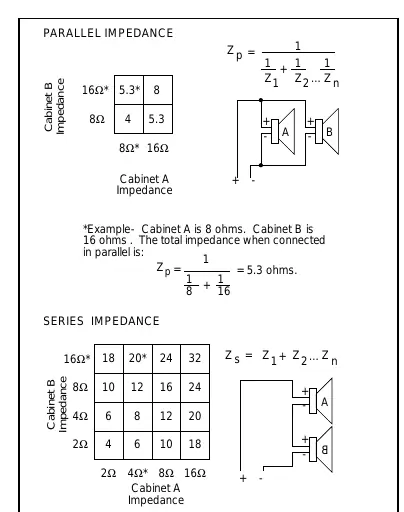
- Parallel Connection: Combined impedance decreases. Most cabinets are pre-wired for this.
- Series Connection: Combined impedance increases.
- Cable Gauge: Use appropriate wire gauges based on length. For 25-50 feet (7.6-15.25 meters) with 8-ohm impedance, use at least 16 AWG wire.
Horn inserts
The 1225HP features a Controlled Dispersion horn. You can change the horizontal coverage pattern from 90 degrees to 60 degrees by installing the included horn inserts.
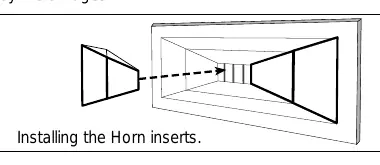
- Remove the Phillips head screws from the grille and lift the grille away.
- Place the wider end of the insert under the front lip of the horn.
- Guide the smaller end under the ribs near the throat of the horn until secured by the 3 ridges.
- Reinstall the grille.
Bi-amp operation
For increased headroom, you may use an active electronic crossover (such as the Fender PCN-2 or PCN-4). When using this mode, the internal crossover is disabled.
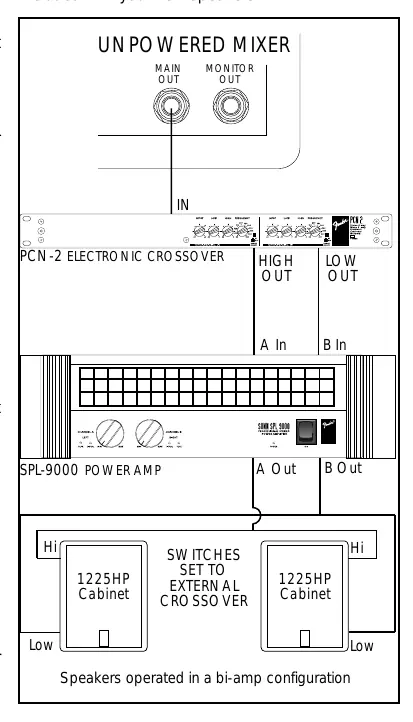
- Set the switch on the back of the speaker to the Bi-Amp position.
- Important: If the switch is set to external, do not plug a full-range signal into the High Frequency input, as this will destroy the compression driver.
- The crossover frequency for the 1225HP should be set to approximately 2200 Hz.
Setup suggestions
Placement significantly affects sound quality. Placing speakers near a large, flat wall can increase bass output by approximately 3 dB but may cause feedback. If feedback occurs, move the speaker. When using multiple cabinets, arrange them to minimize overlapping radiating patterns.
Carpet covering care
The cabinet is covered in a tough, black indoor/outdoor synthetic carpet. To clean, use a sponge and a light soapy water solution to wipe away smudges or dirt. For stubborn stains, use a slightly more concentrated soapy solution or carpet shampoo with a brush. Avoid spilling liquids on the input panel, grille, and speakers.
Specifications
- Power Rating: 400W program, 200W EIA
- Nominal Impedance: 8 ohms
- Frequency Response: 60 Hz to 15 kHz (+/- 3 dB)
- Crossover Frequency: 2200 Hz
- Connections: (2) 1/4 inch Phone Jacks, (2) Speakon Jacks
- Dimensions: 28.6" H x 19.8" W x 19.2" D
- Weight: 84 lbs (38 kg)
Manufacturer information
Fender Musical Instruments Corporation
Practical help
Common problems
Feedback or excessive bass
If the speaker is placed near a large, flat wall, move the speaker to a different location.
Compression driver damage
Ensure the crossover switch is set correctly. If set to external, do not send a full-range signal to the High Frequency input.
Sound system failure
Check speaker cables. Poorly made or maintained cables are the most common source of failure.
Before use
- Verify the crossover switch position (Normal vs. Bi-Amp) matches your setup.
- Ensure speaker wire gauge is sufficient for the cable length.
- Check that the impedance of the speaker array matches the amplifier requirements.
- Confirm the horn dispersion pattern (90 or 60 degrees) is appropriate for your venue.
Specs in practice
- 400W Program
- The power handling capacity of the speaker system.
Images and diagrams
- Parallel/Series wiring diagrams show how to calculate total impedance when connecting multiple speakers.
- Horn insert installation diagram illustrates placing the insert under the horn lip and ribs.
- Bi-amp and Tri-amp diagrams show the signal path from the mixer through the crossover and power amp to the speakers.
Model compatibility
- Compatible with Fender PCN-2 and PCN-4 active electronic crossovers.
- Designed for use with standard power amplifiers; use 4th-order Linkwitz-Riley or digital FIR crossovers for bi-amping.

Manual page author
Emily Carter
User documentation editor
Prepares concise manual descriptions and highlights the most useful setup, operation, and maintenance information for readers.