Electronics / Audio
Owner's Manual for Flamma FC11 Envelope Filter Pedal
Quick guide for the Flamma FC11 Envelope Filter Pedal, covering setup, control adjustments, suggested settings, and technical specifications for optimal performance.
Table of contents
Quick guide from the manual
The Flamma FC11 is a compact envelope filter/dynamic auto-wah pedal designed for both guitar and bass. It features a pure analog circuit. For best results, it is recommended to place the pedal before any overdrive or distortion pedals in your signal chain.
Setup Instruction
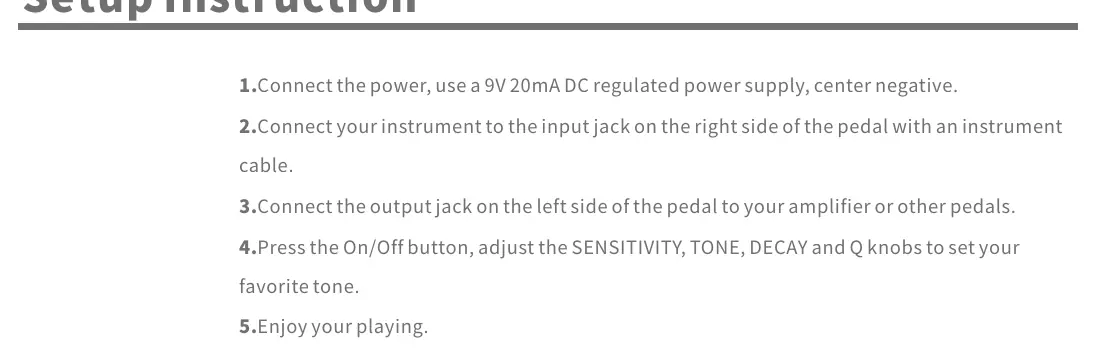
- Connect a 9V DC (center negative) regulated power supply.
- Connect your instrument to the input jack on the right side using an instrument cable.
- Connect the output jack on the left side to your amplifier or other pedals.
- Press the footswitch to engage the effect and adjust the knobs to shape your tone.
Panel Instructions
- True bypass footswitch: Engages or disengages the effect.
- SENSITIVITY: Adjusts the dynamic response to your pick attack. Clockwise increases sensitivity, making it easier to trigger the filter.
- TONE: Adjusts the overall frequency range. Clockwise provides a brighter tone; counter-clockwise is ideal for bass. When set to 0, it acts as a static frequency filter.
- DECAY: Controls the release and closing speed of the filter.
- Q: Adjusts the resonance of the wah effect. Higher settings (clockwise) create a narrower, more pronounced peak.
Suggested Settings
The manual provides starting points for various sounds including Funky, Vocal Sweep, Subtle Vowel, and Money For Nothin Filter. Note that the optimal sensitivity setting depends heavily on your specific instrument and pickups; a recommended starting position is 12 o'clock.
Specifications
- Power: 9V DC center negative, 20mA current draw.
- Input/Output: 1/4 inch mono audio jacks.
- Dimensions: 47mm (D) x 83mm (W) x 52mm (H).
- Weight: 153g.
It is highly recommended to use an isolated power supply to avoid unexpected noise caused by sharing power with other pedals.
Practical help
Common problems
Unexpected noise in the signal
Use an isolated or individual power supply instead of sharing power with other pedals.
Filter does not open or respond correctly
Adjust the SENSITIVITY knob. If it is too low, the pedal may not respond to your pick attack; if too high, it may be overly sensitive.
Before use
- Ensure you have a 9V DC center-negative power supply.
- Verify that the pedal is placed before overdrive/distortion pedals in your chain.
- Check that your instrument cable is connected to the input jack on the right side.
- Ensure the amplifier is connected to the output jack on the left side.
Specs in practice
- Center negative
- The polarity of the power plug; the inner pin must be negative.
Images and diagrams
- The layout shows the footswitch (01), LED indicator (02), power input (03), input jack (04), output jack (05), and control knobs (06-09).
Model compatibility
- Suitable for both guitar and bass.
- Recommended to be placed before overdrive and distortion pedals.

Manual page author
Michael Turner
Technical manual editor
Reviews PDF manuals for structure, safety notes, and practical product details so readers can find the right information quickly.