Tools / Anchoring Systems
Hilti HIT-RE 100-HC Injection System User Guide
Comprehensive installation and technical guide for the Hilti HIT-RE 100-HC injection system. Includes drilling, cleaning, injection procedures, and technical specifications for rebar connections.
Table of contents
Manual images
Click an image to enlargeQuick Guide
The Hilti HIT-RE 100-HC is an injection system designed for post-installed rebar connections in normal weight concrete. This document serves as the technical assessment and installation guide. Key requirements include proper hole drilling, thorough cleaning of the borehole, and correct injection techniques to ensure structural integrity. Always verify the rebar is dry and free of oil before installation.
Product Description
The system consists of the Hilti HIT-RE 100-HC epoxy resin mortar, a static mixer (HIT-RE-M), and steel reinforcing bars (rebars) with diameters ranging from 8 mm to 40 mm. It is intended for anchoring or overlap connection joints in existing concrete structures.
Installation Instructions
Safety Regulations: Always review the Material Safety Data Sheet (MSDS) before use. Wear well-fitting protective goggles and protective gloves when working with the system.
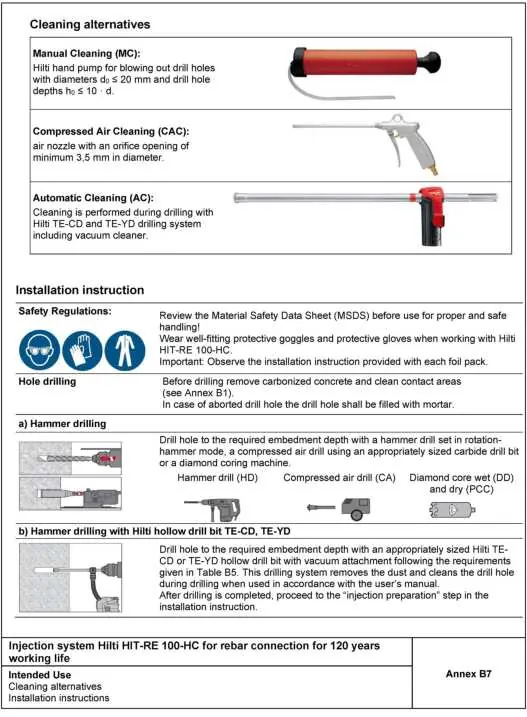
Hole Drilling: Before drilling, remove carbonated concrete and clean contact areas. Use a hammer drill, compressed air drill, or diamond coring machine to reach the required embedment depth. Ensure the drill hole is parallel to existing rebar using drilling aids like Hilti HIT-BH, a lath, or a spirit level.
Cleaning Procedures
Proper cleaning is critical for load values. The borehole must be free of dust and debris.
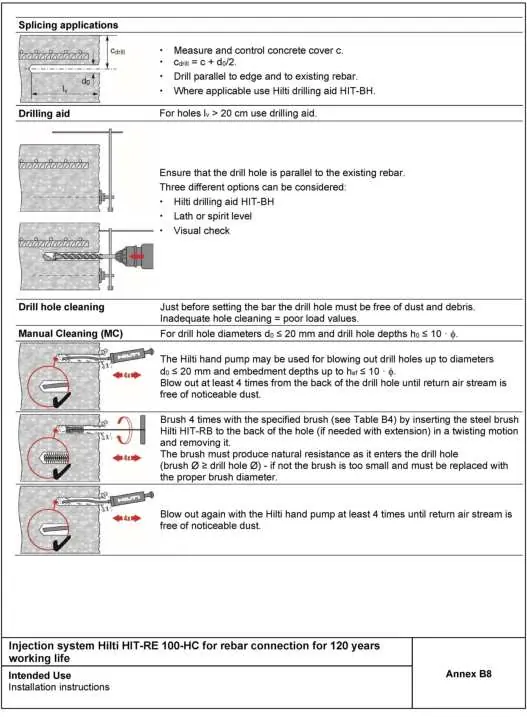
- Manual Cleaning (MC): For hole diameters ≤ 20 mm and depths ≤ 10·d. Use the Hilti hand pump to blow out the hole at least 4 times, brush 4 times with the specified Hilti HIT-RB steel brush, and blow out again 4 times.
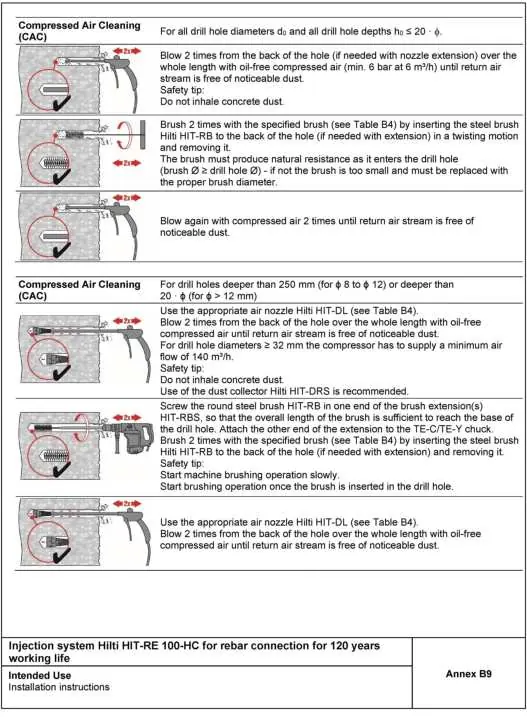
- Compressed Air Cleaning (CAC): For all diameters. Use oil-free compressed air (min. 6 bar). Blow out, brush, and blow out again. For deeper holes, use the appropriate air nozzle (Hilti HIT-DL).
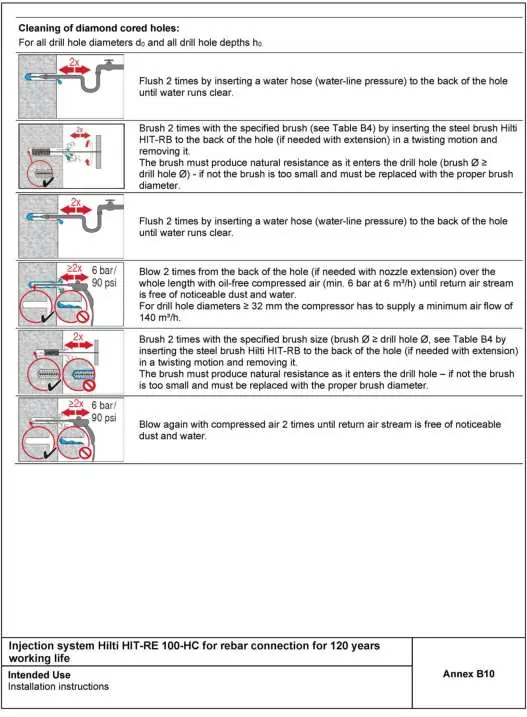
- Diamond Cored Holes: Flush 2 times with water, brush 2 times, flush 2 times, then dry with compressed air and brush/blow out as per standard procedures.
Injection & Setting
Injection Preparation: Tightly attach the Hilti mixing nozzle HIT-RE-M to the hard cartridge. Squeeze out the first 3 full strokes of mortar before injecting into the hole.
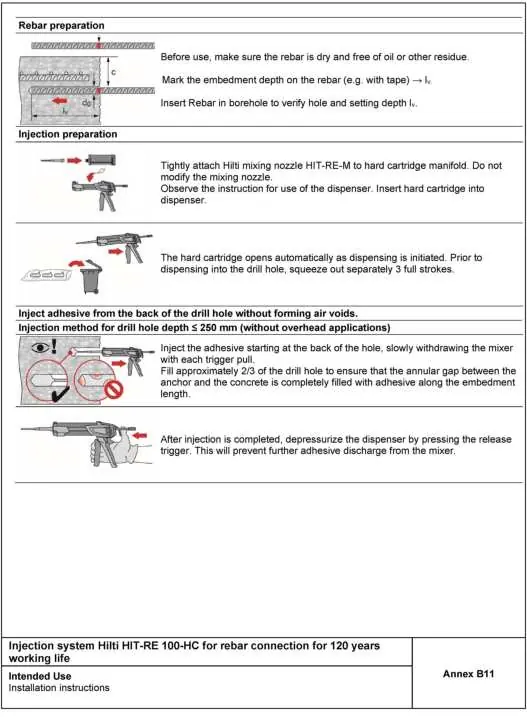
Injection Method: Inject adhesive starting from the back of the hole, slowly withdrawing the mixer to avoid air voids. Fill approximately 2/3 of the hole. For deep holes (> 250 mm) or overhead applications, use extensions and piston plugs.
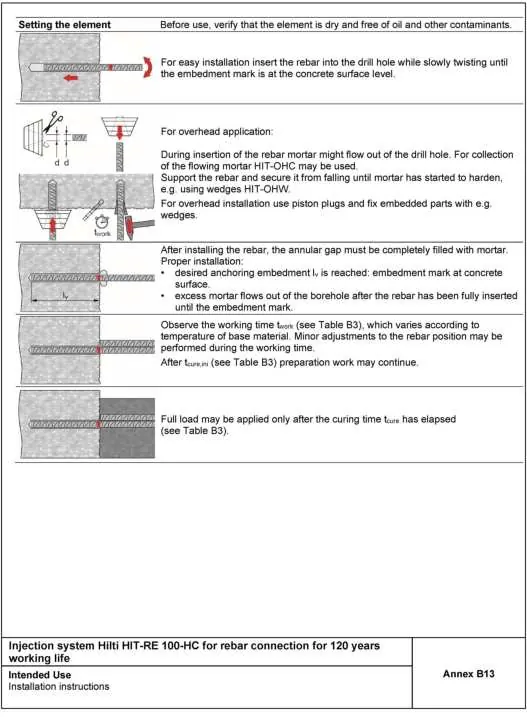
Setting the Element: Insert the rebar into the filled hole while slowly twisting until the embedment mark is at the concrete surface level. Ensure the annular gap is completely filled with mortar. Allow the system to cure according to the temperature-dependent curing times before applying any load.
Technical Specifications
The system is designed for a working life of at least 120 years. It is compatible with concrete strength classes C12/15 to C50/60. The installation temperature range is +5°C to +40°C, and the in-service temperature range is -40°C to +80°C.
Manufacturer information
Hilti Corporation
Practical help
Common problems
Inadequate hole cleaning
Results in poor load values. Ensure the hole is completely free of dust and debris using the specified brushes and air/water cleaning methods.
Air voids during injection
Inject adhesive starting from the back of the hole, slowly withdrawing the mixer with each trigger pull.
Rebar not parallel to existing reinforcement
Use drilling aids like Hilti HIT-BH, a lath, or a spirit level to ensure parallel alignment.
Before use
- Verify rebar is dry and free of oil/residue.
- Check concrete base material (normal weight, C12/15 to C50/60).
- Ensure ambient temperature is between +5°C and +40°C for installation.
- Select correct drill bit and brush size based on rebar diameter (refer to Table B4/B5).
- Review Material Safety Data Sheet (MSDS) for handling.
Specs in practice
- Rebar diameter
- 8 mm to 40 mm.
- Working life
- At least 120 years.
- In-service temperature
- -40°C to +80°C.
- Reaction to fire
- Class A1.
Images and diagrams
- Annex B7-B10: Detailed cleaning procedures for different drilling methods (Hammer, Compressed Air, Diamond Core).
- Annex B11-B12: Injection preparation and filling methods for standard and deep/overhead holes.
- Annex B13: Final element setting and curing control.
Model compatibility
- Compatible with normal weight concrete (C12/15 to C50/60).
- Not for use in carbonated concrete without removing the carbonated layer.
- Requires specific Hilti dispensers (HDM 500, HDE 500).

Manual page author
Michael Turner
Technical manual editor
Reviews PDF manuals for structure, safety notes, and practical product details so readers can find the right information quickly.