Music / Pedalboard Accessories
User Manual for Palmer PWT12IEC Pedalboard Power Supply
Quick guide for the Palmer PWT12IEC pedalboard power supply. Learn about output configurations, voltage settings, mounting instructions, and safety precautions.
Table of contents
Manual images
Click an image to enlargeQuick guide from the manual
The Palmer PWT12IEC is a universal power supply unit designed for effect pedals. It features 12 isolated DC outputs, one non-isolated DC output, and USB-A/USB-C charging ports. The unit is powered directly via a standard IEC power cable. Always verify the polarity and voltage requirements of your effect pedals before connecting them to avoid damage.

Connections and operating elements
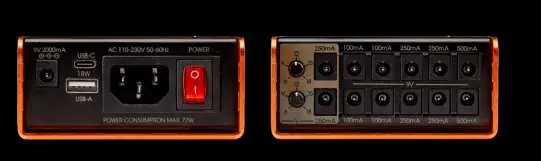
- AC INPUT: IEC connection for power supply.
- POWER: Rocker switch with indicator light for turning the unit on and off.
- DC OUTPUT (Non-isolated): 9V output with up to 2000mA for high-current requirements.
- USB: USB-C and USB-A ports with up to 18W total power for charging mobile devices.
- OUTPUT 1 AND 2: Two isolated outputs with potentiometers for adjustable voltage (6V to 18V, up to 250mA).
- OUTPUT 3 TO 6: Four isolated 9V outputs, up to 100mA each.
- OUTPUT 7 TO 10: Four isolated 9V outputs, up to 250mA each.
- OUTPUT 11 AND 12: Two isolated 9V outputs, up to 500mA each.
Voltage settings
Outputs 1 and 2 allow for continuously adjustable output voltage between 6V and 18V. Use the potentiometers to set the required voltage before connecting your effect device. Ensure the voltage matches the requirements of your pedal to prevent damage.
Mounting
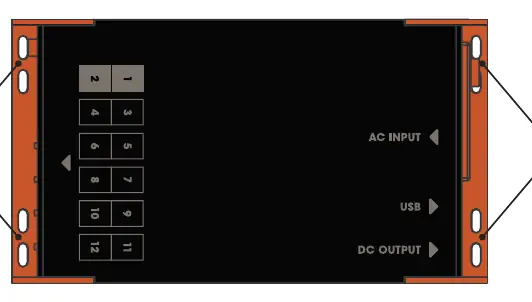
The power supply housing includes mounting holes on the base plate and side panels. This allows for secure attachment to a pedalboard, for example, using cable ties.
Safety warnings
- Reverse Polarity: Ensure the polarity of the effect unit matches the power supply (positive pole outside, negative pole inside).
- Overvoltage: Ensure the output voltage of the power supply matches the input voltage required by the effect unit.
- AC Input: Do not connect effect devices intended for AC voltage to this DC power supply.
- General: Keep out of reach of children. Do not open or modify the device.
Technical data
- Input voltage: AC 100 - 240 V
- Isolated DC outputs: 12
- Output connections: 2.1 x 5.5 mm
- Polarity: Centre-negative
- Max. output power: 30.6 W
- Operating temperature: 0°C to 40°C
Practical help
Common problems
Effect pedal damage due to reverse polarity
Ensure the pedal's DC input polarity matches the power supply (positive pole outside, negative pole inside).
Effect pedal damage due to overvoltage
Verify the output voltage of the power supply matches the pedal's required input voltage before connecting.
Damage from incorrect power type
Do not connect effect devices designed for AC voltage to this DC power supply.
Before use
- Check that the mains voltage is compatible (100-240V).
- Verify the polarity of your effect pedals (must be centre-negative).
- Set the voltage for outputs 1 and 2 using the potentiometers before connecting pedals.
- Ensure all cables are securely connected.
- Check that the total power consumption does not exceed the unit's limits.
Show more Show less
Specs in practice
- Isolated Outputs
- Prevents ground loops and noise interference between connected pedals.
- Centre-negative
- The standard polarity for most guitar pedals; the inner pin is negative, the outer sleeve is positive.
- Adjustable Outputs (1-2)
- Allows powering pedals that require non-standard voltages between 6V and 18V.
Images and diagrams
- The front panel features the AC input, power switch, USB ports, and the non-isolated 2000mA output.
- The rear/top panel contains the 12 isolated DC outputs with their respective current ratings.
Model compatibility
- Compatible with effect pedals requiring 6V to 18V DC.
- Outputs 1-2 are adjustable; others are fixed at 9V.
- Not suitable for pedals requiring AC power input.

Manual page author
David Miller
Documentation analyst