Tools / Drills
VEVOR 1.5-Ton Low Profile Floor Jack (Model VL-80020) User Guide
Comprehensive user guide for the VEVOR 1.5-Ton Low Profile Floor Jack, covering safety, operation, maintenance, and technical specifications for model VL-80020.
Table of contents
Product Overview
The VEVOR 1.5-Ton Low Profile Floor Jack (Model VL-80020) is a professional-grade lifting tool designed for automotive maintenance and repair. Its low-profile design allows it to slide easily under vehicles with limited ground clearance, making it an essential tool for both home mechanics and professional workshops. Built with high-strength steel, this jack provides reliable lifting capacity and stability for vehicles weighing up to 1.5 tons.
Safety Precautions
Safety is paramount when operating hydraulic lifting equipment. Always ensure the vehicle is parked on a level, solid surface before attempting to lift. Never exceed the rated capacity of 1.5 tons, as this can lead to equipment failure and serious injury. Always use jack stands to support the vehicle once it has been lifted; never rely solely on the floor jack to hold the weight of the vehicle while working underneath. Keep hands and feet clear of the lifting mechanism during operation.
Operating Instructions
To operate the jack, first ensure the release valve is closed by turning the handle clockwise until firm resistance is felt. Position the saddle of the jack directly under the vehicle's designated lifting point. Pump the handle up and down to raise the saddle until it contacts the vehicle frame. Continue pumping until the desired height is reached. To lower the vehicle, slowly turn the release valve handle counter-clockwise. Always lower the load slowly and in a controlled manner to prevent sudden drops.
Maintenance and Care
Regular maintenance is required to ensure the longevity and performance of your floor jack. Periodically check the hydraulic oil level and top up if necessary using high-quality hydraulic jack oil. Inspect the jack for any signs of leaks, loose bolts, or damaged components before every use. Keep the moving parts, such as the wheels and pivot points, lubricated to ensure smooth operation. If the jack feels spongy or fails to hold pressure, it may require bleeding the hydraulic system to remove trapped air.
Troubleshooting and Disposal
If the jack fails to lift the load, check that the release valve is fully closed and that the oil level is sufficient. If the jack drifts down under load, the release valve may be dirty or the hydraulic seals may be worn. In such cases, professional repair is recommended. When the jack reaches the end of its service life, dispose of it according to local environmental regulations, ensuring that hydraulic oil is recycled at an authorized facility.
Manufacturer information
VEVOR
Practical help
Common problems
Jack fails to lift the load
Ensure the release valve is fully closed and check hydraulic oil levels.
Jack drifts down under load
Check for debris in the release valve or worn hydraulic seals.
Spongy feel during pumping
Bleed the hydraulic system to remove trapped air.
Before use
- Ensure the vehicle is on a level, solid surface.
- Check for any hydraulic oil leaks.
- Verify the release valve is closed.
- Inspect the saddle for proper alignment.
- Ensure the rated capacity is not exceeded.
- Have jack stands ready for support.
Specs in practice
- Rated Capacity
- The maximum weight the jack can safely lift (1.5 tons).
Images and diagrams
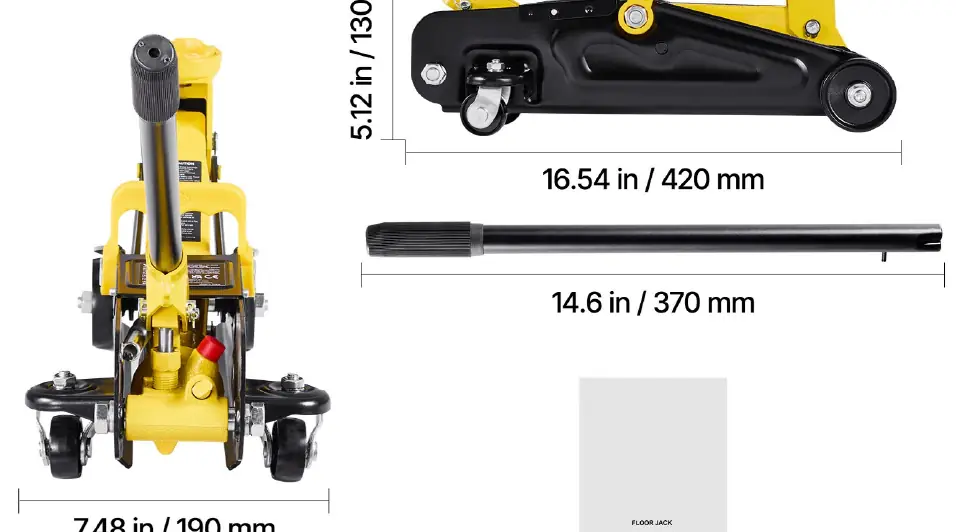
- The jack features a swivel saddle for secure contact with vehicle lift points.
- The handle is used for both pumping the hydraulic ram and operating the release valve.
- Rear caster wheels allow for easy positioning under the vehicle.
Model compatibility
- Designed for vehicles up to 1.5 tons.
- Suitable for low-clearance chassis designs.

Manual page author
Emily Carter
User documentation editor
Prepares concise manual descriptions and highlights the most useful setup, operation, and maintenance information for readers.