Industrial / Material Handling
Vevor Manual Trolley User Guide
Comprehensive user guide for Vevor manual trolleys. Learn how to assemble, adjust, and safely operate your trolley, including load capacities and maintenance tips.
Table of contents
Manual images
Click an image to enlargeQuick guide from the manual
This manual provides essential instructions for the safe assembly and operation of Vevor manual trolleys. Before use, ensure the trolley is correctly adjusted to your specific I-beam or H-beam track width. The most critical safety rule is to never exceed the rated load capacity and never work under a lifting load. Always wear heavy-duty work gloves during assembly and operation.
Safety Instructions
Adhering to safety protocols is mandatory to prevent serious injury:
- Assembly: Assemble only according to these instructions. Improper assembly creates hazards.
- PPE: Wear heavy-duty work gloves during the assembly process.
- Load Limits: Over-loading is strictly forbidden.
- Operational Safety: Passing or working under a lifting load is strictly prohibited.
- Flexibility: The trolley must be used flexibly. It is strictly prohibited to use it if individual connections are inflexible.
Model and Parameters
The trolley is available in several models with varying load capacities and rail width compatibilities:
- Models 0.5-F to 3T-F: Load capacities range from 0.5 Ton (1100 lbs) to 3 Ton (6600 lbs). Compatible with rail widths from 2.5 to 7 inches (64-177mm).
- Models 0.5-K to 5T-K: Load capacities range from 0.5 Ton (1100 lbs) to 5 Ton (11000 lbs). Compatible with rail widths from 2.5 to 8 inches (64-203mm).
Assembly and Use
Proper adjustment is required for safe operation:
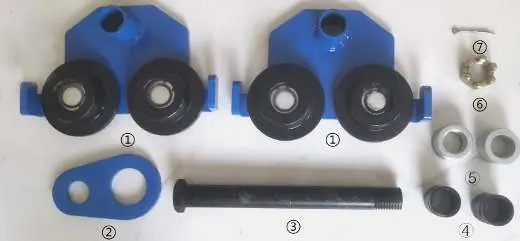
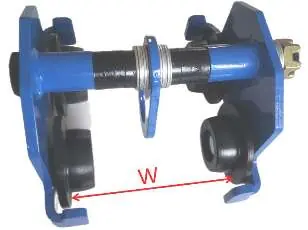
- Adjustment: Measure the rail width of your I-beam or H-beam. Adjust the trolley using the provided washers. Assemble the required number of washers equally to the inside or outside of the trolley side plates.
- Clearance: The dimension (W) between the Trolley Wheel Flanges must be approximately 1/5 inch (5mm) greater than the rail beam width.
- Locking: Assemble the washers, trolley side plates, and hanging ring plate on the trolley pin. Lock them securely with nuts to prevent them from falling off.
- Securing: The end of the trolley pin must be locked with a wire pin, which should be bent using pliers to ensure it stays in place. Note: Models 0.5-F and 0.5-K feature two nuts fixed at the end of the trolley pin.
Maintenance
To ensure the longevity and safety of the equipment:
- Greasing: Regularly grease the bearing and beam surface.
- Inspection: Examine bolts and nuts regularly to ensure they are tightened.
- Storage: After use, dry the trolley before storage to prevent rusting of bolts. Avoid prolonged exposure to the sun to prevent aging of components.
Manufacturer information
VEVOR
Practical help
Common problems
Inflexible connections
Do not use the trolley if connections are inflexible; ensure all parts move freely before operation.
Rusting of bolts
Dry the trolley thoroughly after use before placing it into storage.
Overloading
Strictly adhere to the load capacity specified for your specific model (0.5T to 5T).
Before use
- Wear heavy-duty work gloves.
- Verify the rail width of your I-beam or H-beam.
- Adjust washer placement so wheel flange clearance (W) is 5mm (1/5 inch) wider than the rail.
- Ensure all nuts are tightened securely.
- Check that the wire pin is inserted and bent with pliers.
- Grease the bearing and beam surface.
Specs in practice
- Load Capacity
- The maximum weight the trolley can safely support, ranging from 0.5 Ton to 5 Ton depending on the model.
Images and diagrams
- 1: Trolley side plates and wheels assembly
- 2: Hanging ring plate
- 3: Trolley Pin
- 4: Thickened washers
- 5: Thin washers
Model compatibility
- Compatible with I-beam and H-beam tracks.
- Ensure the model purchased matches your required load capacity and rail width.

Manual page author
Michael Turner
Technical manual editor
Reviews PDF manuals for structure, safety notes, and practical product details so readers can find the right information quickly.