Electronics / Audio
User Guide for Walrus Audio Silt Harmonic Fuzz Pedal
Quick guide for the Walrus Audio Silt Harmonic Fuzz pedal. Learn about controls, power requirements, harmonic mode, and step-by-step tube replacement procedures.
Table of contents
Manual images
Jump to the sectionQuick guide from the manual
The Walrus Audio Silt Harmonic Fuzz is an analog pedal featuring an internal 12AU7 pre-amp tube. It is designed to provide rich fuzz tones and harmonic overtones. The pedal is compatible with other pedals in your signal chain and does not require being placed first.
Power Requirements
To ensure optimal performance and avoid noise, please adhere to the following power specifications:
- Voltage: 9V - 12V DC
- Polarity: Center Negative
- Current: 300mA minimum
- Recommendation: Use an isolated power supply. Daisy chain power supplies are not recommended.
- Tip: Running the pedal at 12V provides an extra gain boost.
Controls
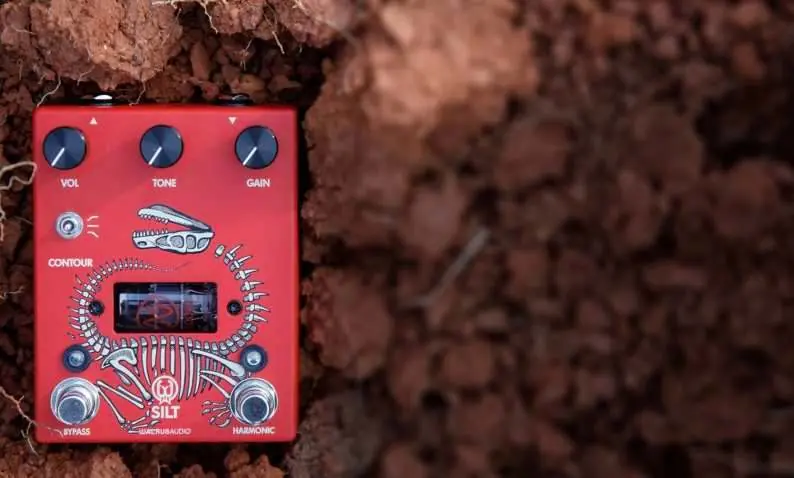
- Volume: Sets the overall output volume of the pedal.
- Tone: A lowpass/highpass tilt control. Clockwise cuts lows and boosts highs; counter-clockwise cuts highs and boosts lows.
- Gain: Controls the input gain into the fuzz circuit, ranging from subtle crunch to full-throttle fuzz.
- Contour: Toggles between highpass (up), flat (middle), and lowpass (down) curves in the pre-tube EQ stage. Useful for adjusting to different pickup styles.
- Harmonic Switch: Activates a frequency doubler before the drive section, producing crispy, octave-like sounds.
Tube Maintenance
If the internal tube fails, follow these steps to replace it. The manufacturer recommends using a JJ 12AU7 (ECC82) tube.
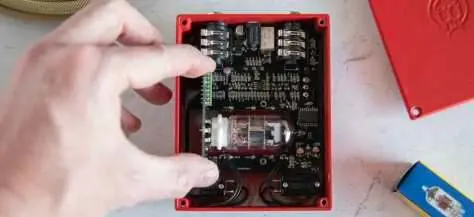

- Take out the four screws to remove the backplate.
- Grab both ends of the tube’s PCB and gently pull straight up.
- Gently pull the tube out of the socket.
- Put the new tube into the tube socket, ensuring all pins are aligned.
- Connect the tube PCB back to the Silt’s main PCB, ensuring that all 10 pins are lined up (8 pins on the longer side, 2 pins on the shorter side).
Technical Specifications
- Input Impedance: ~1M Ohms
- Bypass Options: True Bypass (Relay Bypass)
- Dimensions: 2.25” (57.15mm) Height x 3.62” (91.94mm) Width x 4.79” (121.66mm) Depth
Support
If you have questions or need a repair, you can contact the manufacturer via email at [email protected].
Practical help
Common problems
Excessive noise or hum
Ensure you are using an isolated power supply. Daisy chain power supplies are not recommended.
Tube failure
Replace the internal tube with a JJ 12AU7 (ECC82) following the maintenance procedure in this guide.
Before use
- Verify power supply is 9V-12V DC
- Ensure power supply is Center Negative
- Confirm power supply provides at least 300mA
- Use an isolated power supply for best performance
Specs in practice
- Input Impedance ~1M Ohms
- Standard high-impedance input suitable for guitar pickups.
Images and diagrams
- The pedal features a 10-pin connector and a 2-pin connector on the tube PCB that must be aligned correctly during reassembly.
Model compatibility
- The pedal does not need to be placed first in your signal chain.

Manual page author
Michael Turner
Technical manual editor
Reviews PDF manuals for structure, safety notes, and practical product details so readers can find the right information quickly.