Electronics / Audio
Walrus Audio MERAKI Stereo Analog Delay Pedal User Manual
Complete user guide for the Walrus Audio MERAKI Stereo Analog Delay Pedal. Includes instructions on power requirements, control functions, internal dip switch settings, feedback trim pot adjustments, and MIDI configuration.
Table of contents
Manual images
Jump to the sectionQuick guide from the manual
The Walrus Audio MERAKI is a true stereo analog delay pedal featuring eight MN3005 chips. It requires a 9V DC, Center Negative, 500mA power supply. It is highly recommended to use an isolated power supply; daisy chain power supplies are not recommended. The pedal offers 1200ms of delay time with parallel, ping-pong, and series modes.
Controls
The pedal features several knobs and switches to shape your sound:
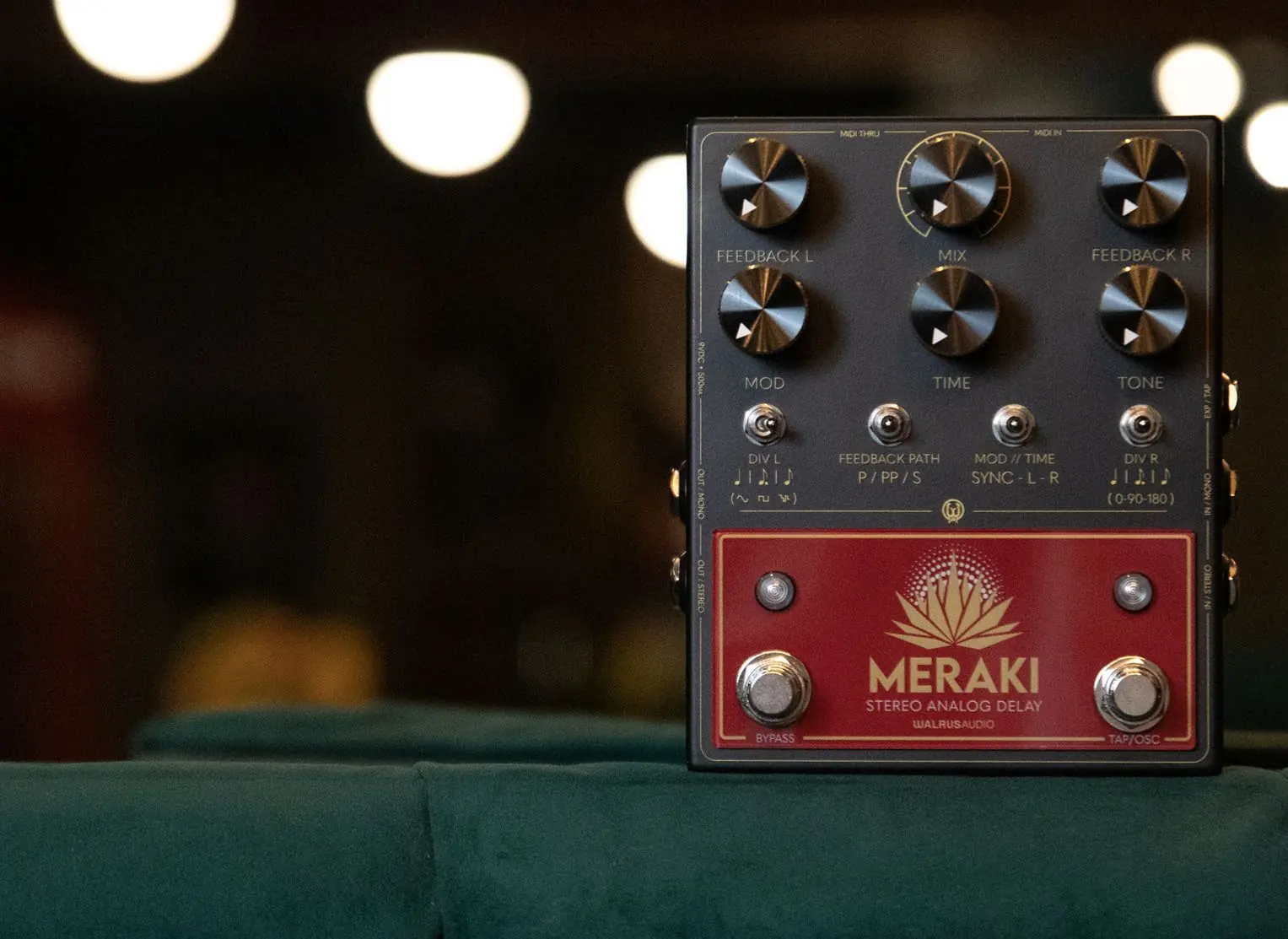
- Mix: Adjusts the overall level of repeats in both left and right channels simultaneously.
- Feedback Left/Right: Adjusts the amount of repeats in the respective channel, from a single repeat to full oscillation.
- Mod (Mod Rate): Adjusts the depth of modulation. Hold the Bypass switch and use the Mod knob to adjust the mod rate.
- Time: Adjusts delay time (80-1200ms). Clockwise for longer, counter-clockwise for shorter.
- Tone: Adjusts a Tilt EQ in the delay lines. Clockwise boosts highs/cuts lows; counter-clockwise boosts lows/cuts highs.
- Tap Division Left/Right: Selects between quarter note, dotted eighth, and eighth note repeats.
- Feedback Mode Switch: Selects between Parallel, Ping-Pong, and Series delay lines.
- Sync/Left/Right Switch: Selects which side of the pedal to adjust. Sync affects both, L affects left only, R affects right only.
- Bypass Switch: Turns the pedal on/off. Hold to access secondary controls.
- Tap Tempo Switch: Sets delay time. Hold to maximize feedback (Oscillation).
Internal Settings
The MERAKI features internal components that allow for deeper customization:
Internal Dip Switches
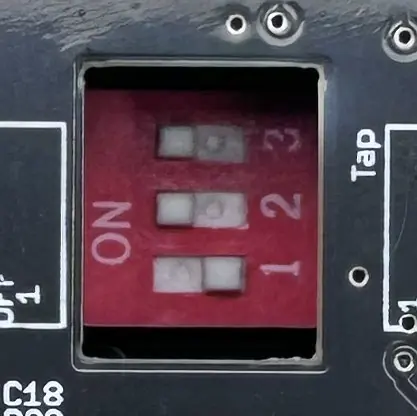
Remove the back plate to access internal dip switches to configure the External Tap/Expression jack:
- Tap: Set switches 1 to ON, 2 to OFF, 3 to OFF.
- Expression: Set switches 1 to OFF, 2 to ON, 3 to ON.
Feedback Control Trim Pots
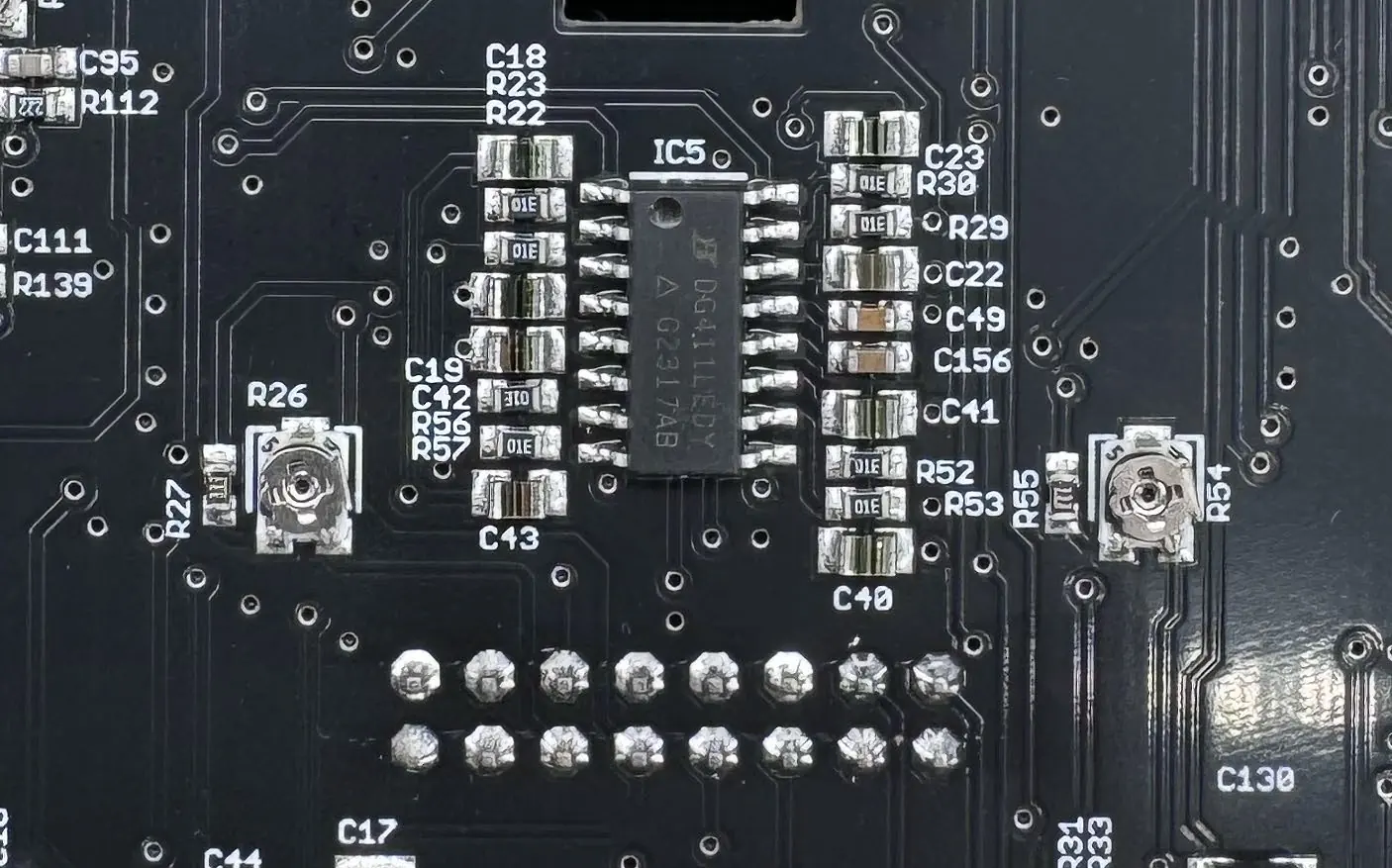
Inside the pedal, there are two trim pots (one for Left, one for Right) to adjust how quickly the delay repeats go into self-oscillation. Turn clockwise to slow down oscillation speed, or counter-clockwise to speed it up.
MIDI Operation
The pedal supports MIDI via MIDI In/Thru ports. To change the MIDI channel, hold down both stomp switches while applying power. The LEDs will flash; send a MIDI message on the desired channel to set it, then the pedal will enter normal operation.
Bypass Modes
The pedal supports two bypass modes. To change modes, hold the Bypass switch while plugging in the power connector:
- Buffered Bypass: Trails enabled (Default).
- True Bypass: No trails.
Practical help
Common problems
Pedal is noisy or behaving unexpectedly.
Ensure you are using an isolated 9V DC, Center Negative, 500mA power supply. Daisy chain power supplies are not recommended.
Expression pedal or Tap tempo not working as expected.
Check the internal dip switch settings. Ensure they are set correctly for either Tap (1 ON, 2 OFF, 3 OFF) or Expression (1 OFF, 2 ON, 3 ON).
Oscillation happens too quickly or too slowly.
Adjust the internal trim pots. Turn clockwise to slow down oscillation speed, or counter-clockwise to speed it up.
Before use
- Use a 9V DC, Center Negative, 500mA power supply.
- Use an isolated power supply to avoid noise.
- Verify internal dip switch settings if using an external expression pedal or tap switch.
- Set the desired Bypass mode (Buffered/Trails or True Bypass) before powering on.
- Set the MIDI channel if integrating into a MIDI rig.
Specs in practice
- Frequency Response
- 60Hz to 20kHz.
- Input Impedance
- ~1M Ohms.
- Output Impedance
- ~100 Ohms.
Images and diagrams
- Internal trim pots are located on the circuit board to control feedback oscillation speed for Left and Right channels.
- Internal dip switches are located on the circuit board to toggle between External Tap and Expression pedal functionality.
Model compatibility
- Requires 9V DC, Center Negative, 500mA power.
- Supports MIDI control for digital parameters.
- Supports external expression pedal or tap tempo switch (requires internal dip switch configuration).

Manual page author
Emily Carter
User documentation editor
Prepares concise manual descriptions and highlights the most useful setup, operation, and maintenance information for readers.