Electronics / Studio Monitors
User Manual for Behringer MONITOR SPEAKERS 1C
Quick guide for the Behringer MONITOR SPEAKERS 1C. Includes wiring instructions, safety guidelines, and technical specifications.
Quick answers from the manual
Quick answer
- To connect the MONITOR 1C, mute your amplifier, strip the speaker wire ends, press the rear connector clamps, insert the wires observing correct polarity, and release the clamps to secure. p. 1
Key actions
- Connect speakers to amplifier p. 1
Problems and fixes
Tweeter temporarily stops working
Lower the volume to allow the integrated protective circuitry to reset the tweeter.
p. 1Technical specifications
| Parameter | Value | Meaning | Pages |
|---|---|---|---|
| Power capacity | 25 W RMS, 100 W Peak | Maximum power handling | p. 1 |
| Impedance | 4 Ohm | Electrical resistance | p. 1 |
Where to find it in the PDF
- Wiring and Specifications p. 1
- Safety Instructions p. 1
Table of contents
Quick Guide
The Behringer MONITOR 1C is a compact monitor speaker system. This manual provides essential instructions for safe installation, wiring, and operation. Always ensure your amplifier is muted before making connections to prevent damage.
Wiring and Connection
Follow these steps to connect your speakers to an amplifier:
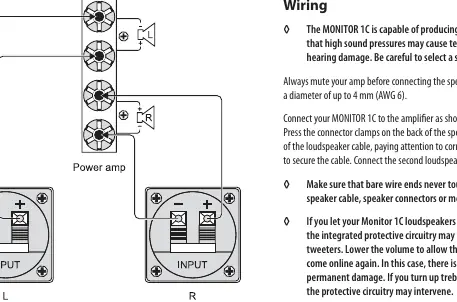
- Ensure the amplifier is muted.
- Use loudspeaker cables with a diameter of up to 4 mm (AWG 6).
- Press the connector clamps on the back of the speaker.
- Insert the bare end of the loudspeaker cable into the opening, ensuring correct polarity (+ to +, - to -).
- Release the clamp to secure the cable.
- Repeat the process for the second speaker.
Important: Ensure that bare wire ends do not touch the open end of another speaker cable, other speaker connectors, or metal parts of your amplifier.
Protection Circuitry
The MONITOR 1C features integrated protective circuitry. If the speakers are operated at or near their power limit, the circuit may temporarily disconnect the tweeters. If this happens, lower the volume to allow the tweeter to automatically reactivate. This is a safety feature and does not indicate a fault.
Safety Instructions
- Read, keep, and follow all instructions.
- Do not use the apparatus near water.
- Clean only with a dry cloth.
- Mount speakers on a solid, stable, and level base or stand. Vibrating floors do not provide reliable support.
- Do not install near heat sources such as radiators, stoves, or amplifiers.
- Use only attachments and accessories specified by the manufacturer.
- Refer all service to qualified service personnel.
- Do not block ventilation openings.
Technical Specifications
- Connector type: Clip terminal
- Wire diameter: < 4 mm
- Power capacity: 25 W RMS, 100 W Peak
- Impedance: 4 Ohm
- Frequency range: 60 Hz to 23 kHz (-10 dB)
- Tweeter: 1/2 inch
- Woofer: 5 1/2 inch
- Crossover frequency: 5000 Hz
Manufacturer information
Behringer
Practical help
Common problems
Tweeter stops working during high volume usage
The integrated protection circuitry has engaged. Lower the volume to allow the tweeter to automatically reactivate.
Sound distortion or interference
Check that bare wire ends are not touching other speaker cables, connectors, or metal parts of the amplifier.
Before use
- Mute the amplifier before connecting speakers.
- Ensure speaker cables have a diameter of 4 mm or less.
- Verify the mounting surface is solid, stable, and level.
- Check that polarity (+/-) is correctly matched between the amplifier and speakers.
Specs in practice
- Power capacity
- Rated at 25 W RMS (continuous) and 100 W Peak.
- Frequency range
- 60 Hz to 23 kHz, indicating the range of sound reproduction.
Images and diagrams
- The wiring diagram illustrates the connection from the amplifier output to the speaker input terminals.
- It highlights the use of clip terminals on the rear of the speaker.
Model compatibility
- Compatible with amplifiers supporting 4 Ohm impedance.
- Supports speaker wire diameters up to 4 mm (AWG 6).

Manual page author
Michael Turner
Technical manual editor
Reviews PDF manuals for structure, safety notes, and practical product details so readers can find the right information quickly.