Tools / Power Tools
User Manual for Bosch GHG 20-63 and GHG 23-66 Heat Gun
Quick guide for the Bosch GHG 20-63 and GHG 23-66 heat guns. Includes setup, airflow and temperature regulation, maintenance, and example applications.
PDF source: polski · summary: English
Quick answers from the manual
Quick answer
- The Bosch GHG 20-63 and GHG 23-66 are professional heat guns for deforming/welding plastic, removing paint, and heat-shrinking. Operate by sliding the on/off switch upwards and using the buttons to regulate temperature and airflow. p. 12, 13, 14
Key actions
- Switching on p. 13
- Switching off p. 13
First start
- Smoke during initial use p. 13
Show 4 more answers Show less
Problems and fixes
Overheating
The thermal protection regulation switches off the heating automatically. The blower continues to run.
p. 13Maintenance and reset
- Keep ventilation slots clean p. 15
Technical specifications
| Parameter | Value | Meaning | Pages |
|---|---|---|---|
| Rated power input | 2000 W (GHG 20-63), 2100/2300 W (GHG 23-66) | Power consumption | p. 12 |
| Airflow | 150-500 l/min | Air volume range | p. 12 |
| Temperature | 50-630°C (GHG 20-63), 50-650°C (GHG 23-66) | Temperature range | p. 12 |
Where to find it in the PDF
- Controls and components p. 3
- Application examples p. 4, 5
Table of contents
Manual images
Click an image to enlargeQuick guide from the manual
The Bosch GHG 20-63 and GHG 23-66 are professional heat guns designed for deforming and welding plastic, removing paint, and heat-shrinking. They are also suitable for soldering, tinning, melting adhesive bonds, and thawing water pipes. Always test the airflow and temperature on a concealed area before starting work.
Safety Instructions
- Handle with care: The heat gun produces intense heat, increasing the risk of fire and explosion.
- Flammable materials: Take particular care when working near flammable materials. Hot airflow or the nozzle can ignite dust or gases.
- Ventilation: Keep your work area well-ventilated, as gases and steam produced during work are often harmful.
- Protective gear: Always wear safety goggles and protective gloves. Do not touch the hot nozzle.
- Supervision: Do not leave the heat gun unattended while switched on.
Product Description
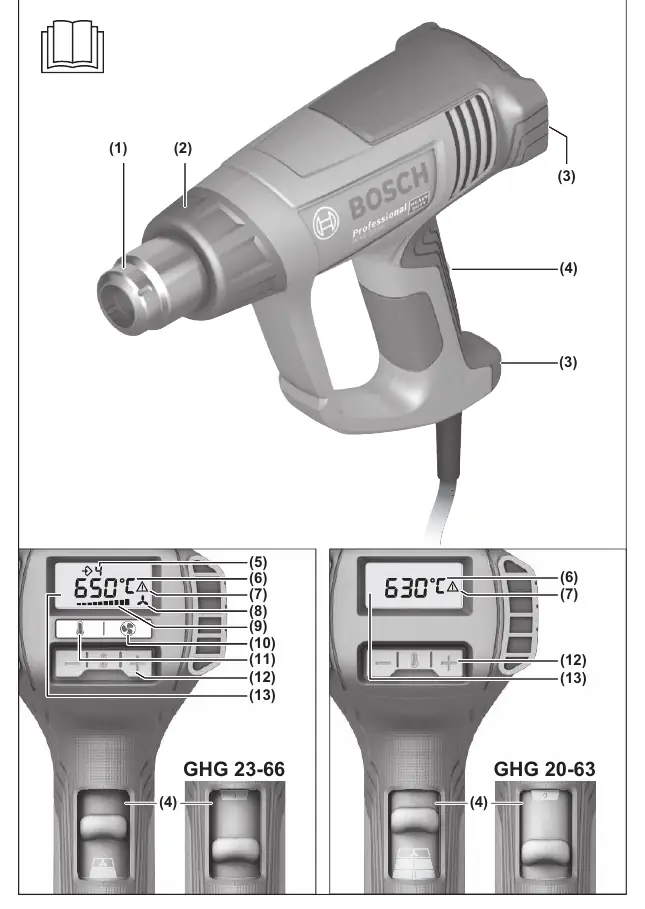
The heat gun features an on/off switch with power settings, a display for temperature and airflow (GHG 23-66), and various nozzle attachments for specific tasks.
Operation
Starting Operation
Slide the on/off switch upwards to turn the tool on. If the tool overheats, the thermal protection regulation will automatically switch off the heating, though the blower will continue to run. Once cooled, the heating will automatically switch back on.
Regulating Airflow and Temperature
For the GHG 20-63, airflow and temperature are regulated via the on/off switch and the +/- buttons. For the GHG 23-66, airflow can be set in 10 steps using the fan button and +/- buttons. You can also save airflow/temperature combinations on the GHG 23-66.
Switching Off
Slide the on/off switch downwards to the 0 position. After working at high temperatures, let the tool run for a short time at the lowest temperature setting to cool down before switching off.
Maintenance and Cleaning
Always pull the mains plug before working on the heat gun. Keep the tool and ventilation slots clean for safe operation. If the power cord needs replacement, it must be done by Bosch or an authorized service center.
Example Applications
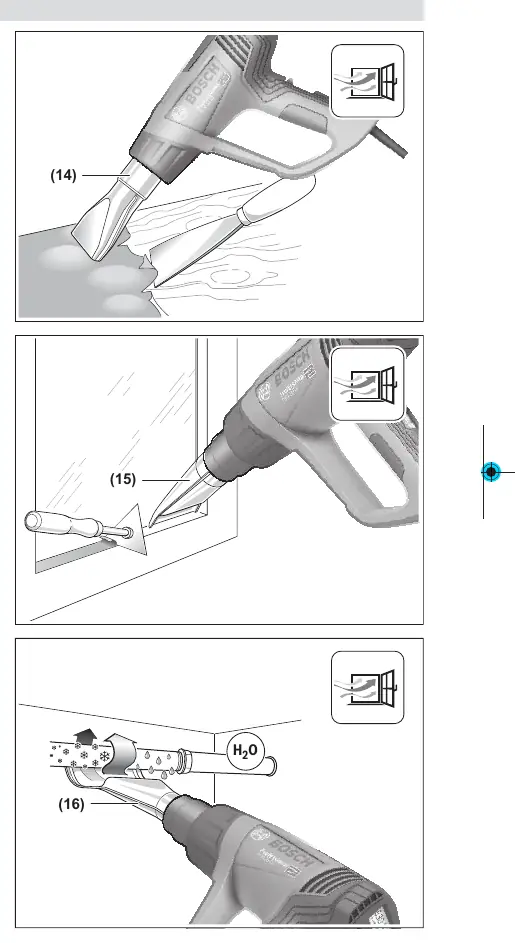
- Removing varnish/loosening adhesives: Use the surface nozzle. Soften the varnish with hot air and remove with a clean spatula.
- Stripping paint from window frames: Use the glass protection nozzle to prevent glass breakage.
- Thawing water pipes: Use the angle nozzle. Heat frozen points from the outlet towards the inlet.
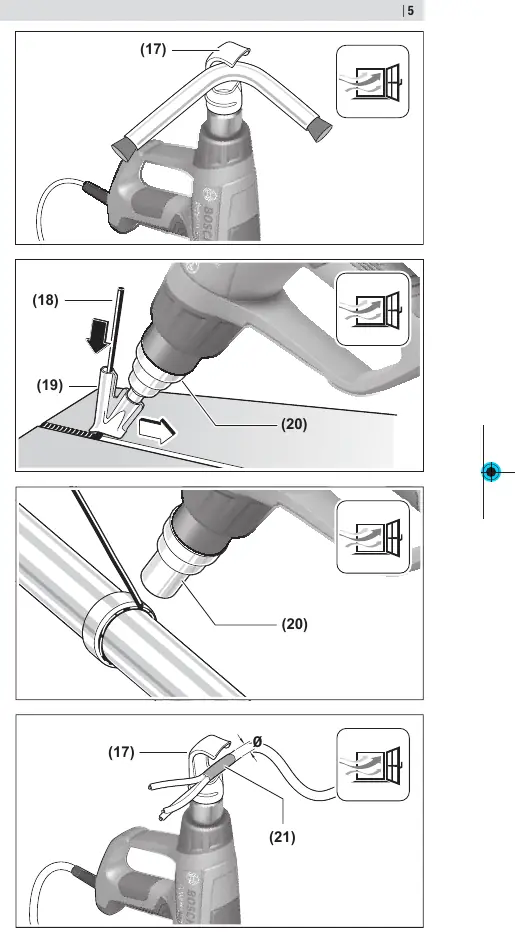
- Shaping plastic pipes: Use the reflector nozzle. Fill pipes with sand and seal both ends to prevent bending.
- Welding plastic: Use the reducing nozzle and welding shoe. Ensure the workpiece and welding wire are of the same material.
- Soft soldering: Use the reducing nozzle for spot welding or the reflector nozzle for pipes.
- Heat-shrinking: Use the reflector nozzle and select a heat-shrink tube of appropriate diameter.
Manufacturer information
Bosch
Practical help
Common problems
Overheating
Check for air blockage or insufficient air supply. The thermal protection will automatically switch off the heating.
Smoke during initial use
This is normal; a protective coating on metal surfaces evaporates during the first use.
Before use
- Check the heat gun, cable, and plug for damage.
- Ensure the work area is well-ventilated.
- Test the airflow and temperature on a concealed area first.
- Wear protective gloves and safety goggles.
- Ensure the nozzle is not too close to the workpiece to avoid air blockage.
Show more Show less
Specs in practice
- Thermal protection
- Automatic safety feature to prevent overheating.
Images and diagrams
- The manual includes diagrams for nozzle applications (A-G) on pages 4 and 5.
- Page 3 shows the controls and display components for both models.
Model compatibility
- Compatible with various Bosch accessories and nozzles.

Manual page author
David Miller
Documentation analyst