Electronics / Cables & Adapters
Corning ALTOS Loose Tube Fiber Optic Cable 012KU4-T4730D20 Specification Guide
Technical specifications and installation guidelines for the Corning ALTOS 012KU4-T4730D20 gel-free, all-dielectric fiber optic cable. Includes mechanical, optical, and environmental data.
Table of contents
Manual images
Click an image to enlargeKey Information
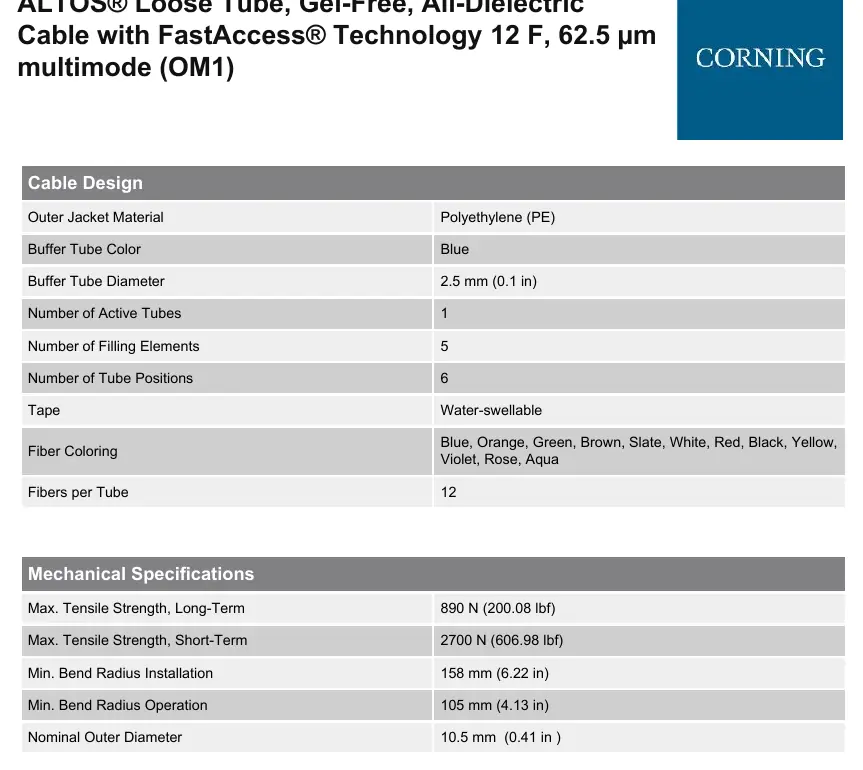
The Corning ALTOS 012KU4-T4730D20 is a gel-free, all-dielectric fiber optic cable designed for outdoor and limited indoor use. It features FastAccess technology, which simplifies cable jacket removal and reduces access time. The cable is fully water-blocked using water-swellable materials, requiring no cleaning during installation.
Product Overview
This cable is designed for campus backbones in lashed aerial and duct installations. The all-dielectric construction means no bonding or grounding is required. It utilizes an SZ-stranded, loose tube design to isolate fibers from installation and environmental rigors.
Installation and Environmental Conditions
Installation Requirements:
- Installation Temperature: -30 °C
- Operating Temperature: -40 °C to 70 °C
- Storage Temperature: -40 °C to -40 °C
- Indoor Use: Permitted when installed according to National Electrical Code (NEC) Article 770.
Corning recommends storing the cable in a proper temperature environment prior to installation to ensure it meets the installation temperature range specifications.
Mechanical Specifications
Adhering to these limits is critical to prevent fiber damage:
- Max. Tensile Strength (Long-Term): 890 N (200.08 lbf)
- Max. Tensile Strength (Short-Term): 2700 N (606.98 lbf)
- Min. Bend Radius (Installation): 158 mm (6.22 in)
- Min. Bend Radius (Operation): 105 mm (4.13 in)
- Nominal Outer Diameter: 10.5 mm (0.41 in)
Optical Characteristics
The cable is optimized for high-performance networking:
- Fiber Type: Multimode (OM1)
- Fiber Core Diameter: 62.5 µm
- Wavelengths: 850 nm / 1300 nm
- Performance: Ready for Gigabit and 10 Gigabit Ethernet applications.
Cable Design
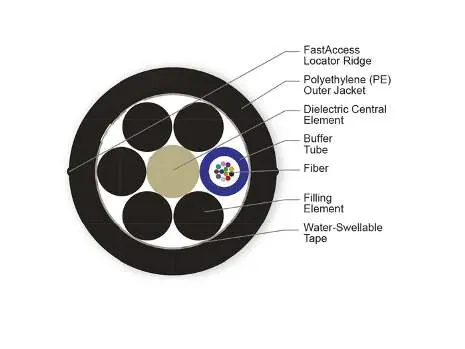
The cable features a medium-density polyethylene (PE) outer jacket. The internal structure includes a dielectric central element, buffer tubes, and water-swellable tape. The buffer tube color is blue, and the fiber coloring follows standard industry sequences (Blue, Orange, Green, Brown, Slate, White, Red, Black, Yellow, Violet, Rose, Aqua).
Manufacturer information
Corning Optical Communications
Practical help
Common problems
Signal loss or fiber breakage
Ensure the cable is not bent beyond the minimum bend radius (158 mm during installation, 105 mm during operation).
Fiber damage during pulling
Do not exceed the maximum tensile strength of 2700 N (short-term) during installation.
Improper installation results
Store the cable in a temperature-controlled environment before installation to ensure it is within the required -30 °C installation temperature range.
Before use
- Verify the part number (012KU4-T4730D20) matches your project requirements.
- Confirm the installation environment temperature is at -30 °C.
- Ensure compliance with NEC Article 770 if installing indoors.
- Prepare appropriate tools for FastAccess technology jacket removal.
- Check that the cable path allows for the minimum bend radius of 158 mm.
Specs in practice
- Max. Tensile Strength
- The maximum pulling force that can be applied to the cable without causing damage to the internal fibers.
- Min. Bend Radius
- The tightest curve the cable can handle without causing signal attenuation or fiber breakage.
Images and diagrams
- The cross-section diagram illustrates the cable's internal components, including the FastAccess Locator Ridge, Polyethylene outer jacket, dielectric central element, buffer tube, and water-swellable tape.
Model compatibility
- Compatible with Gigabit and 10 Gigabit Ethernet networks.
- Suitable for outdoor lashed aerial and duct installations.
- Indoor installation is permitted only when compliant with NEC Article 770.

Manual page author
Michael Turner
Technical manual editor
Reviews PDF manuals for structure, safety notes, and practical product details so readers can find the right information quickly.