Plumbing / Valves & Fittings
Data Sheet for Danfoss NRV 10s H Check Valve
Technical specifications, installation guidelines, and application details for the Danfoss NRV 10s H check valve, designed for R744 (CO2) refrigeration systems. Includes pressure ratings, temperature ranges, and component diagrams.
Table of contents
Manual images
Click an image to enlargeQuick Guide and Overview
The Danfoss NRV 10s H is a check valve specifically designed for R744 (CO2) refrigeration systems. It ensures refrigerant flows in only one direction and can function as an internal relief valve when installed in parallel with GBC ball valves or service shut-off valves. It is also suitable for use in hot gas defrosting lines.
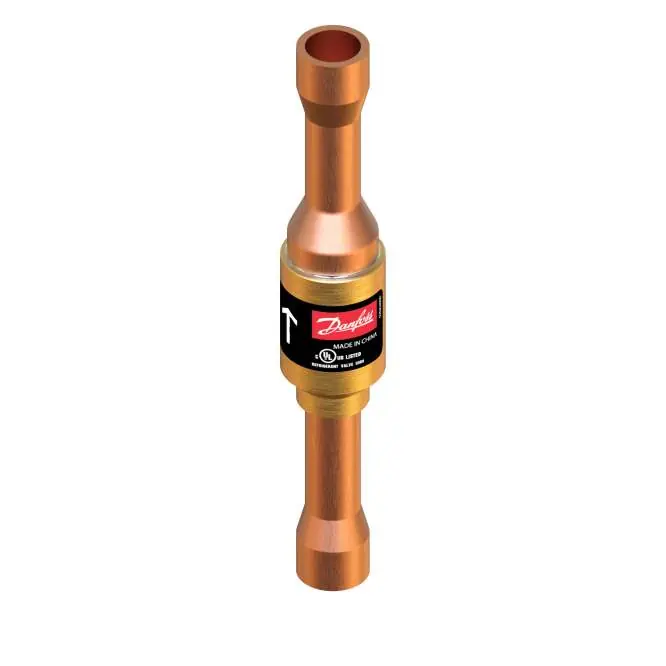
Applications and Installation
The valve is intended for use in refrigeration systems, particularly in secondary loops or cascade systems. When used as a pressure relief valve in parallel with a GBC ball valve, it is recommended to install the NRV above the GBC.
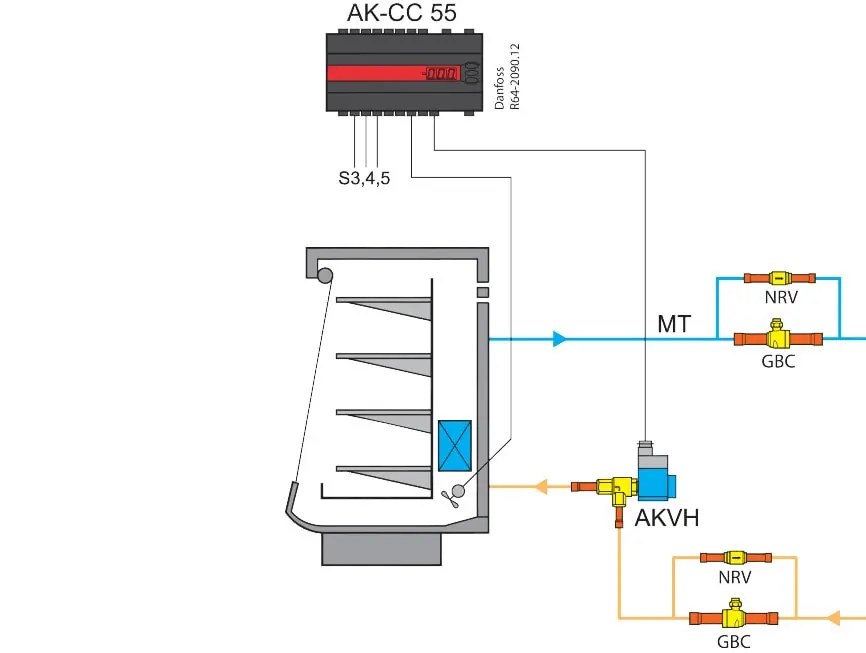
Important Installation Notes:
- The design pressure of the refrigerant-containing component must not be less than the design pressure of associated components.
- The component is not provided with any pressure relief or pressure-regulating relief valve; sufficient valves must be field-installed on the refrigeration system.
- When the system is de-energized, venting of R744 may occur through pressure-regulating relief valves; the valve should not be defeated or bypassed.
- Ensure no stop valve is provided between the relief valve and the parts of the system being protected.
Technical Specifications
The NRV 10s H is built to withstand high-pressure environments typical of CO2 systems.
- Refrigerants: R744 (CO2)
- Compatible Oils: POE, PAG
- Media Temperature Range: -50 to 140 °C (-58 to 285 °F)
- Max. Working Pressure (PS/MWP): 90 bar / 1305 psig
- Minimum Opening Pressure Differential (MinODP): 0.400 bar / 5.800 psi
Design and Components
The valve features a robust construction designed for durability in refrigeration circuits. The internal design includes a copper tube, solder ring, washer, sealing disk with special material, piston, spring, valve body, guide, and stop face.
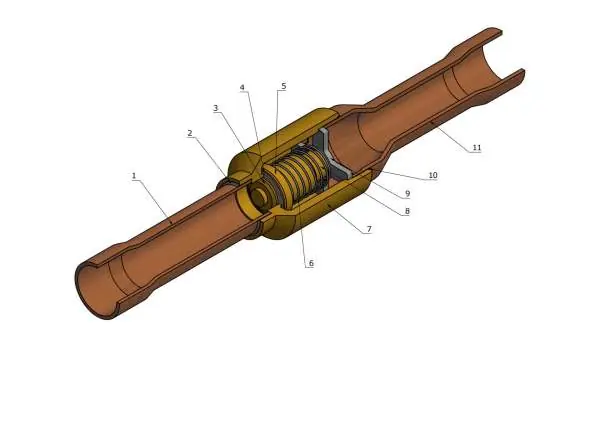
Dimensions
The valve is available in an ODF solder version. For the 3/8 inch connection size, the total length is 109 mm (4.29 in), with a diameter of 18 mm (0.71 in) and a weight of 0.07 kg (0.15 lb).
Certifications and Contact
The product complies with various standards, including EU RoHS, China RoHS, and PED. For detailed declarations of conformity, technical documentation, or support, visit the official Danfoss documentation portal at documentation.danfoss.com or contact Danfoss A/S at +45 7488 2222.
Official resources from the manual
Manufacturer information
Danfoss A/S
Practical help
Common problems
System pressure relief failure
Ensure the NRV is installed above the GBC ball valve when used in parallel as a pressure relief valve.
Refrigerant leakage or system failure
Verify that the system design pressure does not exceed 90 bar (1305 psig) and that the valve is compatible with R744 (CO2).
Before use
- Verify the system refrigerant is R744 (CO2).
- Ensure the system design pressure is within the 90 bar (1305 psig) limit.
- Check that the operating temperature is between -50 °C and 140 °C.
- Confirm the valve is installed in the correct flow direction.
- If used as a relief valve, ensure it is installed in parallel with a GBC ball valve.
Specs in practice
- Max. working pressure (PS/MWP)
- The maximum pressure the valve can withstand, which is 90 bar or 1305 psig.
- Media temperature range
- The operating temperature limits for the valve, ranging from -50 °C to 140 °C (-58 °F to 285 °F).
Images and diagrams
- The exploded view shows the internal components including the piston, spring, and sealing disk.
- The application diagram illustrates the parallel installation of the NRV and GBC valves in a refrigeration circuit.
Model compatibility
- Compatible with R744 (CO2) refrigerant.
- Compatible with POE and PAG oils.
- Designed for use in secondary loops or cascade systems.

Manual page author
David Miller
Documentation analyst
Organizes user manual content into clear summaries, with attention to model details, product context, and everyday usability.