Electronics / Stream Controllers
Elgato Stream Deck XL Quick Start Guide
A quick start guide for the Elgato Stream Deck XL. Learn how to install the software, connect the device, customize keys with icons, manage folders, and integrate social media accounts.
Quick answers from the manual
Quick answer
- To set up the Elgato Stream Deck XL, download the Stream Deck app, connect the device directly to a USB-A port on your computer, and use the software to drag and drop actions onto the keys. p. 3
Key actions
- Install software p. 3
- Connect hardware p. 3
- Customize keys p. 3, 4
First start
- Download app, connect via USB-A, and configure in software. p. 3
Show 4 more answers Show less
Problems and fixes
Device connection issues
Connect directly to a USB-A port; do not use a USB hub.
p. 3Maintenance and reset
- Right-click a key to reset it. p. 4
Technical specifications
| Parameter | Value | Meaning | Pages |
|---|---|---|---|
| Icon size | 144 x 144 pixels | Recommended image dimensions for custom keys. | p. 4 |
Where to find it in the PDF
- Setup and Connection p. 3
- Customization p. 4
- Social Media p. 5
Table of contents
Quick guide from the manual
The Elgato Stream Deck XL is a customizable controller designed for streaming and productivity. To begin using the device, you must install the official software, connect the hardware directly to your computer, and configure your keys via the application interface.
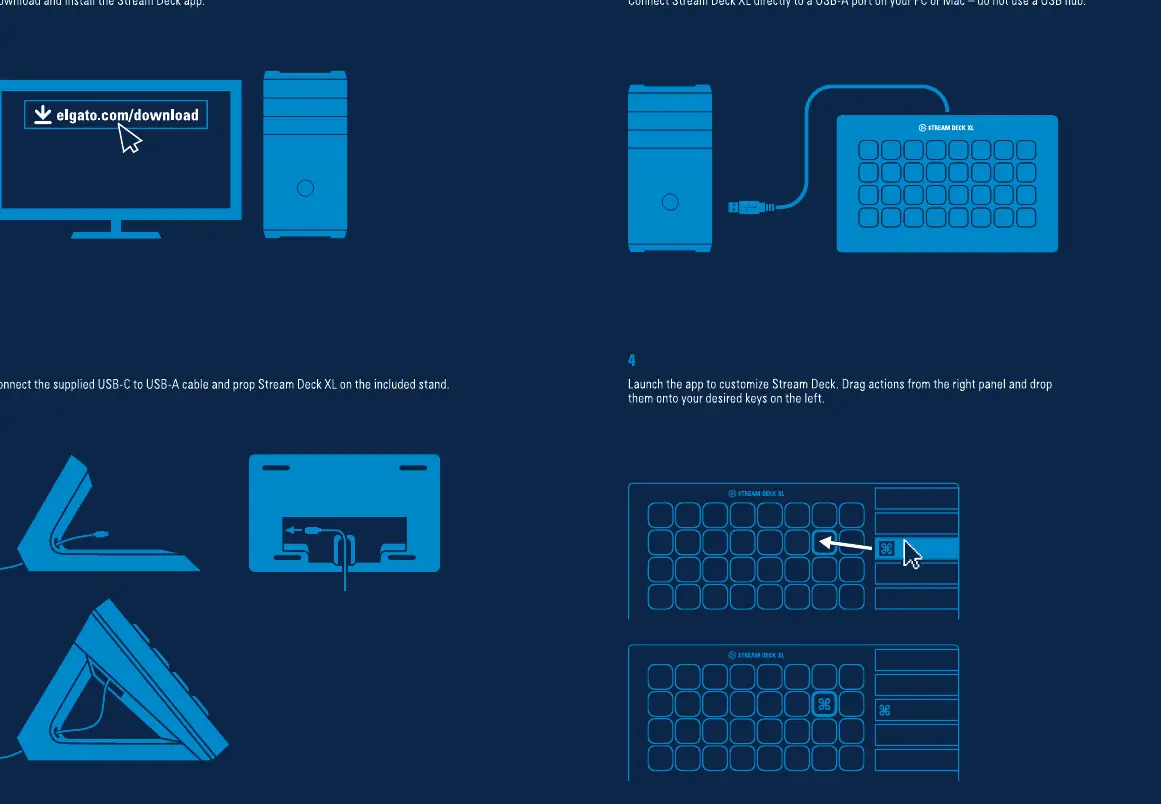
Software installation
Before connecting the hardware, download and install the latest version of the Stream Deck app from the official website at elgato.com/download. This software is required to configure the keys and assign actions.
Hardware connection
Connect the Stream Deck XL directly to a USB-A port on your PC or Mac. Do not use a USB hub, as it may cause connectivity issues. Use the supplied USB-C to USB-A cable and place the device on the included stand for optimal viewing.
Customizing keys
Once the app is launched, you can customize the keys by dragging and dropping actions from the right panel onto your desired keys on the left. You can personalize keys with custom icons; for the best results, use 144 x 144 pixel files in .jpg, .png, or .gif format.
Managing folders
To organize your actions, drag and drop the "Create Folder" action onto a key. You can then drag and drop other actions into that folder. To exit a folder and return to your main configuration, tap the back key.
Social media integration
You can connect your social media accounts to interact with your audience. Access the preferences menu in the Stream Deck app, navigate to the Accounts tab, and enter your account credentials to link your profiles.
Key management
You can manage your configured keys by right-clicking on them. This allows you to copy, delete, or reset individual keys as needed.
Official resources from the manual
Manufacturer information
Elgato
Practical help
Common problems
Device not recognized or unstable
Ensure the device is connected directly to a USB-A port on your computer. Do not use a USB hub.
Custom icons look blurry or distorted
Ensure your image files are exactly 144 x 144 pixels in .jpg, .png, or .gif format.
Before use
- Download the Stream Deck app from elgato.com/download
- Ensure you have an available USB-A port on your computer
- Have your social media account credentials ready for integration
- Prepare custom icons (144x144 pixels) if you wish to personalize keys
Show more Show less
Specs in practice
- Icon resolution
- 144 x 144 pixels is the recommended size for custom key images.
- Connection type
- USB-C to USB-A cable is required for direct connection.
Images and diagrams
- The stand provides an angled orientation for the device.
- The software interface allows drag-and-drop customization of keys.
- Right-clicking a key opens a context menu for Copy, Delete, and Reset options.
Model compatibility
- Requires direct connection to a USB-A port.
- USB hubs are not recommended.

Manual page author
David Miller
Documentation analyst