Power / Batteries Chargers
Enersys SuperSafe SBS EON 100F Hybrid Applications Operation Guide
Comprehensive operation and maintenance guide for Enersys SuperSafe SBS EON Technology batteries in hybrid, off-grid, and cyclic applications.
Table of contents
Product Overview
The SuperSafe SBS EON Technology batteries are designed for high-performance in demanding hybrid and off-grid applications. These batteries excel in environments where mains power is unavailable and reliance on diesel generators, wind turbines, or PV arrays is necessary. They are engineered to handle regular cyclic duty, typically one cycle per day, and offer improved endurance at elevated temperatures.
Operating Conditions
The recommended operating temperature range is -40°C to +50°C, with optimal performance achieved at +20°C. It is critical to ensure that the battery temperature never exceeds +50°C during operation, as this will significantly reduce service life. The system supports two primary operating modes: Controlled Full State of Charge and Controlled Partial State of Charge (PSoC). In PSoC mode, the battery is deliberately operated at a partial charge to maximize expenditure savings, provided it is periodically returned to a full state of charge.
Charging and Commissioning
Prior to initial use, a commissioning charge of 24 hours at 2.40Vpc with no load is required. For cyclic applications, fast charging is recommended with rectifier output set between 2.35 and 2.40Vpc at 20°C. Because these batteries have very low internal resistance, they accept high charge currents; the minimum recommended current is the load plus 0.1C10 Amps. When using time-based recharge methods, temperature compensation must be applied to the charge voltage to ensure longevity.
Discharge and Maintenance
To prevent abusive over-discharge, discharge should be stopped when the voltage reaches the configured depth of discharge. For a 48V system, this typically involves a partial load disconnect at 47V and a low voltage disconnect at 46.3V. Regular data logging is essential for warranty validation. Users should record commission charges, cycle counts, depth of discharge, charge/discharge durations, and temperature history. Batteries must be stored in a cool environment, as higher temperatures increase self-discharge rates. When the open circuit voltage approaches 2.10 Volts/cell, a freshening charge is mandatory.
Disposal
SuperSafe SBS EON batteries are fully recyclable. At the end of their service life, they must be handled, packaged, and transported in accordance with local and national regulations by a licensed battery recycler.
Manufacturer information
EnerSys
Practical help
Common problems
Battery temperature exceeds +50°C
Ensure proper ventilation and control systems are in place; continuous operation above this limit significantly reduces battery life.
Drift in State of Charge (SoC) accuracy
Perform periodic equalization charges and recalibrate the SoC monitoring equipment.
Open Circuit Voltage (OCV) drops to 2.10V/cell
Perform a freshening charge using constant voltage (2.29-2.40Vpc) for 24 hours.
Before use
- Verify the battery temperature is within the -40°C to +50°C range.
- Perform a 24-hour commissioning charge at 2.40Vpc with no load.
- Ensure the rectifier output is set correctly for the intended application (2.35-2.40Vpc).
- Check that the Ah counting device is calibrated to within ±1% accuracy.
- Confirm that the discharge disconnect voltages are set to protect against over-discharge.
Images and diagrams
- Figure 1: Shows the relationship between storage time, OCV, and temperature.
- Figure 2: Illustrates cycle life based on depth of discharge.
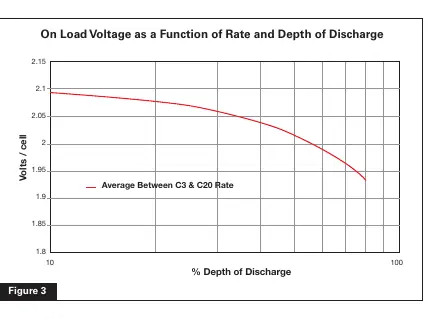
- Figure 3: Displays on-load voltage curves relative to discharge rate.
- Figure 4: Provides time to full charge based on current limits and depth of discharge.
- Figure 5: Details temperature compensation rates for fast charging.
Model compatibility
- Compatible with diesel generators, wind turbines, and PV arrays in hybrid setups.
- Requires rectifier voltage adjustment capabilities for optimal charging.
- Requires Ah counting devices with at least 1% accuracy for PSoC management.

Manual page author
Michael Turner
Technical manual editor
Reviews PDF manuals for structure, safety notes, and practical product details so readers can find the right information quickly.