Home / Security
User Manual for First Alert 2-Story Escape Ladder
Comprehensive user guide for the First Alert 2-Story Escape Ladder. Learn how to choose the right window, safely deploy the ladder in an emergency, and properly store it for future use.
Quick answers from the manual
Quick answer
- The First Alert 2-Story Escape Ladder is a 14-foot emergency exit device for second-story windows. It supports up to 375 lbs and requires a windowsill depth of 6-10 inches and a minimum window opening of 20x32 inches. p. 1, 2
Key actions
- Deploy the ladder by unfolding the sill hooks, placing them over the windowsill, and pulling the release strap. p. 2
First start
- Test fit the ladder on your chosen escape window before storing it to ensure compatibility. p. 2
Show 3 more answers Show less
Maintenance and reset
- Periodically inspect the ladder for damage, loose items, or material deterioration. p. 1
Technical specifications
| Parameter | Value | Meaning | Pages |
|---|---|---|---|
| Length | 14 feet (4.3 meters) | Total length of the ladder. | p. 1 |
| Load Rating | 375 lbs (170 kg) | Maximum weight capacity. | p. 1 |
| Windowsill Depth | 6-10 inches (15-25 cm) | Required depth for secure hook attachment. | p. 1, 2 |
Where to find it in the PDF
- Safety Warnings and Warranty p. 1
- Choosing a Window and Deployment p. 2
Table of contents
Manual images
Click an image to enlargeImportant Information
The First Alert 2-Story Escape Ladder is a 14-foot (4.3 meters) emergency exit device designed for use in two-story homes. It is intended to supplement, not replace, other fire protection measures like smoke alarms and evacuation plans. This ladder is designed for use by one person at a time and has a maximum load rating of 375 lbs (170 kg).
Safety Warnings
- Emergency Use Only: This ladder is not a toy or recreational device.
- Deployment: Do not use from windows above the second floor. Do not deploy into flames.
- Obstructions: Check for outside obstructions like electric lines, telephone wires, or fences before use.
- Children and Pets: Do not carry children or pets unless absolutely necessary.
- Inspection: Periodically inspect the ladder for damage, loose items, or material deterioration.
Choosing a Window
Before storing the ladder, you must test fit it on your chosen escape window. Ensure the window meets the following requirements:
- Width: At least 20 inches (51 cm).
- Height: At least 32 inches (81 cm).
- Windowsill Depth: Between 6 inches (15 cm) and 10 inches (25 cm).
- Accessibility: The window must open easily and completely. Ensure there are no obstructions like furniture, radiators, or security bars.
- Clear Path: There must be a clear path from the window to the ground. Do not use if the window is directly above a first-floor window.
Emergency Deployment
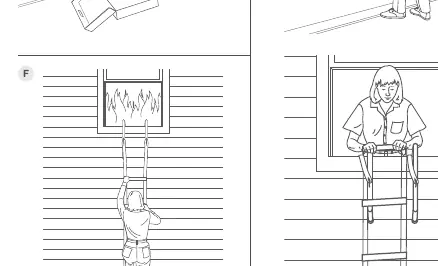
- Prepare: Close the door leading out of the room to prevent fire from being drawn in.
- Unfold: Remove the ladder from the box and unfold the sill hooks so the folding crosspiece is straight and positioned towards you. The red section of the sill hooks should be on top.
- Secure: Place the sill hooks firmly over the windowsill. The black section of the hooks will go outside the window, while the red section remains inside.
- Deploy: Pull the release strap to deploy the ladder.
- Exit: Exit carefully through the window, place your feet on the first rung, and hold onto the window frame until your weight is evenly distributed. Climb down, keeping your body close to the ladder.
Storage and Maintenance
To ensure the ladder is ready for an emergency, store it in an accessible location near the exit window, such as under a bed or in a closet. Keep it in its original box to prevent tangling.
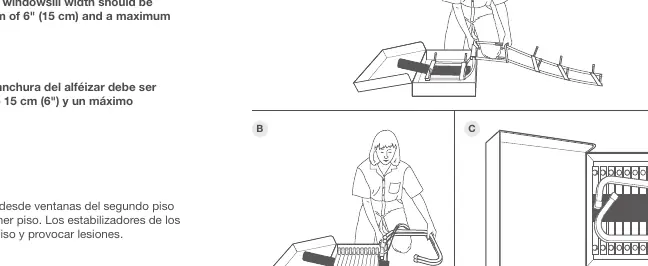
To repack the ladder:
- Stretch the ladder out on the floor with rung standoffs facing up.
- Place rungs as close as possible to each other.
- Use the plastic strap attached to the last rung to secure the rungs.
- Place the folded sill hooks on top of the rungs, between the standoffs.
Manufacturer information
First Alert
Practical help
Common problems
Window is too small or large for the hooks.
Ensure the windowsill depth is between 6 and 10 inches. If it falls outside this range, do not use the ladder on that window.
Ladder becomes tangled when removed from the box.
Always store the ladder in its original box, with rungs secured by the plastic strap and hooks placed correctly between standoffs.
Window is obstructed by furniture or security bars.
Do not use the ladder on windows with obstructions. Choose a different window that opens easily and completely.
Before use
- Test fit the ladder on your chosen window before storing it.
- Verify the window opens easily and completely.
- Measure the windowsill depth (must be 6-10 inches).
- Check outside for obstructions like trees, bushes, or wires.
- Ensure the window is on the second floor (max 14 ft height).
Show more Show less
Specs in practice
- Windowsill Depth
- 6-10 inches (15-25 cm) - required for secure hook attachment.
- Min. Window Opening
- 20 inches wide by 32 inches high.
Images and diagrams
- Diagram A: Measuring the windowsill depth from outside to inside.
- Diagram B: Securing the rungs with the plastic strap to prevent tangling.
- Diagram C: Placing the folded sill hooks on top of the rungs between standoffs.
- Diagram D, E, F: Steps for deploying the ladder in an emergency.
Model compatibility
- Not for use on windows above the second floor.
- Not for use on windows directly above a first-floor window (stabilizers may break the lower window).
- Not for use on windows with storm windows or multi-track windows that prevent full opening.

Manual page author
David Miller
Documentation analyst