Electronics / Networking
User Manual for StarTech.com Gigabit Ethernet to SC Fiber Media Converter MCMGBSCSM10
Quick start guide for the StarTech.com MCMGBSCSM10 Gigabit Ethernet to SC Fiber Media Converter. Includes installation steps, LED indicator explanations, and LFP configuration.
Table of contents
Quick guide from the manual
This guide provides instructions for the StarTech.com MCMGBSCSM10 Gigabit Ethernet to SC Fiber Media Converter. The device is designed to convert 10/100/1000 Mbps Ethernet to a 1000Base-LX fiber connection. It features Link Fault Pass-through (LFP) functionality and supports auto-negotiation for triple-speed Ethernet connections.
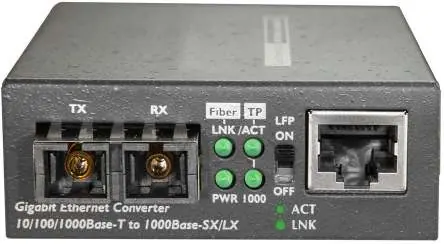
Package contents
- 1 x Media Converter
- 1 x Universal Power Adapter (NA/JP, UK, EU, ANZ)
- 1 x Quick Start Guide
Installation
- Power off the device you intend to connect to the media converter.
- Connect a fiber optic cable to the device and to the SC fiber port on the media converter. Ensure that you swap the TX and RX cables between the device and the media converter.
- Connect an Ethernet cable to the device and to the RJ45 Ethernet port on the media converter.
- Connect the universal power adapter to the power port on the media converter and plug it into a wall outlet. Verify that the PWR LED on the media converter lights up.
- Power on the connected device. Check that the FX and TP-Link LEDs illuminate.
Link Fault Pass-through (LFP)
The MCMGBSCSM10 includes LFP functionality, which is enabled by default. If a link failure occurs on the local side, the media converter interrupts the link on the remote side to notify network administrators. To disable LFP:
- Disconnect the power adapter from the media converter.
- Set the Link Fault Pass-through switch to the OFF position.
- Reconnect the power adapter to the media converter.
LED Indicators
- PWR: Solid green indicates power is on; off indicates no power.
- Fiber LNK/ACT: Solid green indicates fiber connection detected; off indicates no connection; flashing green indicates data is being sent or received.
- TP LNK/ACT: Solid green indicates Ethernet connection detected; off indicates no connection; flashing green indicates data is being sent or received.
- TP 1000: Solid green indicates 1000Mbps connection; off indicates 10/100Mbps connection.
Official resources from the manual
Practical help
Common problems
Fiber link not detected
Ensure the fiber cable is securely connected and that the TX and RX cables are swapped correctly between the device and the converter.
Ethernet link not detected
Verify the Ethernet cable is securely connected to both the converter and the network device.
LFP feature not behaving as expected
Check the LFP switch position on the front panel. It is enabled by default (ON). To disable, you must power cycle the unit after changing the switch position.
Before use
- Ensure you have a Gigabit (1000Mbps) fiber network.
- Verify you have an Ethernet network (10/100/1000).
- Power off all devices before making physical connections.
- Check that you have the correct power adapter for your region.
Specs in practice
- LFP (Link Fault Pass-through)
- A diagnostic feature that drops the remote link if the local link fails, alerting administrators to connection issues.
- Triple Speed
- The RJ45 port supports auto-negotiation for 10, 100, and 1000 Mbps speeds.
Images and diagrams
- The front panel features the SC fiber ports (TX/RX), LFP switch, LED indicators, and the RJ45 Ethernet port.
- The rear panel contains the 5V DC power input.
Model compatibility
- Designed for Single Mode fiber networks.
- Supports 10/100/1000 BASE-T Ethernet standards.

Manual page author
David Miller
Documentation analyst
Organizes user manual content into clear summaries, with attention to model details, product context, and everyday usability.