Tools / Power Tools
Handling instructions for HiKOKI DH 1826DA and DH 1826DC Cordless Rotary Hammer
Quick guide for the HiKOKI DH 1826DA and DH 1826DC cordless rotary hammers, covering battery operation, mode selection, Reactive Force Control (RFC), and maintenance procedures.
Table of contents
Manual images
Jump to the sectionQuick guide from the manual
This document provides handling instructions for the HiKOKI DH 1826DA and DH 1826DC cordless rotary hammers. It covers safe operation, battery management, mode selection, and maintenance. Always ensure the tool is switched off and the battery is removed before performing any adjustments, accessory changes, or maintenance.

Operation modes
The tool features three main operation modes selectable via the change lever:
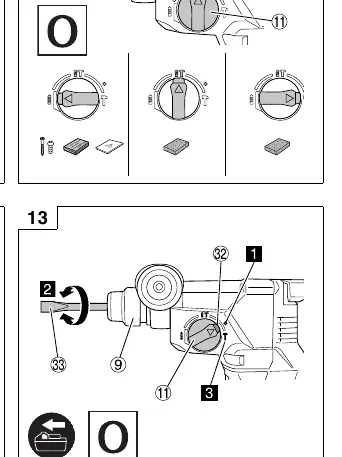
- Rotation and hammering: For drilling anchor holes, concrete, or tile.
- Rotation only: For drilling in steel or wood (requires optional accessories).
- Hammering only: For light-duty chiseling, groove digging, and edging.
Auto stop function
The tool includes an auto stop function for continuous drilling. To use it, press the changeover switch for over two seconds to enter memory mode (auto stop lamp blinks). Perform the drilling task; the tool records the time from switch ON to switch OFF. Subsequent drilling will automatically stop if the work exceeds the recorded time. Cancel by pressing the switch again for over two seconds.
Reactive Force Control (RFC)
The RFC feature reduces tool body jerking if the bit is suddenly overburdened. If triggered, the motor stops and the display lamp blinks. Release the switch, remove the cause of the overburden, and wait for the blinking to stop before resuming.
Battery and charging
Use only specified HiKOKI batteries and chargers. The battery indicator shows remaining power. If the tool stops due to overload or overheating, allow the battery to cool before resuming. Keep battery terminals clean and free of concrete dust to prevent malfunctions.
Maintenance and inspection

- Tool inspection: Sharpen or replace dull bits to maintain efficiency.
- Mounting screws: Regularly check and tighten all mounting screws.
- Cleaning: Wipe the tool with a soft, dry cloth. Do not use solvents. Clean the battery compartment and terminals after drilling concrete to ensure proper contact.
- Storage: Store in a dry place below 40°C, out of reach of children.
Manufacturer information
HiKOKI
Practical help
Common problems
Tool does not run
Check battery charge, ensure battery is securely clicked into place, and clean concrete dust from terminals.
Tool suddenly stopped
The tool was likely overburdened (RFC triggered) or the battery is overheated. Remove the cause of the overburden or let the battery cool.
Drill bits fall off or cannot be attached
Ensure the bit shank type matches the tool and the bit diameter is within the designated range.
Before use
- Ensure the battery is fully charged.
- Check that the battery is firmly installed.
- Verify the correct operation mode is selected.
- Ensure the side handle is securely tightened.
- Check for buried electrical cables or conduits in the work area.
Specs in practice
- n0 (No-load speed)
- The rotational speed of the tool when not under load (0-950 /min).
- Bpm (Full-load impact rate)
- The number of impacts per minute under full load (0-4300 /min).
Images and diagrams
- Fig. 1: Overview of tool parts and display panel.
- Fig. 4: Correct battery insertion into the charger.
- Fig. 11: Selecting the operating mode (Rotation, Hammering, or both).
- Fig. 23: Reactive Force Control (RFC) activation scenario.
Model compatibility
- Compatible with HiKOKI Multi Volt and BSL18xx series batteries.
- Existing batteries (BSL3660/3626X/3626/3625/3620 and BSL14xx series) cannot be used.

Manual page author
David Miller
Documentation analyst
Organizes user manual content into clear summaries, with attention to model details, product context, and everyday usability.