Tools / Anchoring Systems
Installation Guide for Hilti HIT-Z and HIT-Z-R Anchor Rods
A comprehensive installation guide for Hilti HIT-Z and HIT-Z-R anchor rods. This guide provides step-by-step visual instructions, torque specifications, and technical parameters for proper installation using Hilti HIT-HY 200 mortar systems.
Quick answers from the manual
Quick answer
- The Hilti HIT-Z/HIT-Z-R installation involves drilling, cleaning, injecting HIT-HY 200 mortar, inserting the anchor, allowing it to cure, and tightening to the specified torque. p. 1
Key actions
- Drill the hole to the specified diameter (d0) and depth (hef). p. 1
- Clean the hole thoroughly. p. 1
- Inject mortar and insert the anchor. p. 1
- Tighten the anchor to the specified torque (Tinst). p. 1
Technical specifications
| Parameter | Value | Meaning | Pages |
|---|---|---|---|
| Torque (Tinst) 3/8" | 15 lb/ft (20 Nm) / 30 lb/ft (40 Nm) | Torque for HIT-Z vs HIT-Z-R | p. 2 |
| Torque (Tinst) 1/2" | 30 lb/ft (40 Nm) / 65 lb/ft (90 Nm) | Torque for HIT-Z vs HIT-Z-R | p. 2 |
| Torque (Tinst) 5/8" | 60 lb/ft (80 Nm) / 125 lb/ft (170 Nm) | Torque for HIT-Z vs HIT-Z-R | p. 2 |
| Torque (Tinst) 3/4" | 110 lb/ft (150 Nm) / 165 lb/ft (220 Nm) | Torque for HIT-Z vs HIT-Z-R | p. 2 |
Where to find it in the PDF
- Installation Steps p. 1
- Technical Specifications p. 2
Table of contents
Quick Guide from the Manual
This document provides the installation procedure for Hilti HIT-Z and HIT-Z-R anchor rods using the HIT-HY 200-A or HIT-HY 200-R mortar systems. The installation must be performed within a temperature range of +5°C to +40°C (+41°F to +104°F).
Installation Steps
Follow these steps to ensure a secure installation:
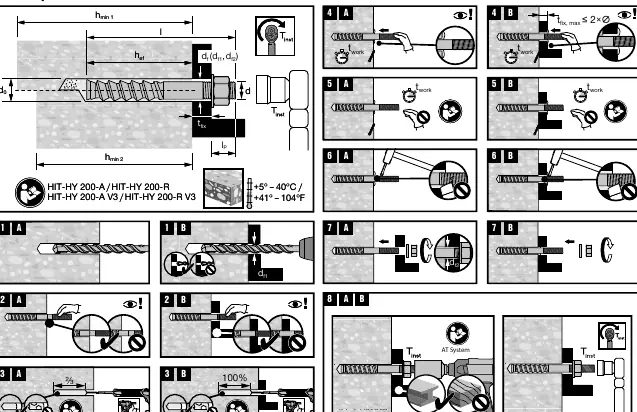
- Drilling: Drill the hole to the required diameter (d0) and depth (hef).
- Cleaning: Thoroughly clean the drilled hole to remove dust and debris.
- Injection: Inject the HIT-HY 200 mortar into the hole. Ensure the hole is filled to the required percentage (typically 2/3).
- Insertion: Insert the anchor rod into the hole.
- Curing: Allow the mortar to cure for the specified working time (twork). Do not disturb the anchor during this period.
- Tightening: Once cured, tighten the anchor to the specified torque (Tinst) using the appropriate tool.
Technical Specifications
The installation parameters vary based on the anchor diameter (3/8", 1/2", 5/8", 3/4"). Key parameters include:
- Hole Diameter (d0): Ranges from 7/16" to 7/8" depending on the anchor size.
- Embedment Depth (hef): Varies by diameter; refer to the technical table for specific depth requirements.
- Torque (Tinst): Specific torque values are required for HIT-Z/HIT-Z-F and HIT-Z-R variants. For example, 3/8" anchors require 15 lb/ft (20 Nm) for HIT-Z and 30 lb/ft (40 Nm) for HIT-Z-R.
- AT System: The installation may require specific AT system components (e.g., SIW 4AT-22 + SI-AT-22) depending on the anchor size.
Manufacturer information
Hilti Corporation
Practical help
Common problems
Improper hole cleaning
Ensure the hole is thoroughly cleaned of dust and debris before injecting mortar to guarantee proper adhesion.
Incorrect torque application
Use a calibrated torque wrench and apply the specific torque value (Tinst) listed for your anchor diameter and material type (HIT-Z vs HIT-Z-R).
Temperature out of range
Ensure the ambient temperature is between +5°C and +40°C (+41°F and +104°F) during installation.
Before use
- Verify the anchor diameter and length.
- Check the ambient temperature is within +5°C to +40°C.
- Ensure the correct drill bit diameter (d0) is used.
- Confirm the required embedment depth (hef).
- Have the correct torque wrench and AT system components ready.
Images and diagrams
- The installation diagram illustrates the 8-step process from drilling to final tightening.
- The technical table provides specific values for different anchor diameters (3/8", 1/2", 5/8", 3/4").
Model compatibility
- Compatible with HIT-HY 200-A, HIT-HY 200-R, HIT-HY 200-A V3, and HIT-HY 200-R V3 mortar systems.
- Specific AT System components are required based on anchor diameter.

Manual page author
David Miller
Documentation analyst
Organizes user manual content into clear summaries, with attention to model details, product context, and everyday usability.