Automotive / ECU Tuning
Emergency Response Guide for Honda Prelude 2026-Present
A comprehensive emergency response guide for the Honda Prelude 2026-Present. This document provides critical safety information, including vehicle identification, immobilization procedures, high-voltage system shutdown, lifting points, and...
Table of contents
Manual images
Click an image to enlargeImportant Information for Emergency Responders
This guide is intended for emergency responders and service personnel. Lack of engine noise does not mean the vehicle is off. The vehicle may remain capable of movement until it is fully shut down. Always wear appropriate Personal Protective Equipment (PPE) when handling the vehicle.
Vehicle Identification
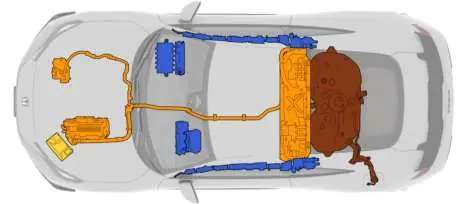
The Honda Prelude 2026-Present can be identified by its specific front and rear emblems. The vehicle contains high-voltage components, airbags, seat belt pretensioners, and a gasoline tank. Refer to the component map for the location of high-voltage cables, battery packs, and SRS control units.
Immobilization and Lifting
To immobilize the vehicle:
- Block the wheels.
- Pull the parking brake switch up; the BRAKE indicator will illuminate.
- Press the brake pedal and press the P (Park) button.
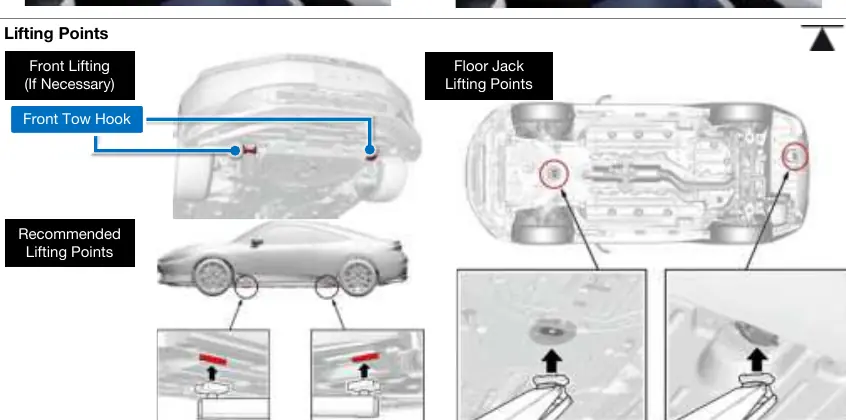
For lifting, use the designated front tow hook for front lifting if necessary. Refer to the vehicle diagram for the specific floor jack lifting points located under the chassis.
Disabling Direct Hazards
Preferred Method:
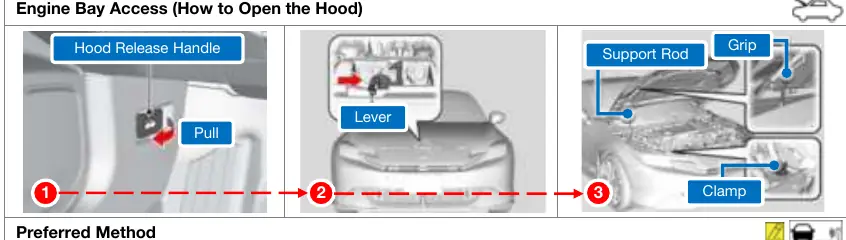
- Open the hood using the release handle.
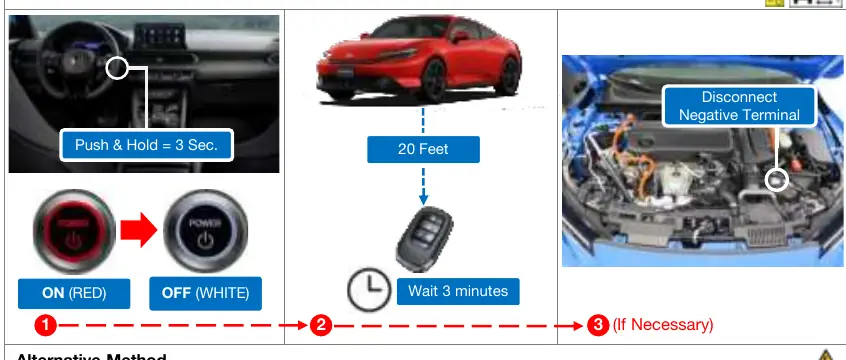
- Push and hold the power button for 3 seconds to turn the system OFF (White indicator).
- Move the key at least 20 feet away and wait 3 minutes.
- Disconnect the negative terminal of the 12-volt battery.
Alternative Method: If the preferred method is not possible, high-voltage cables can be cut at designated locations using appropriate rescue tools.
Occupant Access
The vehicle uses a combination of laminated and tempered glass. Be aware of glass types when attempting to gain access to the cabin.
Emergency Procedures
In Case of Fire
Use plenty of water, carbon dioxide, nitrogen gas, chemical powder, or fire foam. If safe, open the passenger door and direct water into the high-voltage battery vent located under the rear seat cushion. Be aware of the potential for battery reignition.
In Case of Submersion
There is no risk of electric shock from touching the vehicle body in or out of the water. If the high-voltage battery was submerged, you may hear noises as cells discharge. Pull the vehicle out of the water first, then shut down the high-voltage system. Always wear insulating gloves, goggles, and boots if touching high-voltage components.
Manufacturer information
Honda Motor Co., Ltd.
Practical help
Common problems
Vehicle is silent
Lack of engine noise does not mean the vehicle is off. Always assume the vehicle is active until fully shut down.
Need to disable high voltage
Use the preferred method: Power off, move key 20 feet away, wait 3 minutes, and disconnect the negative 12V battery terminal.
Vehicle is submerged
Remove the vehicle from water first. There is no shock risk from the body, but wear PPE if touching high-voltage components.
Before use
- Wear appropriate PPE
- Block the wheels
- Engage the parking brake
- Shift to Park (P)
Show more Show less
Specs in practice
- High-Voltage Battery
- 262 V, Lithium-Ion
- 12-Volt Battery
- Lead Acid
Images and diagrams
- The vehicle diagram highlights high-voltage components in orange, SRS control units in yellow, and seat belt pretensioners in purple.
- Cutting points for the alternative shutdown method are clearly marked on the vehicle diagram.

Manual page author
David Miller
Documentation analyst