Industrial / Fuel Dispensing Equipment
Husky 1HSS Nozzle User Guide
Quick guide for the Husky 1HSS pressure-activated automatic shut-off nozzle. Includes features, specifications, model options, and system components for truck and high-volume fueling.
Quick answers from the manual
Quick answer
- The Husky 1HSS is a pressure-activated, automatic shut-off nozzle for truck and high-volume fueling, supporting flow rates up to 25 gpm (94.6 Lpm). p. 1, 2
Key actions
- Ensure the nozzle is not raised above horizontal to prevent Flo-Stop activation. p. 1
Problems and fixes
Nozzle shuts off unexpectedly
Check if the pump is off, the tank is full, the lever was opened before the pump was turned on, or the leak detector has not completed the test cycle.
p. 1Show 2 more answers Show less
Technical specifications
| Parameter | Value | Meaning | Pages |
|---|---|---|---|
| Max Flow Rate | 25 gpm / 94.6 Lpm | Maximum dispensing capacity | p. 1, 2 |
| Inlet | 1 inch NPT or BSP | Connection type | p. 2, 4 |
Where to find it in the PDF
- Product Overview and Models p. 1
- Dimensions and Construction p. 2
- Options and Accessories p. 3, 4
Table of contents
Manual images
Click an image to enlargeQuick guide from the manual
The Husky 1HSS is a pressure-activated, automatic shut-off nozzle designed for truck and high-volume fueling applications. It is capable of dispensing up to 25 gpm (94.6 Lpm). The nozzle features an ADA-compliant EZ Lever that reduces the force required to open the main poppet valve to 5 lbs or less.
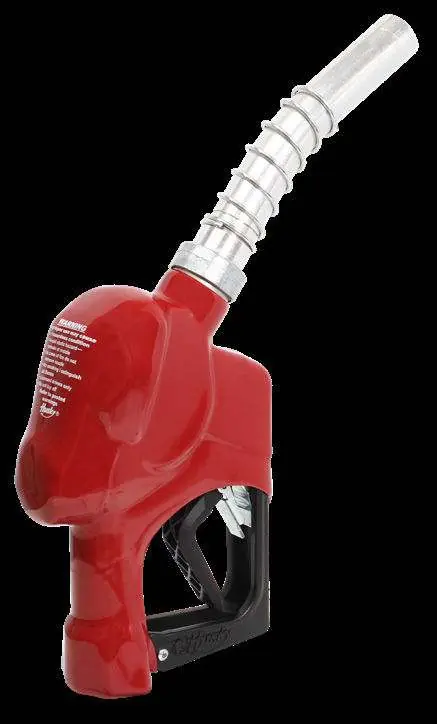
Automatic shut-off conditions
The 1HSS nozzle is designed to shut off automatically under the following conditions:
- The pump shuts off.
- The gas tank is full.
- The lever is opened before the pump is turned on.
- The leak detector has not completed the test cycle.
Additionally, the nozzle is equipped with a unique Flo-Stop device that shuts off the nozzle if it falls from the fill neck or raises above the horizontal position.
Construction and specifications
The nozzle is built for durability in high-volume environments:
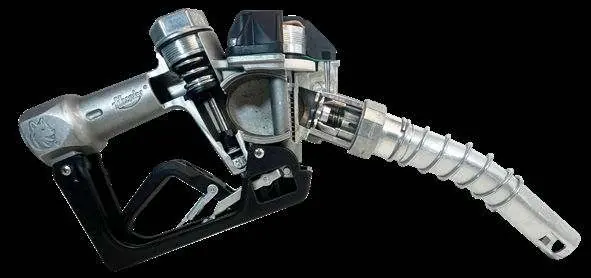
- Body: One-piece die-cast aluminum with high-impact polymer or metal handguard.
- Seals: Fluorocarbon.
- Packing: Double o-ring seal protected by fiber-reinforced Teflon.
- Lever: Two-piece polymer EZ Lever.
- Inlet: 1 inch (25.4 mm) NPT or 1 inch (25.4 mm) BSP.
- Temperature: Optional cold weather seals are rated to -40°F/C.
System options and accessories
The 1HSS system supports various configurations to suit different fueling station requirements:
- Guards: Available in Full Grip, Waffle, and Mate guard styles.
- Handguards: Options include Standard Polymer, Standard Metal, and specific versions for Gilbarco, Tokheim, and Wayne dispensers (with or without magnet).
- Swivels and Safe-T-Breaks: A wide range of NPT and BSP compatible swivels, Safe-T-Breaks, and combination units are available.
- Latch Plates: 1-position and 2-position latch plates are available for hold-open clips.
Manufacturer information
Husky
Practical help
Common problems
Nozzle shuts off unexpectedly
Verify the pump is running, the tank is not full, the lever was not opened before the pump started, and the leak detector has completed its test cycle.
Nozzle falls out of fill neck
The Flo-Stop device will automatically shut off the nozzle if it falls from the fill neck or is raised above the horizontal position.
Before use
- Ensure the nozzle is properly connected to the dispenser hose.
- Verify the inlet type (NPT or BSP) matches your dispenser.
- Check that the lever operates smoothly.
- Confirm the nozzle is equipped with the correct handguard for your dispenser type (e.g., Gilbarco, Tokheim, Wayne).
Show more Show less
Specs in practice
- Lever Operating Force
- ADA-compliant design requires ≤5 lbs of force to open the main poppet valve.
Images and diagrams
- Dimensions: The nozzle height is 13 9/16 inches (344.5 mm) and width is 10 1/4 inches (260.4 mm).
- Flow Chart: Illustrates fuel flow (GPM/LPM) relative to inlet pressure (PSI/KPa).
Model compatibility
- Optional cold weather seals are available for temperatures down to -40°F/C.
- Handguards can be fitted with magnets for dispensers with proximity switches or provided without magnets for flapper switches.

Manual page author
David Miller
Documentation analyst