Automotive / Garage Equipment
User Manual for Pittsburgh 8-Ton and 12-Ton Heavy Duty Bottle Jack
Quick guide for the Pittsburgh Heavy Duty Bottle Jack (8-Ton and 12-Ton models). Includes safety instructions, lifting and lowering procedures, maintenance, and troubleshooting.
Table of contents
Manual images
Click an image to enlargeQuick Guide
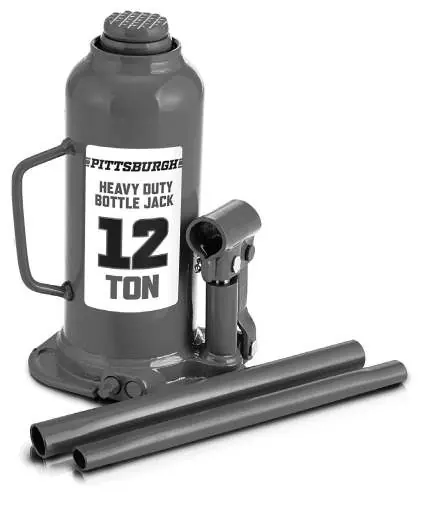
This manual provides instructions for the Pittsburgh Heavy Duty Bottle Jack, available in 8-Ton (56734) and 12-Ton (56739) capacities. Always read the safety information before use. The jack is designed for lifting vehicles on hard, level surfaces and must be used in conjunction with jack stands for safety.
Specifications
- 56734: 8 Tons (16,000 lb.) capacity, 17-3/4" max height, 9" min height.
- 56739: 12 Tons (24,000 lb.) capacity, 18" max height, 9" min height.
Important Safety Information
- Do not exceed rated capacity.
- Use only on hard, level surfaces.
- Lifting device only; immediately support the vehicle with jack stands after lifting.
- Do not adjust the safety valve.
- Wear ANSI-approved safety goggles and heavy-duty work gloves.
- Keep bystanders, children, and visitors away while operating.
- Do not work under the vehicle without properly supporting it with jack stands.
- Do not use for aircraft purposes.
Operating Instructions
Bleeding the Hydraulic System
If the jack does not appear to be working properly, it may need to be bled of excess air:
- Check the oil level.
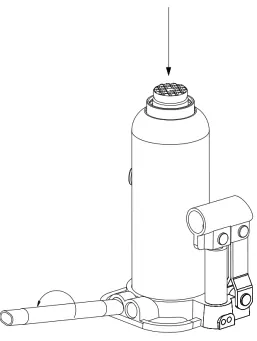
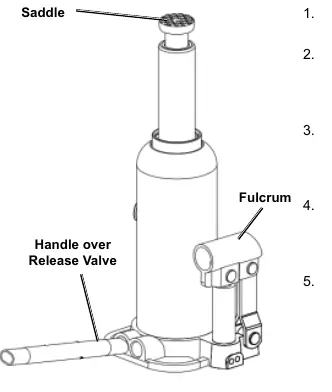
- Place the handle over the release valve and open it by turning counterclockwise.
- Insert the handle into the fulcrum and pump about five times.
- Apply pressure to the saddle and pump the handle quickly several more times to remove trapped air.
- Use a flat dull-sided edge to push down the top inside rim of the oil fill plug to equalize pressure, then release.
- Turn the handle clockwise to close the release valve and test the jack.
Lifting
- Set the jack on a flat, level, solid surface.
- Close the release valve by turning the handle clockwise.
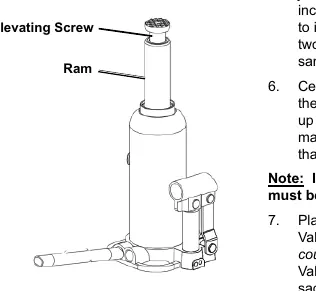
- Position the saddle under the vehicle manufacturer's recommended lifting point. Use the elevating screw to adjust the height if necessary.
- Pump the handle using smooth, full strokes.
- Once raised, slide jack stands of appropriate capacity under the vehicle.
- Lower the vehicle onto the jack stands.
Lowering
- Remove all tools and parts from under the vehicle.
- Position the saddle under the lifting point and pump slightly to raise the vehicle off the jack stands.
- Remove the jack stands.
- Slowly turn the release valve counterclockwise (never more than two full turns) to lower the vehicle to the ground.
Maintenance and Servicing
- Inspection: Before each use, check for broken, cracked, or bent parts, and loose or missing components. Do not use damaged equipment.
- Oil Level: Check before each use. With the jack upright and level, remove the oil fill plug. The oil should be level with the bottom of the fill hole.
- Oil Change: Change the hydraulic oil at least once every three years. Drain old oil, refill with high-quality hydraulic jack oil until it reaches the fill hole, and bleed the system.
- Cleaning: Clean with a clean cloth and detergent or mild solvent. Store in a safe, dry location.
Troubleshooting
- Jack will not lift: Check that the release valve is closed fully.
- Saddle lowers under load: Valves may be blocked. Lower the saddle, close the valve, manually lift the saddle, then open the valve and force the saddle down quickly to flush the valves.
- Pump feels spongy: The jack may require bleeding.
- Oil leaking from fill plug: Unit may have too much hydraulic oil; check fluid level and adjust.
Parts List
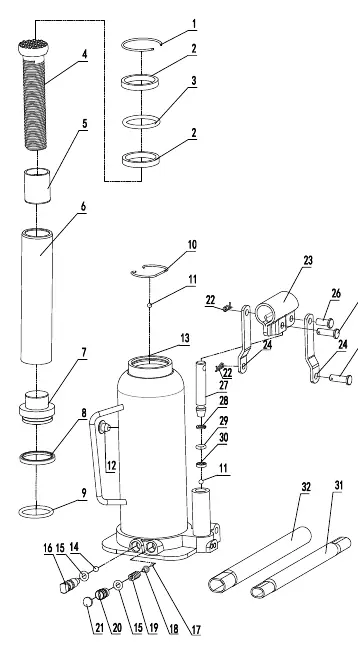
The manual includes a detailed parts list and diagram for models 56734 and 56739, including components like the saddle, elevating screw, ram, piston, release valve, and pump plunger. When ordering parts, specify the UPC: 193175465832 (12 Ton) or 193175465849 (8 Ton).
Practical help
Common problems
Jack will not lift at its weight capacity
Check that the release valve is closed fully.
Saddle lowers under load
Valves may be blocked. Flush the valves by lowering the saddle, closing the valve, manually lifting the saddle, then opening the valve and forcing the saddle down quickly.
Pump stroke feels spongy
The jack may require bleeding to remove trapped air.
Oil leaking from fill plug
Unit may have too much hydraulic oil; check fluid level and adjust.
Before use
- Inspect for broken, cracked, or bent parts.
- Check for loose or missing parts.
- Check hydraulic oil level.
- Ensure the surface is hard and level.
- Read the vehicle owner's manual for recommended lifting points.
- Wear ANSI-approved safety goggles and heavy-duty work gloves.
Specs in practice
- Weight Capacity
- The maximum load the jack is designed to lift safely (8 Tons or 12 Tons).
Images and diagrams
- Saddle: The contact point that lifts the vehicle.
- Release Valve: Turn counterclockwise to lower the jack, clockwise to close.
- Fulcrum: The socket where the handle is inserted to pump the jack.
- Elevating Screw: Adjustable screw on top of the saddle for fine-tuning height.
Model compatibility
- 56734: 8-Ton capacity.
- 56739: 12-Ton capacity.
- Not for aircraft use.
- Use only on hard, level surfaces.

Manual page author
Emily Carter
User documentation editor
Prepares concise manual descriptions and highlights the most useful setup, operation, and maintenance information for readers.