Electronics / Microphones
User Manual for Saramonic SG MIC Shotgun Microphone
Quick guide for the Saramonic SG MIC shotgun microphone. Learn about setup, 48V phantom power requirements, technical specifications, and usage precautions.
Quick answers from the manual
Quick answer
- The Saramonic SG MIC is a professional supercardioid shotgun microphone that requires 48V phantom power to operate. It is designed for film, dialog, and field production. p. 2
Key actions
- Connect the microphone to a 48V phantom power source (camera, mixer, or recorder) using the provided XLR cable. p. 2
First start
- Attach the microphone to the clip, connect the XLR cable to your recording device, and ensure 48V phantom power is enabled on that device. p. 2
Problems and fixes
Microphone not working
Verify that the connected device is supplying 48V phantom power.
p. 2Maintenance and reset
- Clean the unit with only a soft, dry cloth. Keep away from dust and moisture. p. 2
Technical specifications
| Parameter | Value | Meaning | Pages |
|---|---|---|---|
| Frequency Response | 20-20kHZ | Full frequency range | p. 3 |
| Sensitivity | -37dB | Microphone sensitivity | p. 3 |
Where to find it in the PDF
- Product Overview p. 2
- Specifications p. 3
Table of contents
Manual images
Click an image to enlargeQuick guide from the manual
The Saramonic SG MIC is a professional supercardioid shotgun microphone designed for film production, dialog, ENG, and field production. It requires 48V phantom power to operate. Ensure your recording device, camera, or mixer is set to provide this power for the microphone to function.
Product Overview
The package includes the following items:
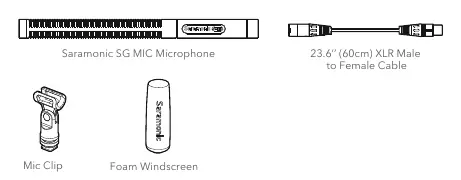
- Saramonic SG MIC Microphone
- 23.6 inch (60cm) XLR Male to Female Cable
- Mic Clip
- Foam Windscreen
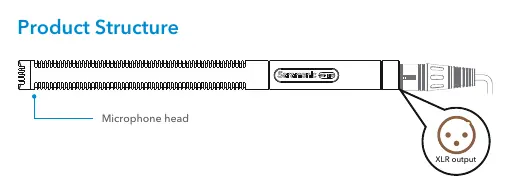
The microphone features a rugged all-brass body and a 3-pin XLR output connector.
Setup and Power Supply
To set up the microphone:
- Attach the microphone to your recording device or camera using the included XLR cable.
- Ensure your recording device (such as the Saramonic SR-PAX1, SmartRig+, SmartRig II, or SR-AX107) is configured to supply 48V phantom power.
- Use the included mic clip for mounting and the foam windscreen for outdoor or windy conditions.
Usage Precautions
- Do not disassemble the unit; it is for professional use only.
- Keep the microphone away from heat sources like radiators or spotlights.
- Clean the unit only with a soft, dry cloth.
- Protect the device from dust and moisture during use and storage.
- For the best pick-up pattern, do not hold your hand against the microphone capsule cover.
Technical Specifications
The Saramonic SG MIC offers the following performance characteristics:
- Frequency Response: 20-20kHZ
- Polar Pattern: Supercardioid
- Sensitivity: -37dB
- Signal-to-Noise Ratio: 80dB
- Max SPL: 128dB
- Operating Temperature: -20°C to 50°C
- Output Connection: 3-pin XLR
Practical help
Common problems
No sound output
Ensure your camera, mixer, or recording device is providing 48V phantom power to the microphone.
Poor audio quality or muffled sound
Ensure your hand is not covering the microphone capsule cover, as this interferes with the pick-up pattern.
Before use
- Verify the recording device supports 48V phantom power
- Connect the provided XLR cable securely
- Attach the foam windscreen if recording outdoors
- Mount the microphone using the provided clip
- Check that the environment is within the -20°C to 50°C operating range
Specs in practice
- Supercardioid Polar Pattern
- Highly directional pickup that focuses on sound in front of the mic while rejecting noise from the sides and rear.
- 128 dB Max SPL
- The maximum sound pressure level the microphone can handle without distortion.
Images and diagrams
- The product structure diagram identifies the microphone head and the XLR output port.
- The polar pattern diagram illustrates the directional sensitivity of the microphone.
Model compatibility
- Requires 48V phantom power.
- Compatible with devices like Saramonic SR-PAX1, SmartRig+, SmartRig II, and SR-AX107.

Manual page author
David Miller
Documentation analyst
Organizes user manual content into clear summaries, with attention to model details, product context, and everyday usability.