Plumbing / Sinks Faucets
User Manual for Steinbach Skyfall Solar Shower
Quick guide for the Steinbach Skyfall solar shower, covering installation, tank filling, operation, maintenance, and troubleshooting.
Table of contents
Quick guide from the manual
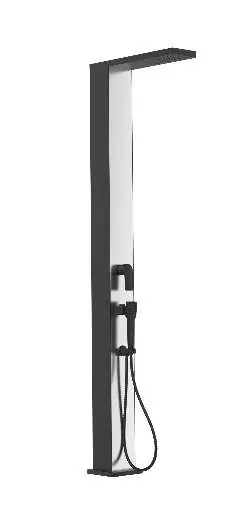
This solar shower is designed for outdoor use. It features a 40-liter tank that heats water using solar energy. The shower must be securely anchored to a stable, level, and slip-proof surface (concrete or wood) before use. If temperatures drop below 10°C, the tank must be drained and the shower stored in a frost-free location.
Installation
Assembling the solar shower:
- Place sealing rings into the top opening of the tank.
- Use the provided Allen wrench and screws to attach the shower head to the tank.
- Screw the hose adapter onto the hose connection.
- Attach the O-ring to the drain cap and screw it into the tank.
- Screw the handheld shower mount into the tank.
- Attach the hose to the handheld shower mount and the handheld shower itself.
Setting up: Position the shower at the prepared location. A second person should hold the shower steady while you bolt the base to the floor using appropriate mounting materials (not included).
Filling the tank
- Connect a garden hose to the hose adapter and the water supply faucet.
- Turn on the water supply. Turn the shower faucet to the 'hot' position and open it to allow the tank to fill (takes approx. 3 minutes).
- Once water flows consistently from the shower head, close the shower faucet.
- Turn off the water supply faucet.
Operation
To use the shower, connect the garden hose, turn on the water supply, and use the control dial to select the desired setting (Rain shower, Handheld shower, or Waterfall). Adjust the temperature using the main faucet. Note that water may drip from the shower head even when the faucet is closed; this is normal due to thermal expansion in the unpressurized tank.
Maintenance and Cleaning
Clean the product only with standard bathroom cleaner, clear water, and a lint-free cloth. Before long periods of non-use, drain the tank to prevent bacterial growth. To drain, disconnect the water supply, open the faucet, and remove the drain cap.
Troubleshooting
If water leaks from screw connections, wrap the thread with Teflon tape. If no water flows, check the supply hose for blockages. If the water is not hot, ensure the shower is placed in a sunny location. If the water smells or is discolored, drain and refill the tank.
Manufacturer information
Steinbach International GmbH
Practical help
Common problems
Water drips from shower head when faucet is closed
This is normal due to water heating in the unpressurized tank; it is not a defect.
Water leaks from a screw connection
Wrap the thread with Teflon tape.
No water flows from the shower head
Check the water supply and garden hose for damage or blockages.
Water is not hot
Ensure the shower is positioned in an area with sufficient sunlight.
Water smells or is discolored
Drain the tank via the drain cap and refill with fresh water.
Before use
- Ensure the shower is bolted to a stable, level surface.
- Check that all screw connections are tight (use Teflon tape if necessary).
- Ensure the shower is oriented in the correct direction.
- Drain the tank if the shower has not been used for a long period.
- Verify the water supply is connected and free of blockages.
Specs in practice
- Maximum operating water pressure
- 5 bar (use a pressure regulator if necessary)
Images and diagrams
- The shower body acts as a solar collector; cold water enters at the bottom, pushing heated water out from the top.
- Pressure buildup from heating is released through the shower head, causing occasional dripping.
Model compatibility
- Requires a stable, level, and slip-proof surface (concrete or wood).
- Optional Steinbach Outdoor floor element (art. no. 049028) is available for installation.

Manual page author
David Miller
Documentation analyst
Organizes user manual content into clear summaries, with attention to model details, product context, and everyday usability.