HVAC / Air Conditioners
Installation and Owner's Manual for ACIQ Multi-Zone Condenser
Comprehensive installation and operation guide for ACIQ Multi-Zone Condenser (ACIQ-18Z-E-M2, ACIQ-24Z-E-M3). Includes safety protocols for R32 refrigerant, electrical wiring, piping installation, vacuuming procedures, and a detailed list...
Quick answers from the manual
Quick answer
- This manual provides installation, operation, and maintenance instructions for the ACIQ R32 Multi-Zone Condenser. It covers safety protocols for R32 refrigerant, electrical wiring, piping installation, vacuuming procedures, and a comprehensive list of fault codes. p. 1, 13, 14, 15
Key actions
- Perform vacuuming p. 13
- Connect wiring p. 14, 15
First start
- Verify piping and wiring connections. p. 15
- Ensure valves are fully open. p. 15
Problems and fixes
Unit does not operate
Check power supply, fuse, wiring, and start-up delay.
p. 16Error codes
| Code | Meaning | Action | Pages |
|---|---|---|---|
| A1 | Fault with the room temperature sensor on the N # indoor unit | Check sensor, wiring, and PCB. | p. 17 |
| H1 | High Pressure Switch Protection | Check for system dirty blocking. | p. 17 |
Technical specifications
| Parameter | Value | Meaning | Pages |
|---|---|---|---|
| Refrigerant | R32 | Type of refrigerant used. | p. 2 |
| Vacuum requirement | -14.7psi (-76cmHg) | Required pressure for air expulsion. | p. 13 |
Where to find it in the PDF
- Safety and Warnings p. 3, 4, 5, 6
- Installation p. 7, 8, 9, 10
- Electrical Connections p. 14, 15
- Fault Codes p. 16, 17, 18, 19
Table of contents
Manual images
Click an image to enlargeQuick guide from the manual
This manual provides essential instructions for the installation, operation, and maintenance of the ACIQ R32 Multi-Zone Condenser. Important: This unit uses R32 refrigerant, which is flammable. Installation must be performed by a certified contractor. Ensure the installation site is well-ventilated and meets the required floor space specifications.
Safety Precautions
- R32 Refrigerant: Handle with extreme care. Do not use open flames or ignition sources near the unit.
- Electrical Safety: The unit must be grounded. Use a dedicated circuit. Do not attempt electrical work yourself; hire a qualified electrician.
- Installation Environment: Avoid areas with flammable gas leaks, strong electric/magnetic fields, or direct exposure to salt air/corrosive gases.
- Maintenance: Always switch off the power before cleaning or maintenance.
Installation
The outdoor unit must be installed on a secure, level surface. Ensure there is adequate clearance for airflow as specified in the manual.
Piping and Vacuuming
- Use only clean, undamaged copper tubing.
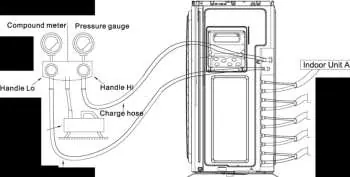
- Vacuuming: A vacuum pump must be used to expel air from the pipes and indoor unit. The vacuum must run for at least 15 minutes until the gauge reads -14.7psi (-76cmHg).
- Leak Test: After vacuuming, check all connections for leaks using the bubble method or a leak detector.
Electrical Connections
All electrical work must adhere to local and national codes. The system requires an independent power supply. Ensure the grounding wire is securely connected to the designated terminal. Secure all cables with cable ties to prevent disconnection.
Testing and Inspection
Before operation, verify that:
- All piping and wiring are correctly connected.
- Gas and liquid valves are fully open.
- The unit is properly grounded.
- The unit is mounted securely.
Fault Codes
The unit features a self-diagnostic system. If a malfunction occurs, the LED or digital tube will display a fault code. Common codes include:
- A1-A6: Indoor unit sensor or motor faults.
- C1-C6: Outdoor unit sensor faults.
- E1-E8: Protection faults (e.g., high pressure, discharge temperature).
- F1-F9: Compressor or module protection.
- H1-H9: Protection faults (e.g., high pressure, drainage).
Maintenance
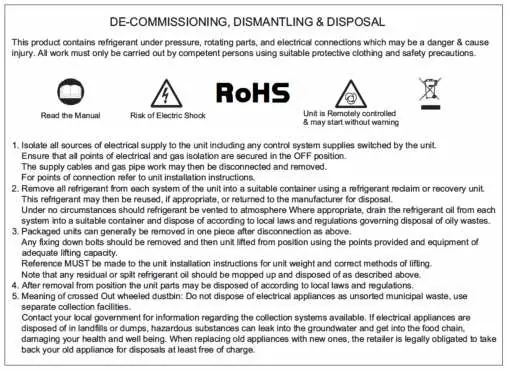
Regular maintenance is required to ensure system efficiency. If the unit is to be decommissioned, follow the specific procedures for refrigerant recovery and disposal to prevent environmental damage.
Manufacturer information
ACiQ
Practical help
Common problems
Unit does not operate at all
Check if the power is on, the fuse is intact, the wiring is secure, and if the unit is within the 3-minute start-up delay period.
Cooling or heating efficiency is poor
Check for dirty air filters, obstructed air inlets/outlets, or if the setting temperature is appropriate.
Mist emitted during operation
This is normal during rapid cooling or the defrosting process.
Low hissing sound
This is normal and caused by refrigerant flowing inside the unit.
Before use
- Ensure the unit is installed by a certified contractor.
- Verify the refrigerant is R32 and the installation site meets floor space requirements.
- Confirm the unit is properly grounded.
- Check that all piping and wiring connections are secure and leak-free.
- Ensure the vacuuming process is completed using a vacuum pump.
- Confirm gas and liquid valves are fully open.
Specs in practice
- R32 Refrigerant
- A flammable refrigerant that requires specific handling, ventilation, and leak detection protocols.
- Operating Voltage
- The unit operates within 90%-110% of the local rated voltage.
- Vacuum Pressure
- The system must reach -14.7psi (-76cmHg) during the air expulsion process.
Images and diagrams
- The installation diagrams show the required clearance distances from obstructions to ensure proper airflow.
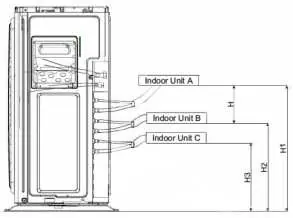
- The piping diagram illustrates the connection of indoor units to the outdoor condenser.
- The vacuum pump setup diagram shows the correct connection of the manifold valve, charge hose, and vacuum pump.
Model compatibility
- The line set piping size is determined by the indoor unit fittings.
- Adapters may be required for specific indoor unit models (e.g., 18K models).
- The system is designed for multi-zone configurations.

Manual page author
Emily Carter
User documentation editor
Prepares concise manual descriptions and highlights the most useful setup, operation, and maintenance information for readers.