Music / Guitar Effects
User Manual for Axiom SCV-1 Stereo Chorus-Vibrato Pedal
Quick guide for the Axiom SCV-1 Stereo Chorus-Vibrato pedal. Learn about control functions, stereo operation, and technical specifications.
Table of contents
Quick Guide
The Axiom SCV-1 is a 100% analog, bucket-brigade (BBD) chorus/vibrato pedal designed to produce a wide range of modulation effects, from subtle to deep. It features true bypass circuitry to ensure signal integrity when the effect is off.
Control Functions
The pedal features eight control knobs to shape your sound:
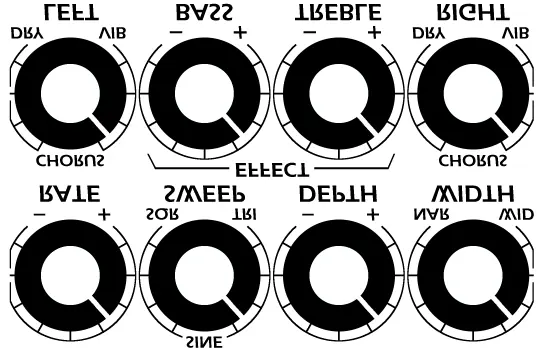
- RATE: Adjusts the sweep rate of the modulation. Turn clockwise to increase speed.
- SWEEP: Gradually changes the modulation waveform shape from square to sine to triangular.
- DEPTH: Controls the range of the modulation, from narrow to wide.
- WIDTH: Increases the base delay time (from less than 1ms to 20ms) as the knob is turned clockwise, creating a more intense effect.
- LEFT: Adjusts the modulation effect in the left channel from dry to vibrato.
- RIGHT: Adjusts the modulation effect in the right channel from dry to vibrato.
- BASS: Increases modulation applied to low frequencies.
- TREBLE: Increases modulation applied to high frequencies.
Stereo Operation
The SCV-1 allows for independent control of the left and right channels. This enables true stereo effects, such as 'motionless' chorus in both channels, pure vibrato in one channel and dry in the other (wet/dry chorus), or vibrato in both channels (180 degrees out of phase).
Technical Specifications
- Power: 9 Vdc (adapter or battery), 2.1 mm center negative.
- Current Draw: 38 mA (maximum).
- Input Impedance: 900 kOhm (minimum).
- Dimensions: Height 4.7", Width 3.9", Depth 1.3".
- Weight: 1.4 lbs (without 9V battery).
Practical help
Common problems
No sound or weak signal
Ensure the 9V battery is fresh or the power adapter is correctly connected (2.1mm center negative). Check that cables are securely plugged into the correct inputs/outputs.
Effect not intense enough
Increase the WIDTH knob to increase the base delay time, or increase the DEPTH knob to expand the modulation range.
Before use
- Ensure you are using a 9V DC power supply with a center-negative polarity.
- Check that your instrument cable is connected to the input.
- Verify that the pedal is set to the desired stereo or mono configuration using the LEFT and RIGHT knobs.
Specs in practice
- 9V DC Center Negative
- The standard power requirement for most guitar pedals. Using the wrong polarity can damage the unit.
- 900 kOhm Input Impedance
- Ensures the pedal does not load down your guitar pickups, preserving high-end frequencies.
- Bucket-Brigade (BBD) Circuitry
- An analog technology used to create delay-based effects like chorus and vibrato, known for a warm, organic sound.
Images and diagrams
- The control layout consists of two rows of four knobs.
- The top row controls the modulation characteristics (Rate, Sweep, Depth, Width).
- The bottom row controls the channel-specific output and frequency shaping (Left, Bass, Treble, Right).
Model compatibility
- Compatible with standard 9V DC guitar pedal power supplies.
- Designed for use with electric guitars, but can be used with other instruments.

Manual page author
David Miller
Documentation analyst
Organizes user manual content into clear summaries, with attention to model details, product context, and everyday usability.