Tools / Generators
User Manual for Champion 10,000W Tri-Fuel Electric Start Generator 201438
Quick guide for the Champion 10,000W Tri-Fuel Electric Start Generator (Model 201438). Includes assembly, fuel setup (gasoline, propane, natural gas), operation, maintenance, and troubleshooting.
Table of contents
Quick Guide from the Manual
This generator is designed to run on gasoline, propane (LPG), or natural gas (NG). Before first use, you must assemble the wheels and support leg, connect the battery, and add engine oil. Always operate the generator outdoors in a well-ventilated area to prevent carbon monoxide poisoning. The unit features a CO Shield system that automatically shuts off the engine if it detects unsafe levels of carbon monoxide.
Safety and CO Shield
Carbon Monoxide Safety: Generator exhaust contains poisonous carbon monoxide gas. Never operate the generator indoors, in garages, basements, or any enclosed space, even if doors and windows are open. Always point the exhaust away from people and buildings.
CO Shield System: This system monitors CO accumulation. If it detects unsafe levels, it shuts off the engine and a red LED will blink. If a system fault occurs, a yellow LED will blink. If the generator shuts off, move it to a well-ventilated outdoor area before attempting to restart.
Assembly
Unpacking and Setup:
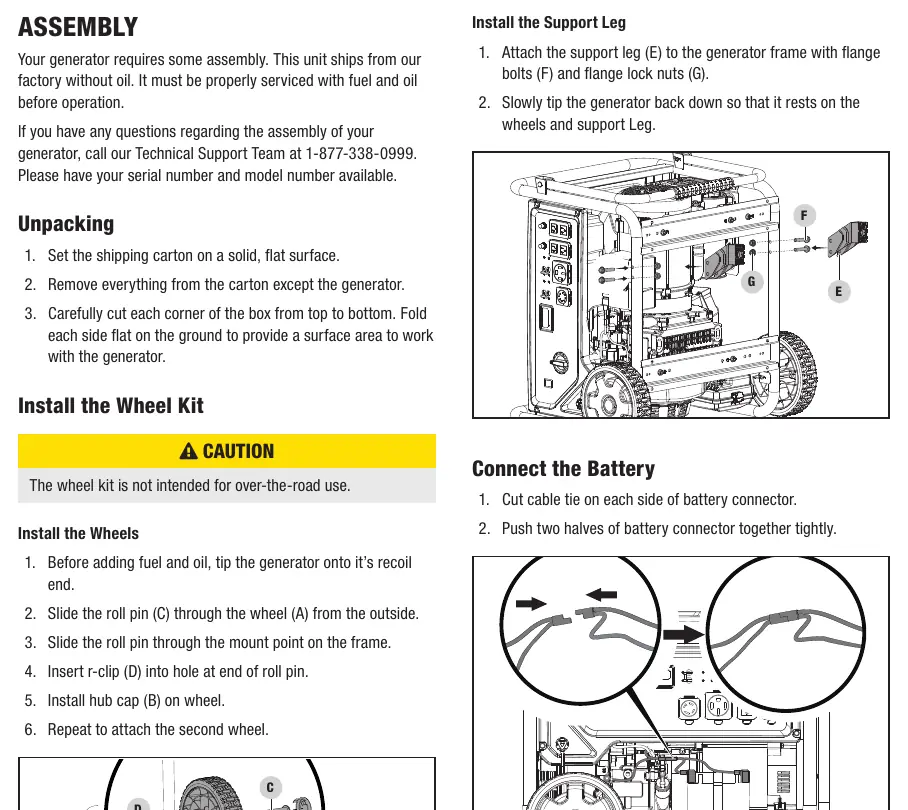
- Wheels: Tip the generator onto its recoil end. Slide the roll pin through the wheel and mount point on the frame, then secure with the r-clip. Install the hub cap.
- Support Leg: Attach the support leg to the frame using the provided flange bolts and lock nuts.
- Battery: Connect the two halves of the battery connector.
- Oil: Place the generator on a level surface. Remove the oil fill cap/dipstick and add up to 43.9 fl. oz. (1300 ml) of 10W-30 oil. Do not overfill.
Operation
Fuel Setup:
- Gasoline: Use regular unleaded gasoline (minimum 87 octane, max 10% ethanol). Do not overfill.
- Propane (LPG): Connect the LPG hose to the generator and the LPG cylinder. Open the cylinder valve and check for leaks with soapy water.
- Natural Gas (NG): Connect the NG hose using the adapter fitting. Use pipe sealant or Teflon tape on the adapter connection to the supply line, but not on the flare connection to the hose. Check for leaks before starting.
Starting the Engine:
- Ensure the generator is on a flat surface and all electrical loads are disconnected.
- Turn the fuel select dial to the desired fuel position (Gasoline, Propane, or Natural Gas).
- Move the choke lever to the "CHOKE" position.
- For electric start, press and hold the ignition switch to "START" for up to 5 seconds. For manual start, pull the recoil cord slowly until resistance is felt, then pull rapidly.
- Once the engine starts, gradually move the choke lever to the "RUN" position.
Maintenance
Follow the maintenance schedule to ensure longevity:
- Every 8 hours/before use: Check oil level, clean around air intake/muffler, check LPG hose for leaks.
- First 5 hours: Change engine oil.
- Every 50 hours/annually: Clean air filter.
- Every 100 hours/annually: Change oil, clean/adjust spark plug, clean spark arrestor, clean fuel valve filter.
Storage
If storing for more than 30 days, drain the gasoline from the carburetor to prevent clogging. For long-term storage (over 1 year), drain the fuel tank completely. Always disconnect LPG/NG hoses and store the generator in a cool, dry place.
Manufacturer information
Champion Power Equipment
Practical help
Common problems
Generator will not start
Check for fuel, ensure fuel select dial is set correctly, check oil level, ensure spark plug wire is connected, or check if the CO Shield module has been tampered with.
Generator shuts down during operation
Check for low oil, overload, or CO Shield activation. If CO Shield triggered, move to a well-ventilated area and ensure exhaust is not blowing back into the operating area.
Generator starts but runs roughly
Check choke lever position, clean or replace air filter, or clean the spark arrestor.
Generator will not start electrically
Recharge the generator battery.
Before use
- Check engine oil level (10W-30 recommended).
- Check fuel level (Gasoline, Propane, or Natural Gas).
- Ensure generator is on a flat, level surface.
- Ensure generator is outdoors and away from windows/doors.
- Check for fuel leaks (especially for LPG/NG connections).
- Ensure battery is connected.
- Disconnect all electrical loads before starting.
Specs in practice
- Running Watts
- 10,000W (Gasoline), 9,000W (LPG), 8,000W (NG).
- Gasoline Capacity
- 7.7 gallons (29.1 L).
- Engine Displacement
- 500 cc.
- Spark Plug Gap
- 0.028-0.031 in. (0.7-0.8 mm).
Images and diagrams
- The control panel features the ignition switch, fuel select dial, Intelligauge, and various AC receptacles (120V/240V).
- The fuel select dial allows switching between Gasoline, Propane, and Natural Gas.
- The Intelligauge displays voltage, frequency, run time, and total run time, and includes the CO Shield LED indicator.
Model compatibility
- Requires a 30A transfer switch installed by a licensed electrician for home connection.
- LPG hose works with standard 20, 30, and 40 lb tanks.
- NG supply line must be sized to provide at least 130,000 BTU/hr.

Manual page author
Michael Turner
Technical manual editor
Reviews PDF manuals for structure, safety notes, and practical product details so readers can find the right information quickly.