Electronics / Monitors
Cisco Emergency Responder 15SU3 Release Notes
Release notes for Cisco Emergency Responder 15SU3, covering new features, system requirements, supported hardware, and resolved caveats.
Table of contents
Introduction
Cisco Emergency Responder 15SU3 introduces several key updates to enhance system security and functionality. Notable changes include the removal of DH groups 17 and 18 from the IPSec Policy Configuration page, requiring administrators to reconfigure policies before upgrading. Additionally, the Cipher Management page now allows for the configuration of SSH host key algorithms. Support has also been expanded to include switch port-based tracking for the Meraki Managed Catalyst Switch C9300.
Requirements
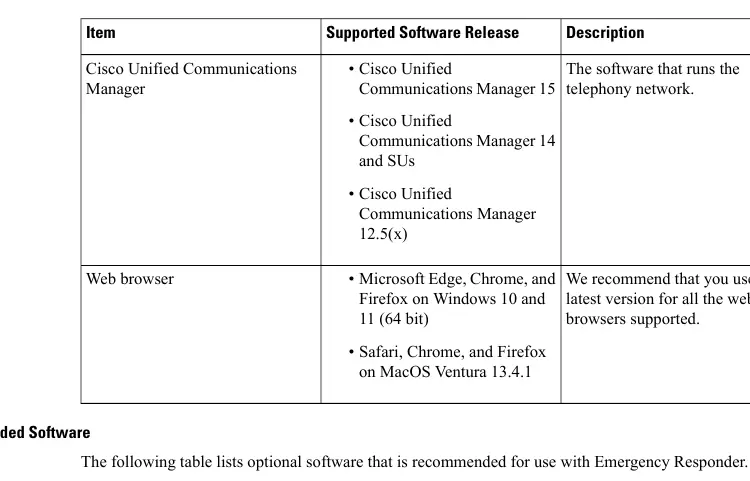
Before performing an upgrade, ensure your environment meets the necessary hardware and software requirements. Supported software includes Cisco Unified Communications Manager versions 15, 14 (and SUs), and 12.5(x). Recommended web browsers for the administration interface include Microsoft Edge, Chrome, and Firefox on Windows 10/11, as well as Safari, Chrome, and Firefox on MacOS Ventura 13.4.1. An SMTP email server is recommended for sending notifications to onsite security personnel.
Supported Devices
Emergency Responder supports a wide range of Cisco IP phones, Telepresence/Webex devices, and third-party SIP phones. Tracking methods include switch-port based tracking (requiring Cisco Discovery Protocol or SNMP), IP subnet-based tracking, and manual definition. Wireless access points are supported for tracking when defined in Unified Communications Manager 11.5 or later. The system also supports various Cisco routers and a comprehensive list of LAN switches, including the Catalyst C1000, 2960, 3560, 3650, 3750, 3850, 4500, 6500, 9200, 9300, 9400, and 9500 series, as well as Meraki switches.
Upgrades and Maintenance
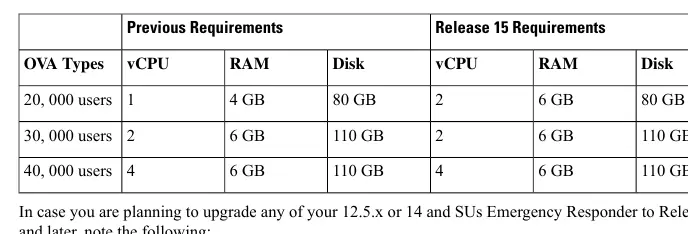
Direct upgrades to Release 15 are supported from specific versions of 12.5(x) and 14. Administrators must apply the required Upgrade Readiness COP files before and after the upgrade process. Note that Cisco Emergency Responder 15 and later does not support Install with Data Import. Virtual machine configuration requirements have been updated; deployments with 12,000 or 20,000 users using 4GB vRAM must increase this to 6GB, and deployments with 20,000 users using 1 vCPU must increase this to 2 vCPUs before upgrading.
Resolved Caveats
This release addresses several known issues, including problems with discovery threads getting stuck, wireless phone tracking failures, and UI login issues for nodes with long hostnames. Users can access the Cisco Bug Search tool to track specific bug IDs and view detailed information on resolved caveats.
Related manuals
Related manuals from the same brand or category.
Software / Apps Services
Release Notes for Cisco Prime Collaboration Deployment, Release 15SU3
CiscoDocuments / Warranty Safety
Cisco TrustSec Configuration Guide for Cisco IOS Release 15M&T
CiscoElectronics / Routers
Cisco Aironet 1532I-E Access Point Secure Data Wipe Guide
CiscoElectronics / Routers
Cisco IOS Release 15.1M&T: Key Updates and Supported Platforms
CiscoElectronics / Routers
Cisco Business 143AC Mesh Extender
CiscoElectronics / Routers
Cisco Business 142AC Mesh Extender Quick Start Guide
CiscoElectronics / Routers
Cisco Business 141AC Mesh Extender User Guide
CiscoElectronics / Routers
Cisco Business 140AC Access Point User Guide
CiscoSoftware / Apps Services
Cisco Unity Connection 12.x Server Maintenance Guide
Cisco
Manual page author
Michael Turner
Technical manual editor
Reviews PDF manuals for structure, safety notes, and practical product details so readers can find the right information quickly.