Furniture / Beds & Mattresses
Assembly Instructions for Coaster Fine Furniture 205131T Twin Bed
A complete assembly guide for the Coaster Fine Furniture 205131T Twin Bed. Includes parts list, hardware identification, step-by-step assembly instructions, and product dimensions.
Quick answers from the manual
Quick answer
- This document provides assembly instructions for the Coaster Fine Furniture 205131T Twin Bed. Assembly takes approximately 35 minutes and requires a Phillips screwdriver. p. 2, 3
Key actions
- Assemble headboard p. 4
- Assemble footboard p. 4
- Connect rails p. 4
- Install slats p. 5
First start
- Sort hardware and check parts list before beginning assembly. p. 2, 3
Problems and fixes
Broken or defective parts
Do not attempt to repair or modify. Contact the store immediately.
p. 2Technical specifications
| Parameter | Value | Meaning | Pages |
|---|---|---|---|
| Inner Size | 39.50"W x 76.00"D | Mattress size compatibility | p. 6 |
Where to find it in the PDF
- Assembly Instructions p. 1, 2, 3, 4
- Dimensions p. 6
Table of contents
Manual images
Click an image to enlargeQuick Guide
This document provides assembly instructions for the Coaster Fine Furniture 205131T Twin Bed. The estimated assembly time is 35 minutes. Please ensure you have a Phillips head screwdriver available, as it is required for assembly but not provided by the manufacturer.
Parts Identification
Before beginning, verify that all parts are present:
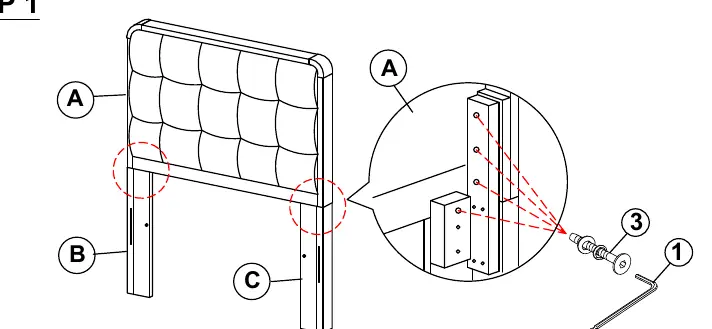
- A: Headboard Panel (1pc)
- B: Left Headboard Leg (1pc)
- C: Right Headboard Leg (1pc)
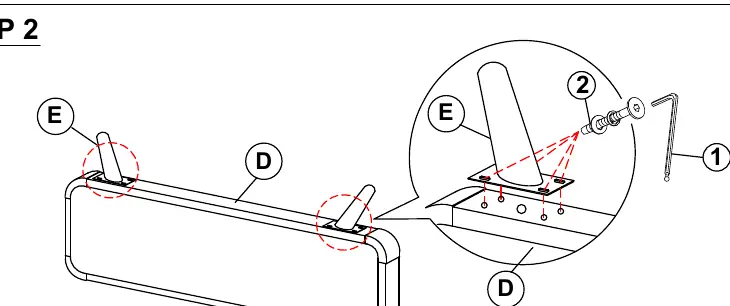
- D: Footboard Panel (1pc)
- E: Footboard Leg (2pcs)
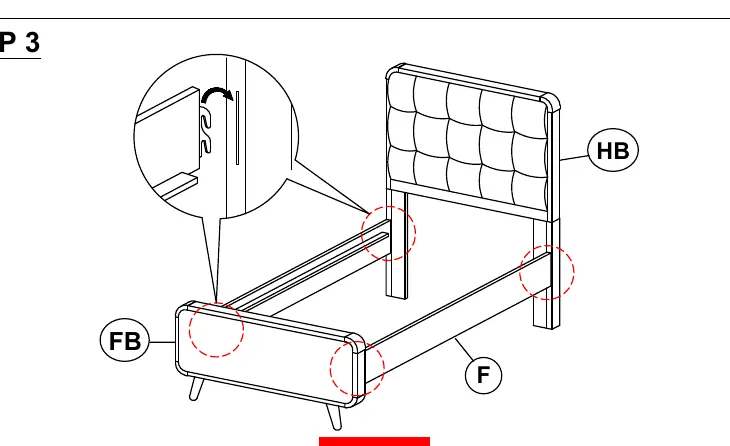
- F: Bed Rail (2pcs)
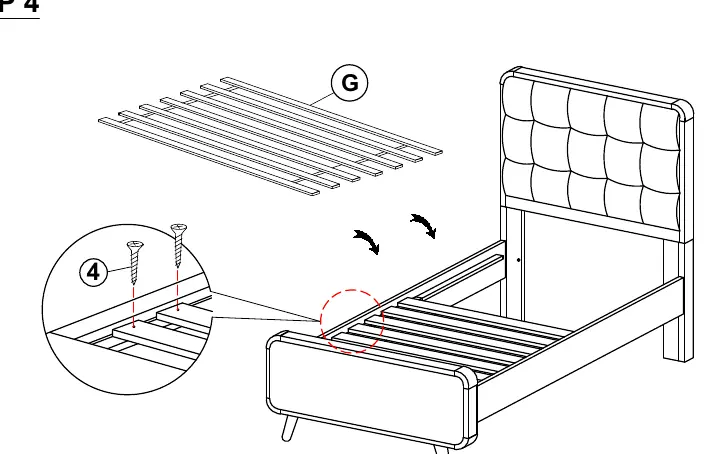
- G: Roll Slat (2 sets, 7pcs each)
Hardware Identification
The hardware pack is located in box B3. Ensure you have the following:
- 1: Allen Wrench (M4 x 110mm) - 1pc
- 2: Short Bolt with Washer (M6 x 25mm) - 8pcs
- 3: Long Bolt with Washer (M6 x 45mm) - 8pcs
- 4: Flat Head Screw (#8 x 1 1/8") - 28pcs
Assembly Instructions
Step 1: Headboard Assembly
Attach the Left Headboard Leg (B) and Right Headboard Leg (C) to the Headboard Panel (A) using the Long Bolts with Washers (3) and the Allen Wrench (1).
Step 2: Footboard Assembly
Attach the Footboard Legs (E) to the Footboard Panel (D) using the Short Bolts with Washers (2) and the Allen Wrench (1).
Step 3: Frame Assembly
Connect the Bed Rails (F) to the assembled Headboard (HB) and Footboard (FB). Ensure all connections are secure.
Step 4: Slat Installation
Place the Roll Slats (G) onto the bed frame. Secure the slats to the rails using the Flat Head Screws (4) and a Phillips head screwdriver.
Dimensions
The inner size of the bed is 39.50"W x 76.00"D. Please note a dimension tolerance of ±5%.
Manufacturer information
Coaster Fine Furniture
Practical help
Common problems
Missing parts or hardware
Check all boxes (B1-B3) and verify against the parts and hardware lists before starting assembly.
Damaged or defective parts
Do not attempt to repair or modify the parts. Contact the store immediately.
Before use
- Sort all hardware by size before starting.
- Verify all parts are present according to the parts list.
- Ensure you have a Phillips head screwdriver (not included).
- Clear a sufficient area for assembly.
- Follow the numbered sequence of instructions.
Specs in practice
- Assembly Time
- Estimated 35 minutes.
- Dimension Tolerance
- ±5% variation allowed.
Images and diagrams
- Step 1: Attaching legs to the headboard panel.
- Step 2: Attaching legs to the footboard panel.
- Step 3: Connecting the bed rails to the headboard and footboard.
- Step 4: Installing the roll slats onto the frame.
Model compatibility
- Product is for home use only.
- Not intended for commercial establishments.

Manual page author
David Miller
Documentation analyst
Organizes user manual content into clear summaries, with attention to model details, product context, and everyday usability.