General / Accessories
Corning 036T81-61190-A1 Fiber Optic Cable Specification
Technical specifications and installation guidelines for the Corning 036T81-61190-A1 MIC Unitized Tight-Buffered Interlocking Armored Cable. Includes mechanical limits, temperature ranges, and optical characteristics.
Table of contents
Manual images
Jump to the sectionQuick guide from the manual
This document provides the technical specifications for the Corning 036T81-61190-A1 MIC Unitized Tight-Buffered, Interlocking Armored Cable. The most critical information for installers involves adhering to the mechanical limits to prevent fiber damage. Specifically, ensure the cable is not bent tighter than 338 mm during installation and that pulling force does not exceed 1320 N. Installation must occur within an ambient temperature range of -10 °C to 60 °C.
Product Overview
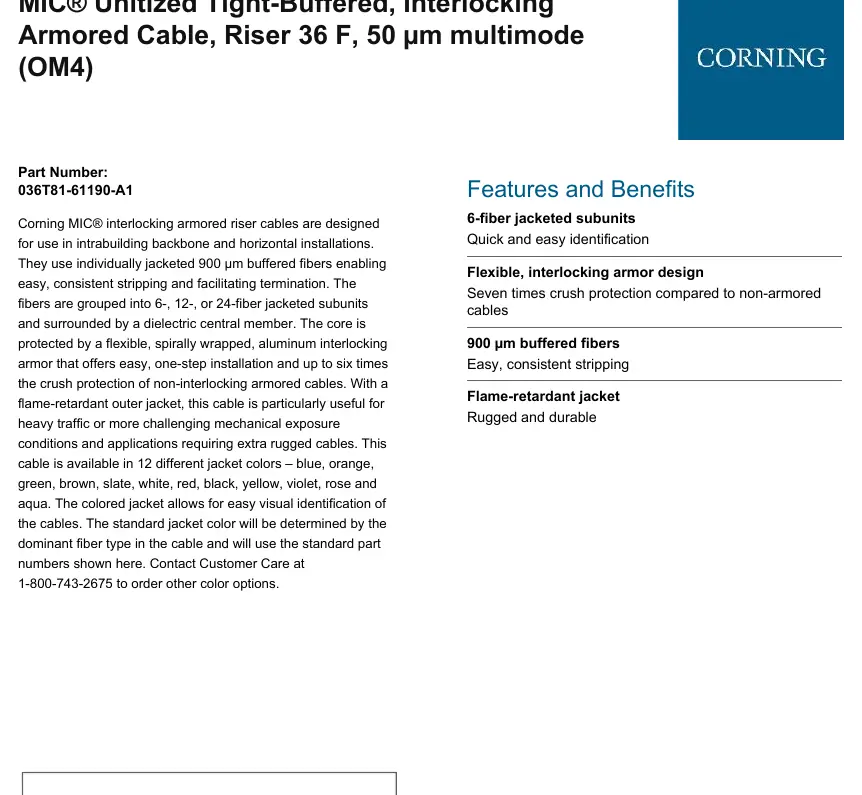
The Corning MIC interlocking armored riser cable is designed for intrabuilding backbone and horizontal installations. It features individually jacketed 900 µm buffered fibers grouped into 6-fiber subunits. The core is protected by a flexible, spirally wrapped, aluminum interlocking armor, which provides crush protection and allows for one-step installation. The cable includes a flame-retardant outer jacket.
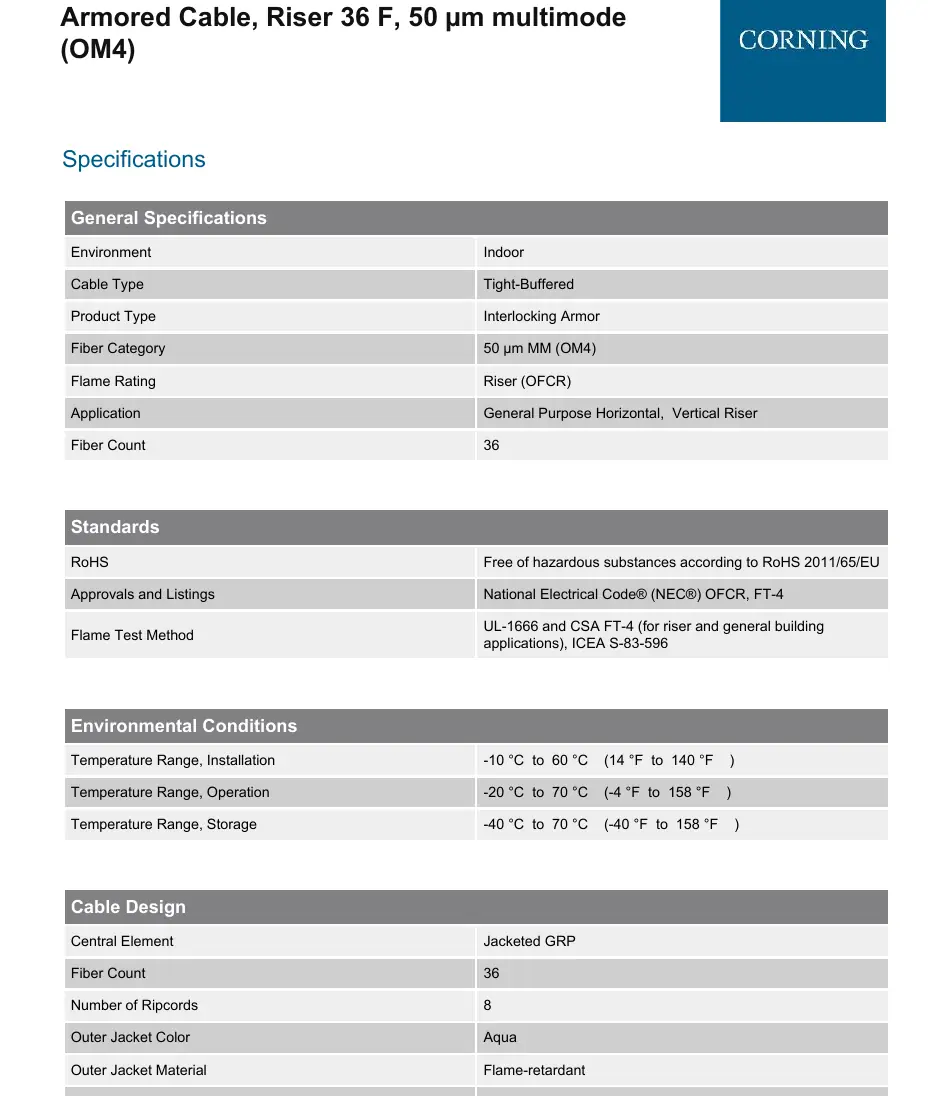
Installation and Environmental Conditions
Proper handling is required to maintain the integrity of the optical fibers. Observe the following environmental limits:
- Installation Temperature: -10 °C to 60 °C (14 °F to 140 °F)
- Operation Temperature: -20 °C to 70 °C (-4 °F to 158 °F)
- Storage Temperature: -40 °C to 70 °C (-40 °F to 158 °F)
Mechanical and Optical Specifications
Adherence to these mechanical limits is essential for long-term performance:
- Max. Tensile Strength (Short-Term): 1320 N (296.75 lbf)
- Min. Bend Radius (Installation): 338 mm (13.31 in)
- Min. Bend Radius (Operation): 225 mm (8.86 in)
- Nominal Outer Diameter: 22.5 mm (0.89 in)
Optical performance characteristics include:
- Fiber Category: 50 µm Multimode (OM4)
- Wavelengths: 850 nm / 1300 nm
- Maximum Attenuation: 2.8 dB/km / 1.0 dB/km
Cable Design
The cable is constructed with 36 fibers total, organized into 6 active tubes with 6 fibers per subunit. The outer jacket is flame-retardant and aqua-colored. The central element is a jacketed GRP (Glass Reinforced Plastic), and the cable includes 8 ripcords for easier jacket removal.
Manufacturer information
Corning Optical Communications
Practical help
Common problems
Signal loss or fiber breakage due to tight bends
Ensure the cable is never bent tighter than 338 mm during installation or 225 mm during permanent operation.
Fiber damage during cable pulling
Do not exceed the maximum short-term tensile strength of 1320 N (296.75 lbf) during installation.
Installation failure due to extreme temperatures
Verify that the installation environment is between -10 °C and 60 °C before beginning work.
Before use
- Verify the part number is 036T81-61190-A1.
- Confirm the application is for indoor, riser-rated environments.
- Check that the installation environment temperature is within the -10 °C to 60 °C range.
- Ensure pulling equipment is calibrated to not exceed 1320 N of force.
- Plan the cable path to respect the 338 mm minimum installation bend radius.
Specs in practice
- Min. Bend Radius Installation
- The minimum radius the cable can be bent during the installation process without damaging the fibers (338 mm).
- Min. Bend Radius Operation
- The minimum radius the cable can be bent once installed (225 mm).
- Max. Tensile Strength
- The maximum pulling force the cable can withstand during installation (1320 N).
- Fiber Category
- OM4 50 µm multimode fiber, suitable for high-speed data transmission.
Model compatibility
- Designed for intrabuilding backbone and horizontal installations.
- Flame rating: Riser (OFCR).
- Compliant with RoHS 2011/65/EU.

Manual page author
Michael Turner
Technical manual editor
Reviews PDF manuals for structure, safety notes, and practical product details so readers can find the right information quickly.